
Whilst Luxury Vinyl Tile is often marketed as the pinnacle of practical flooring, it remains a composite of individual planks that can’t ever truly achieve the architectural purity of a single, continuous surface. When weighing up poured flooring vs luxury vinyl tile (LVT), you likely appreciate the durability of modular tiles, yet you might find visible joins distracting in an open-plan layout or worry about edges lifting over time.
This guide explores the critical differences between these two premium finishes to help you select a solution that aligns with both your design vision and environmental values. We’ll examine how seamless resin systems offer superior hygiene, sustainable material compositions, and a modern aesthetic that traditional tiles simply cannot replicate. By the end, you’ll understand which high-end flooring solution best suits your project’s specific performance needs and aesthetic goals.
Key Takeaways
- Understand how seamless resin systems eliminate the visual disruption of joins and expansion gaps often found in modular flooring solutions.
- Evaluate poured flooring vs luxury vinyl tile (LVT) to discover why bio-based polyurethane offers a more durable, lifting-resistant alternative to PVC.
- Learn about the significant health and environmental advantages of choosing VOC-free materials that improve indoor air quality and sustainability.
- Discover why a non-porous, continuous surface is easier to maintain and provides a more hygienic environment than tiled alternatives.
Poured Flooring vs Luxury Vinyl Tile: Seamlessness and Design Flexibility
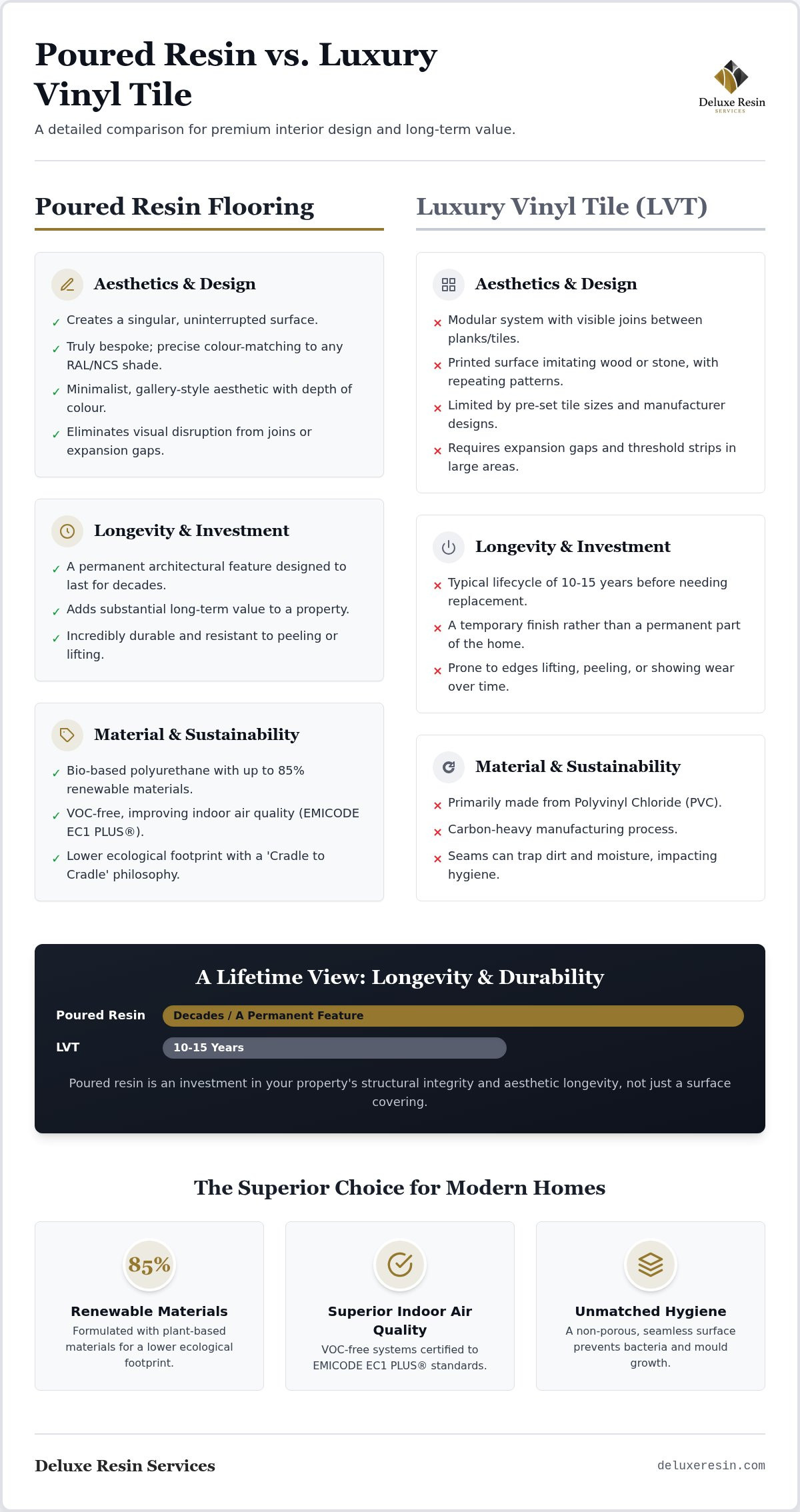
Whilst choosing between poured flooring vs luxury vinyl tile (LVT), the primary consideration is often the balance between authenticity and imitation. Luxury Vinyl Tile (LVT) is a high-performance product engineered to replicate the aesthetics of timber or stone. However, it remains a printed surface. Poured resin is an original architectural material. It offers a bespoke finish with a depth of colour that isn’t restricted by repeating patterns or pre-set tile sizes. This flexibility allows for precise colour-matching to any RAL or NCS shade, creating a truly unique interior palette that reflects your personal style.
The structural freedom of resin is its greatest advantage. LVT is a modular system that typically requires expansion gaps and threshold strips to manage movement, especially in large areas. These physical breaks can compromise the sleekness of a modern interior. Resin systems are liquid-applied. They bond to the substrate to create a singular, uninterrupted plane that flows effortlessly amongst different living zones without the need for unsightly metal dividers. It’s a cohesive solution for sophisticated homes.
The Architectural Impact of a Join-Free Surface
In modern UK open-plan extensions, a seamless floor creates an immediate sense of scale and light. Even premium LVT tiles contain thousands of microscopic seams. Over time, these tiny gaps can collect dust or show signs of wear at the edges. Resin provides a minimalist, gallery-style aesthetic that eliminates this visual noise. This pursuit of a flawless, uninterrupted surface is a hallmark of premium flooring design, often seen in the industrial-grade solutions provided by Polished Concrete Atlanta for high-traffic environments. It’s the preferred choice for homeowners who favour a clean, expansive look where the floor serves as a quiet, sophisticated foundation for the entire room.
Performance and Environmental Impact: Beyond the Surface
When comparing poured flooring vs luxury vinyl tile (LVT), the differences beneath the surface are as significant as the visual finish. Most LVT products are constructed from Polyvinyl Chloride (PVC). This material has undergone extensive study regarding the environmental impact of vinyl flooring, specifically its carbon-heavy manufacturing process and chemical composition. While PVC remains a vital material for technical components produced by specialist UK manufacturers like Abbey Extrusions, polyurethane resin systems offer a sophisticated alternative for flooring that balances technical performance with environmental stewardship.
Hygiene remains a vital factor for modern households. The non-porous, continuous surface of a poured floor prevents the growth of bacteria and mould. Whilst LVT is durable, the microscopic joins between planks can eventually trap dirt and moisture, which is a key consideration when evaluating poured flooring vs luxury vinyl tile (LVT) for kitchens or bathrooms. Resin also provides a more resilient underfoot experience; it’s naturally warmer than stone and works perfectly with underfloor heating. For those prioritising health, we recommend systems with EMICODE EC1 PLUS® certification to maintain superior indoor air quality.
Innovation in material science now allows Deluxe Resin Services to offer sustainable resin solutions formulated with up to 85% renewable, plant-based materials. These products adhere to a ‘Cradle to Cradle’ philosophy, focusing on the long-term lifecycle of the floor rather than just the initial installation. It’s a choice that doesn’t compromise on style whilst ensuring a significantly lower ecological footprint than standard vinyl tiles. This commitment to responsible craftsmanship ensures your home remains both beautiful and environmentally conscious.
Investment and Longevity: Calculating the True Cost of Ownership
When evaluating the long-term value of poured flooring vs luxury vinyl tile (LVT), it’s essential to look beyond the initial installation. Most domestic LVT products have a typical lifecycle of 10 to 15 years before wear, peeling, or lifting necessitates a full replacement. In contrast, a professionally installed resin floor is a permanent architectural feature designed to endure for decades. This durability translates into a substantial value-add for your property. By choosing a bespoke, high-end finish over a modular plastic product, you’re investing in a lasting asset that complements the structural integrity and aesthetic longevity of your home.
Maintenance requirements also differ starkly between the two systems. A seamless floor is significantly faster to clean because there are no grout lines or joins to harbour debris or moisture. This ease of care ensures the surface remains pristine with minimal effort. LVT, despite being marketed as low maintenance, often requires more intensive care over time to keep the thousands of microscopic seams hygienic and free from discolouration.
Professional Installation: Why the Substrate Matters
Achieving a flawless, premium result depends entirely on the meticulous preparation of the substrate. Our specialists follow a rigorous process; this involves diamond grinding the subfloor to ensure a robust mechanical bond and applying technical primers to prevent outgassing. This contrasts sharply with the “floating floor” method frequently used for LVT. Whilst floating systems are quick to lay, they are prone to lateral movement and can create distracting hollow noise issues during daily use. We invite you to consult with our domestic resin flooring specialists to assess your specific project needs and ensure your subfloor is perfectly prepared for a high-performance pour.
Selecting Your Permanent Architectural Statement
Choosing between poured flooring vs luxury vinyl tile (LVT) ultimately depends on whether you seek a temporary modular cover or a permanent architectural finish. Whilst LVT serves as a high-quality imitation, it cannot match the hygienic purity or the expansive aesthetic of a truly seamless resin surface. By opting for a liquid-applied system, you eliminate the visual clutter of joins and threshold strips; instead, you create a cohesive flow that enhances the scale of your interior.
Our solutions prioritise environmental health; they are Cradle to Cradle Certified and formulated with over 85% plant-based materials. With expert national UK installation, we ensure your investment provides a durable, stylish foundation for decades to come. Enquire about our sustainable domestic resin flooring today to transform your project with a premium, eco-conscious finish.
Frequently Asked Questions
Is poured resin flooring more durable than LVT?
Yes, poured resin flooring offers significantly higher long-term durability than modular alternatives. Whilst high-quality LVT is resilient, its layered PVC construction and adhesive bonds typically have a lifecycle of 10 to 15 years before the edges begin to lift or peel. A professionally installed resin floor becomes a permanent part of the building’s structure, resisting heavy traffic and impact without the risk of individual tiles failing.
Can I install LVT over an existing poured resin floor?
It’s technically possible to install LVT over a resin surface, provided the floor is perfectly level and free from contaminants. However, doing so masks a premium architectural finish with a modular product. If you’re weighing up poured flooring vs luxury vinyl tile (LVT) for a renovation, we recommend choosing a single high-performance system that meets your long-term aesthetic and sustainability goals rather than layering materials.
Which flooring option is better for underfloor heating, resin or LVT?
Polyurethane resin is exceptionally well-suited for underfloor heating due to its high thermal conductivity and inherent flexibility. Whilst LVT is also compatible, the seamless nature of a poured floor ensures even heat distribution across the entire room without the risk of expansion gaps opening up. This efficiency makes resin a superior choice for maintaining a consistent, comfortable temperature in modern open-plan extensions.
Is poured resin flooring cold to walk on compared to vinyl?
Poured resin is surprisingly warm and comfortable underfoot, offering a similar level of thermal comfort to high-end vinyl. Unlike stone or ceramic tiles, resin is a resilient material that adopts the ambient temperature of the room. It provides a soft, tactile surface that feels pleasant to walk on even in winter, especially when formulated with our plant-based, sustainable polyurethane resins.