

What if the traditional charm of a timber floor is actually the primary source of your home maintenance anxiety? It’s a common dilemma for those who desire a premium aesthetic but dread the practical limitations of organic materials. You probably admire the warmth of wood, yet find yourself worried about planks warping in damp kitchens or the effort required to keep joints and seams pristine. This guide examines the essential differences in the resin flooring vs engineered wood debate to help you choose a surface that balances luxury with lasting durability. We’ll compare thermal conductivity, seamless finishes, and sustainability credentials, such as bio-based content and certifications like EMICODE EC1 PLUS®. You’ll gain the clarity needed to select a high-performance floor that remains beautiful for decades whilst effortlessly supporting the demands of modern, open-plan living.
Key Takeaways
- Discover how a seamless resin finish eliminates the visual clutter of joints and seams, creating a more expansive feel in contemporary open-plan homes.
- Understand the critical performance differences in the resin flooring vs engineered wood comparison, specifically regarding moisture resistance in kitchens where wood is often prone to warping.
- Learn why modern bio-based resin systems, containing up to 85% renewable materials, offer a sustainable alternative that supports superior indoor air quality through low-emission certifications.
- Evaluate the long-term maintenance requirements of both surfaces to ensure your choice provides a high-performance finish that lasts for decades without the need for frequent refinishing.
Comparing Aesthetics and Design: Seamless Luxury vs Traditional Texture
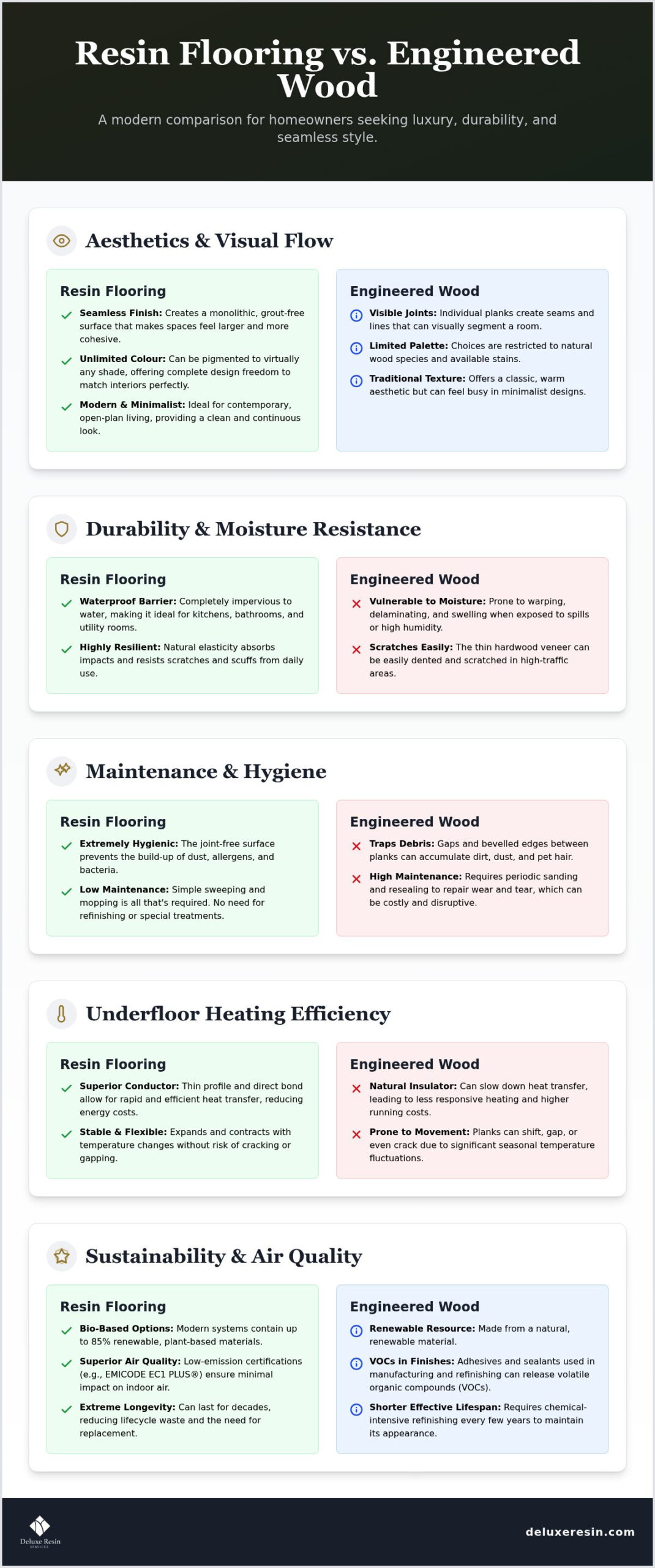
Deciding between resin flooring vs engineered wood often depends on the desired visual rhythm of your home. Engineered wood relies on individual planks to create a floor, which naturally introduces repetitive lines and joints. Whilst this offers a classic texture, it can visually segment a large open-plan space. In contrast, a polyurethane resin surface provides a monolithic, seamless finish. This absence of joints creates a sense of infinite flow, making rooms appear larger and more cohesive. Whether you are looking for classic timber or modern alternatives, consulting with experts at a specialist showroom like McGrath Floor & Design can help you compare these materials in person to see which best suits your home’s aesthetic.
The Seamless Advantage: Hygiene and Visual Flow
The practical benefits of a joint-free surface are significant. Traditional engineered wood construction involves bevelled edges or micro-joints that can trap dust, pet hair, and allergens. Domestic resin flooring specialists often recommend these seamless systems for kitchens and bathrooms because they are inherently more hygienic. Without grout lines or joints to scrub, maintenance becomes a simple task of sweeping and mopping. This creates a premium, high-end feel where the floor transitions between rooms without the need for unsightly threshold strips.
Beyond the structure, resin offers unparalleled colour versatility. Whilst wood is limited to natural species and stains, resin can be pigmented to almost any shade. This allows for bespoke interior designs that truly distinguish the resin flooring vs engineered wood choice. It ensures your flooring complements specific cabinetry perfectly, rather than forcing you to match furniture to a pre-determined grain. This flexibility provides a level of design continuity that traditional timber simply cannot replicate.
Durability and Practicality: Performance in the Modern Home
When evaluating resin flooring vs engineered wood, durability is often the deciding factor for high-traffic households. Polyurethane resin is specifically engineered for resilience. It possesses an inherent elasticity that allows it to absorb impacts and resist scratches more effectively than the thin hardwood veneers found on engineered planks. In British kitchens and utility rooms, moisture remains a constant threat. Whilst wood may delaminate or warp when exposed to dampness or spills, resin is entirely impervious. It creates a waterproof barrier that protects your subfloor and maintains its structural integrity for decades.
Practicality also extends to long-term upkeep. Engineered wood inevitably requires periodic sanding and resealing to mask surface wear. This maintenance process often involves chemical finishes that can have a negative impact on indoor air quality. Resin eliminates this requirement entirely. It doesn’t need specialist treatments or aggressive chemicals to keep its lustre, making it a much lower-maintenance solution for busy families.
Thermal Efficiency and Underfloor Heating Compatibility
When weighing up resin flooring vs engineered wood for a project with underfloor heating, the physical properties of the material are vital. Resin offers a distinct advantage for homes using modern systems. Its thinner profile and direct bond to the subfloor facilitate superior thermal conductivity compared to wood, which acts as a natural insulator and slows heat transfer. Polyurethane resin is also uniquely elastic. It expands and contracts with temperature shifts without the risk of cracking or gapping, unlike timber planks that move significantly during seasonal changes. This responsiveness leads to greater energy efficiency and a more comfortable living environment. If you’re planning a renovation, exploring sustainable resin solutions can ensure your heating system performs at its peak. This focus on durability and material innovation is equally important for outdoor spaces, where Paveezzi Composites provides high-quality composite solutions designed to withstand the elements.
The Sustainable Choice: Bio-Based Innovation and Air Quality
When weighing up resin flooring vs engineered wood, the environmental impact of the raw materials is often a primary consideration. Many homeowners instinctively lean towards timber because of the sustainable benefits of engineered wood as a renewable resource. However, modern innovation has allowed resin to emerge as a formidable, eco-friendly alternative. High-performance bio-based resin systems now incorporate up to 85% renewable, plant-based materials in their formulations. This shift reduces reliance on petrochemicals whilst maintaining a high-end, durable finish. Longevity is also a critical sustainability factor. A professionally installed floor often lasts for decades. This impressive lifespan reduces total lifecycle waste, especially when compared to materials that require frequent replacement or intensive chemical refinishing every few years.
Indoor Air Quality and VOC Emissions
Indoor air quality is a paramount concern for modern families. Evaluating resin flooring vs engineered wood requires a careful look at the chemical composition of the installation materials. Whilst some engineered wood products use adhesives that may contain formaldehyde, Deluxe Resin systems carry the EMICODE EC1 PLUS® certification. This rigorous standard ensures the lowest possible emissions, protecting your home from harmful off-gassing. Our systems are also Cradle to Cradle certified, reinforcing a commitment to safety and environmental stewardship.
Beyond chemical safety, the seamless nature of resin provides a practical health benefit. By eliminating the joints and crevices found in timber, it prevents the accumulation of dust mites and allergens amongst the floorboards. This results in a cleaner, more breathable indoor environment that supports long-term well-being and peace of mind. It’s an evolved solution that balances modern aesthetics with a deep commitment to planetary and personal health.
Elevating Your Home with Future-Proof Flooring
Choosing between resin flooring vs engineered wood is a decision that defines the longevity and atmosphere of your living space. Whilst timber offers a traditional aesthetic, a seamless resin system provides the modern advantages of moisture resistance, superior thermal efficiency, and unmatched hygiene. By selecting a surface with up to 85% renewable content and Cradle to Cradle Certified® materials, you’re investing in both environmental responsibility and a bespoke finish tailored to your interior palette. Our expert national installation team is dedicated to delivering a high-performance surface that withstands the rigours of daily life whilst maintaining its premium appeal. Enquire about our premium, bio-based resin flooring solutions today to transform your home with a floor that balances luxury, durability, and sustainable innovation. We look forward to helping you create a space that feels as good as it looks.
Frequently Asked Questions
Is resin flooring more expensive than engineered wood to install?
The initial investment for resin flooring vs engineered wood depends heavily on the specific material grade and subfloor preparation required. Whilst premium bio-based resins may have a higher upfront cost than entry-level engineered planks, they offer superior long-term value. This is because resin doesn’t require the periodic sanding, staining, or resealing that wood demands to maintain its appearance and structural integrity.
Can resin flooring be installed directly over existing engineered wood?
Professional installers generally advise against applying resin directly over engineered wood. Timber is a natural material that expands and contracts with changes in humidity, which can cause the resin surface to crack or delaminate over time. To ensure a high-performance finish, the existing wood should be removed so the resin can be bonded to a stable, rigid subfloor such as concrete or screed.
Does resin flooring feel cold underfoot compared to wood?
Polyurethane resin is surprisingly warm and comfortable underfoot, often feeling similar to natural timber. Unlike stone or ceramic tiles, it doesn’t sap heat from the body. Because it’s an excellent thermal conductor, it’s also the ideal partner for underfloor heating. It allows heat to permeate the room quickly and efficiently, creating a cosy environment throughout the colder months without the insulating lag of wood.
How long does a domestic resin floor last compared to engineered wood?
A high-quality domestic resin floor is designed to last for several decades, often exceeding 30 years with minimal maintenance. In the resin flooring vs engineered wood comparison, resin holds a distinct durability advantage because it’s a monolithic, resilient surface. Engineered wood is limited by the thickness of its top veneer, which can only be sanded a few times before the entire floor requires replacement.