

Why settle for the sluggish heat-up times of timber or the inevitable grout-line heat loss of tiles when resin flooring with underfloor heating UK could actively work with your heating system? Most homeowners invest in underfloor heating for that ultimate sense of luxury, yet it’s natural to worry that the wrong surface choice will lead to unsightly cracks or wasted energy. You deserve a finish that complements your investment rather than compromising it.
This guide reveals why choosing a seamless resin finish creates the most thermally efficient and resilient partnership for your home. We will compare epoxy and polyurethane systems to help you select the right material for your specific needs. You’ll learn how these bio-based solutions provide rapid heat transfer and long-term durability; this ensures your living space remains both sustainably warm and flawlessly beautiful without any maintenance headaches.
Key Takeaways
- Learn why the low thermal resistance and seamless design of resin allow heat to penetrate your home faster and more evenly than traditional tiled or timber finishes.
- Understand the critical differences between polyurethane and epoxy systems, specifically why flexible polyurethane is essential for preventing cracks during subfloor thermal expansion.
- Discover the essential installation steps, including commissioning the screed, to ensure your resin flooring with underfloor heating UK remains durable and maintenance-free for years.
- Explore the health and environmental benefits of using bio-based, low-emission materials that eliminate “off-gassing” concerns in heated domestic environments.
The Science of Synergy: Why Resin Flooring and Underfloor Heating Work Together
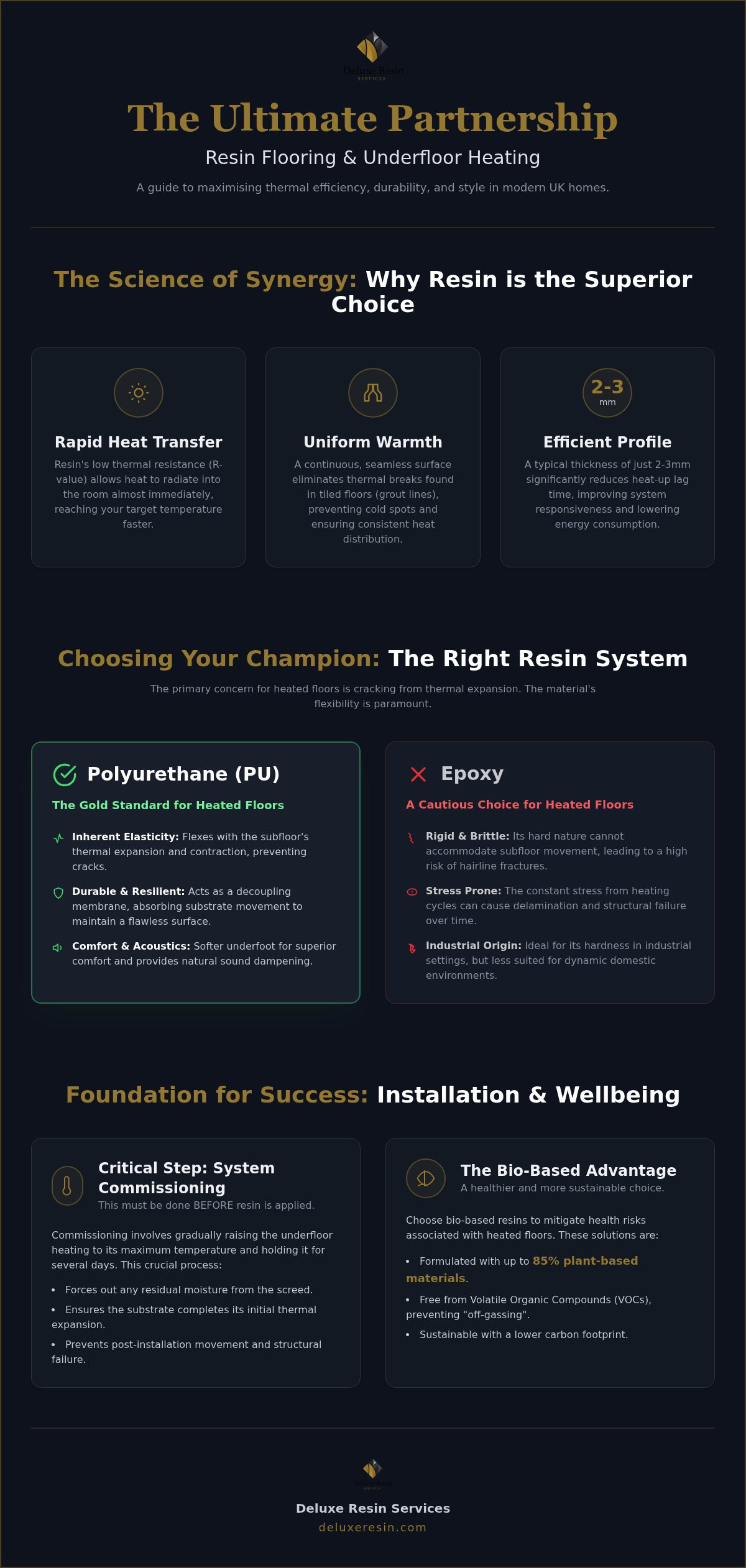
Resin’s molecular density makes it an exceptional conductor of heat. In the context of resin flooring with underfloor heating UK, the material’s low thermal resistance, or R-value, is its greatest asset. While carpets act as insulators that trap heat beneath them and timber expands slowly, resin allows energy to radiate into the room almost immediately. This rapid transfer ensures your heating system isn’t working harder than it needs to.
Beyond conductivity, the seamless nature of the installation provides a distinct advantage over traditional tiling. In a tiled floor, every grout line and expansion joint functions as a thermal break, which is a small gap where heat transfer is interrupted. Because a resin surface is entirely continuous, it provides a uniform thermal bridge across the entire floor area. This ensures there are no cold spots, creating a consistent climate throughout the home.
Even when the system is inactive, resin remains comfortable. Unlike natural stone or ceramic, which can feel icy underfoot, resin naturally adopts the ambient temperature of the room. This warm-to-the-touch property makes it a practical choice for the British climate, providing comfort even during transitional seasons when the heating might be switched off.
Maximising Thermal Efficiency and Energy Savings
The thin profile of a resin system, typically just 2mm to 3mm, significantly reduces lag time. This responsiveness means your home reaches its target temperature faster. Consequently, you can often run your system at lower flow temperatures, which directly lowers monthly energy consumption. To achieve these results, partnering with a domestic resin flooring specialist is vital. They ensure the floor is bonded perfectly to the underlying screed, eliminating air pockets that would otherwise hinder heat transfer.
Selecting the Right Resin System: Polyurethane vs Epoxy for Heated Floors
Cracking is the primary concern for homeowners installing resin flooring with underfloor heating UK. As your heating system cycles on and off, the underlying screed undergoes constant physical changes. It expands as it warms and contracts as it cools. If the floor finish is too rigid, it simply cannot accommodate this movement. This leads to the very fractures you’re trying to avoid.
While epoxy resin is celebrated for its hardness in industrial settings, its brittle nature makes it poorly suited for heated domestic environments. Over time, the stress of thermal cycles often results in hairline fractures. In contrast, polyurethane (PU) systems possess inherent elasticity. This flexibility allows the material to move in harmony with the subfloor, maintaining a flawless surface despite the temperature fluctuations beneath it.
Why Flexible Polyurethane is the Gold Standard for UK Homes
Polyurethane resin essentially acts as a decoupling membrane. It absorbs the kinetic energy of the substrate’s movement, ensuring the surface remains pristine and crack-free. Beyond its durability, the slightly softer composition of PU provides superior comfort underfoot. It also aids in acoustic dampening, which is a significant advantage in open-plan spaces where sound often echoes.
The thermal expansion coefficient is a numerical value representing how much a material expands per degree of temperature change; for a successful installation, this must align closely with the subfloor to prevent delamination. Modern domestic resins offer incredible design freedom, from minimalist solid colours to decorative finishes that rival the industrial appeal of polished concrete. If you’re exploring design options, browsing our range of domestic resin flooring can provide the inspiration needed to transform your home.
Installation Standards and the Importance of Bio-Based Materials
Successful installation of resin flooring with underfloor heating UK relies on meticulous preparation. One critical step is commissioning the heating system before any resin is applied. This involves gradually raising the temperature to its maximum and holding it there for several days. This process forces any residual moisture out and ensures the screed has completed its initial thermal expansion. Skipping this stage invites structural failure, as the substrate will move after the finish is bonded. For projects involving complex subfloor issues, Composites Construction UK provides specialist engineering and structural strengthening to ensure your home’s foundation is perfectly prepared.
Sustainability and health are equally vital in modern domestic projects. Many synthetic floors release Volatile Organic Compounds (VOCs), a process that heat significantly accelerates. Choosing bio-based resins, formulated with up to 85% plant-based materials, mitigates this risk. These sustainable resin solutions offer a lower carbon footprint whilst ensuring your home remains a safe environment. It’s a choice that prioritises long-term ecological impact without compromising on luxury or durability.
To guarantee safety, look for products with EMICODE EC1 PLUS® and Cradle to Cradle certifications. These rigorous standards confirm extremely low emission levels, which is crucial when your floor acts as a large radiator. The professional installation process includes precise moisture testing of the screed and the application of a UV-stable topcoat. This final layer prevents discolouration from sunlight. For maintenance, a simple cleaning regime with pH-neutral products will keep the surface performing for the lifetime of your heating system. This meticulous approach ensures your investment provides comfort and peace of mind for decades. To protect your home from the top down, you can visit I R. Wilson Roofing for professional roofing services.
Investing in a Flawless, High-Performance Home
Combining resin flooring with underfloor heating UK creates a living space that’s both exceptionally warm and visually stunning. By prioritising flexible polyurethane systems over brittle epoxy, you protect your investment from the natural stresses of thermal expansion. Opting for sustainable resin solutions ensures your home remains healthy; our bio-based materials, which are up to 85% renewable, prevent the off-gassing issues common with inferior products. Our expert UK-wide installation team specialises in these premium, Cradle to Cradle Certified finishes. This meticulous approach guarantees a durable, seamless surface that enhances the efficiency of your heating system for years to come.
Request a professional consultation for your luxury resin floor project to begin your home’s transformation. You’re just one step away from a more comfortable, energy-efficient, and sustainable living environment.
Frequently Asked Questions
Can resin flooring crack if the underfloor heating gets too hot?
Resin will not crack if you select a flexible polyurethane system designed for thermal movement. Unlike rigid epoxy, polyurethane is elastic and absorbs the expansion and contraction of the subfloor as temperatures change. It is essential to ensure the heating system is commissioned and operated within the manufacturer’s recommended limits to maintain the integrity of both the substrate and the finish.
How long does it take for a resin floor to heat up compared to tiles?
Resin floors generally heat up significantly faster than tiles or engineered wood. The material’s high thermal conductivity and thin application profile mean there is very little thermal lag. Heat passes into the room almost immediately once the system is active. This responsiveness allows for more precise temperature control and can contribute to lower energy consumption throughout the colder months.
Is it safe to use resin flooring with electric underfloor heating mats?
It is safe to use resin with electric heating mats, provided the cables are fully encapsulated within a high-quality smoothing compound or screed first. The resin is then applied over this stable, level surface. This method protects the electric elements and ensures even heat distribution across the floor. You should always verify that the specific heating system is compatible with resin finishes.
What is the best type of resin for a home with underfloor heating?
Flexible polyurethane is the best choice for any home using resin flooring with underfloor heating UK. Its ability to stretch and contract prevents surface cracking during heat cycles. For the best results, choose bio-based Sustainable Resin Solutions that hold EMICODE EC1 PLUS® certification. These products ensure that your heated floor doesn’t compromise your indoor air quality through off-gassing.
Do I need to turn off my heating before the resin floor is installed?
You must turn off the heating system at least 48 hours before the installation team arrives. The subfloor must be at a stable temperature, typically between 15°C and 22°C, to allow the resin to level and cure properly. After the installation is complete, you should wait several days before turning the heating back on, increasing the temperature by only a few degrees daily.
How thick is a typical resin floor when used with UFH?
A standard domestic resin floor is usually between 2mm and 3mm thick. This minimal depth is a major advantage for underfloor heating because it provides very low thermal resistance. It allows the system to be more responsive than thicker alternatives like stone or carpet. This ensures that the resin flooring with underfloor heating UK remains energy-efficient whilst providing a sleek, modern look.