

What if the very floor meant to provide safety is actually the biggest obstacle to your daily independence? For many wheelchair users, the frustration of navigating high-friction carpets or uneven grout lines is a constant challenge that compromises both comfort and confidence. You shouldn’t have to settle for a clinical, institutional aesthetic just to ensure your home is accessible. This guide demonstrates how seamless flooring for disabled access provides the ultimate combination of safety, durability, and high-end design for modern living.
We will explore how our bio-based resin systems create perfectly level surfaces that remain slip-resistant whilst handling the demands of heavy wheelchair traffic without marking. From bespoke colour matching to sustainable material choices, you’ll discover how to transform your space into a sanctuary that is as stylish as it is secure.
Key Takeaways
- Learn how the total absence of joints in seamless flooring for disabled access significantly reduces the physical effort required for wheelchair propulsion compared to traditional surfaces.
- Understand the technical slip-resistance ratings and how polyurethane resin can be customised to ensure safety across different domestic zones.
- Discover why professional-grade resin is the superior choice for handling the intense point-loading pressure of heavy electric wheelchairs without causing surface damage.
- Explore the benefits of bio-based materials and EMICODE EC1 PLUS® certifications that prioritise indoor air quality whilst maintaining a premium aesthetic.
The Role of Seamless Surfaces in Enhancing Accessibility
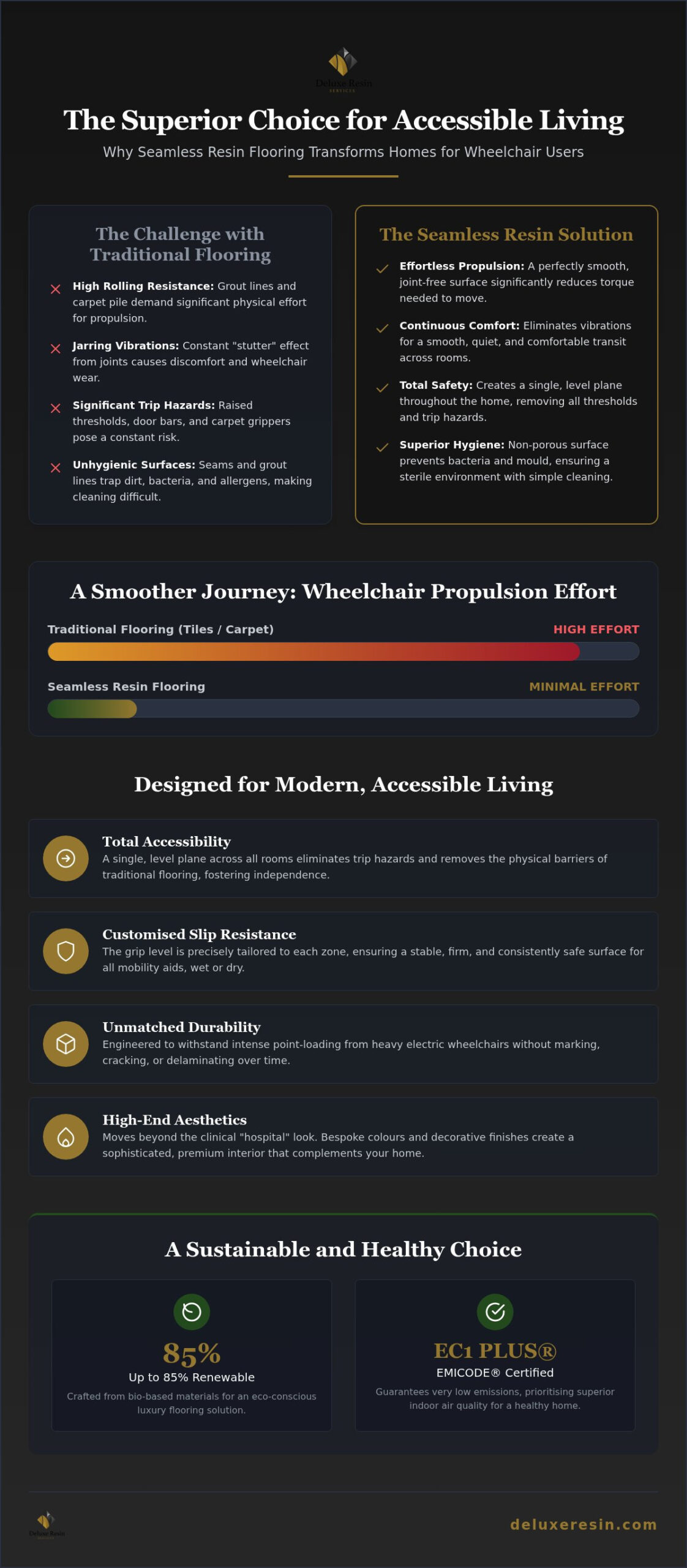
In the context of understanding accessibility, “seamless” refers to a total absence of joints rather than merely a smooth texture. Traditional flooring types, such as tiles or timber, rely on grout lines and expansion gaps that create microscopic obstacles. For wheelchair users, these interruptions require increased physical effort to overcome rolling resistance. Seamless flooring for disabled access eliminates these barriers entirely. By providing a continuous, poured surface, resin reduces the torque needed for propulsion and removes the jarring vibrations often felt when crossing tiled thresholds.
Whilst some “seamless” vinyl options exist, they often rely on adhesives and heat-welded seams that can degrade or trap dirt. Resin is a superior engineering solution because it’s bonded directly to the substrate as a single, liquid-applied layer. This creates a unified floor plan that isn’t just a functional upgrade; it offers a profound psychological benefit. A home without visual or physical partitions feels more open and less restrictive, fostering a sense of freedom that segmented flooring can’t match. It moves away from the clinical aesthetic often associated with safety modifications, providing a sophisticated, high-end environment.
Eliminating Trip Hazards and Room Thresholds
Traditional door bars and carpet grippers represent significant risks for those with limited mobility or visual impairments. These raised edges are common sites for trips and can hinder the smooth passage of mobility aids. Our domestic resin flooring specialists specialise in whole-home installations where the material is poured across multiple rooms. This technique creates a single, level plane throughout the entire ground floor, removing the need for transition strips and ensuring every room is effortlessly reachable.
Safety and Performance: Slip Resistance for Mobility Aids
Safety is paramount in any accessible home design. Unlike standard materials, seamless flooring for disabled access allows for precisely calibrated slip resistance. We tailor the grip level to each room by adjusting the aggregate profile to meet specific slip-resistance ratings. This approach aligns with international best practices, such as the ADA guidelines for flooring, which emphasise the need for stable, firm, and slip-resistant surfaces. Unlike traditional flooring, resin offers a bespoke grip level that remains consistent across the entire surface area.
Structural integrity is just as vital. Heavy electric wheelchairs exert intense point-loading pressure that often causes tiles to crack or vinyl to delaminate over time. Polyurethane resin is resilient enough to handle these concentrated loads without marking or lifting. By choosing seamless flooring for disabled access, you also remove the “stutter” effect. This is the constant vibration caused by crossing grout lines, which isn’t just annoying; it can lead to physical fatigue for the user and increased mechanical wear on the wheelchair itself.
Hygienic and Low-Maintenance Benefits
The non-porous nature of resin prevents bacteria and mould from colonising the floor, which is a key consideration for those with compromised immune systems. You won’t need heavy scrubbing or professional steam cleaning to maintain a sterile environment. Maintenance is remarkably straightforward:
- Remove loose debris with a soft brush or vacuum.
- Mop the surface with warm water and a pH-neutral cleanser.
By applying industrial-grade resins in a home environment, we ensure the surface resists household chemicals and stays pristine for years. If you’re looking for a long-term solution that balances safety with a premium finish, you can explore our sustainable resin solutions to see how they fit your lifestyle.
Choosing Sustainable and Non-Clinical Resin Solutions
Choosing the right seamless flooring for disabled access involves more than just safety; it’s about preserving the character of your home. Many people associate accessibility with a “hospital grey” aesthetic, but resin allows for complete creative freedom. Through bespoke colour palettes and decorative finishes, you can achieve a high-end look that complements your interior design. Whilst maintaining these visual standards, resin also meets rigorous performance criteria such as the ADA Standards for Accessible Design, ensuring your space is both beautiful and compliant.
Modern innovation has led to the development of sustainable materials that are up to 85% renewable. These bio-based resins offer a guilt-free luxury choice for the eco-conscious homeowner. Opting for a bio-based resin floor installation is an excellent way to implement seamless flooring for disabled access that aligns with professional environmental standards without compromising on durability or style.
Comfort and Indoor Air Quality
Indoor air quality is paramount, especially for residents who spend significant time at home. Our systems hold the EMICODE EC1 PLUS® certification, signifying extremely low emissions and a VOC-free environment. This focus on health is matched by physical comfort. Unlike the cold, hard surface of stone, polyurethane resin offers a soft-touch feel that is gentle underfoot. Its excellent thermal conductivity also makes it a perfect partner for underfloor heating.
Transforming Your Home with Modern Accessibility
Creating a truly accessible home no longer requires a compromise between safety and style. By choosing seamless flooring for disabled access, you’re investing in a surface that eliminates physical barriers whilst enhancing the aesthetic of your living space. Our bio-based resin systems are up to 85% renewable and hold the EMICODE EC1 PLUS® certification, ensuring your indoor air quality is as pristine as your floor’s finish. Whether you’re navigating a wheelchair or simply prioritising a trip-free environment, our expert national installation team is here to guide you through every technical and design choice.
Ready to redefine your environment with a durable, non-slip solution? Request a professional consultation for your accessible flooring project today. You deserve a home that supports your independence without sacrificing the premium look you love.
Frequently Asked Questions
Is resin flooring slippery for people using walking frames or sticks?
Resin flooring is not slippery because the surface texture is customised during installation to provide optimal grip. We adjust the aggregate levels to ensure the floor remains safe for those using walking frames or sticks, even when damp. This bespoke approach to seamless flooring for disabled access ensures a consistent, high-traction surface throughout the home, significantly reducing the risk of slips or falls.
Can seamless resin flooring handle the weight of a heavy electric wheelchair?
Yes, our polyurethane resin systems are specifically engineered to withstand the intense point-loading pressure exerted by heavy electric wheelchairs. Unlike traditional tiles that may crack or vinyl that can delaminate under concentrated weight, resin is bonded directly to the substrate. This creates a resilient, industrial-grade surface that maintains its structural integrity and smooth finish despite constant, heavy-duty mobility aid traffic.
Is resin flooring suitable for disabled-access wet rooms and bathrooms?
Resin is an ideal solution for disabled-access wet rooms because it is entirely waterproof and lacks the porous grout lines found in tiling. This seamless nature prevents water ingress and the growth of mould or bacteria. It provides a hygienic, easy-to-clean environment that meets strict safety standards whilst allowing for a level-access transition from the bedroom to the bathroom without any trip hazards.
How long does a resin floor last in a high-traffic accessible home?
A professionally installed resin floor can last for several decades in a high-traffic accessible home with minimal maintenance. Its durability stems from the high-performance materials we use, which are resistant to chemicals, impact, and abrasion. Because the surface is seamless, there are no joints to fail or edges to lift, ensuring the floor remains safe and visually impressive for the long term.