
What if the biggest risk to your production line isn’t a mechanical fault, but the very ground beneath your feet? Facility managers often fear that a floor failure will lead to catastrophic operational downtime, especially when faced with the confusing choice between epoxy and polyurethane systems. You likely want a surface that meets every HSE and hygiene standard whilst remaining low-maintenance for a decade or more. Selecting the right industrial resin flooring contractors is the most critical step in ensuring your facility remains safe, compliant, and efficient.
This guide will help you identify partners who specialise in high-performance solutions that balance durability with environmental responsibility. You’ll discover how to navigate complex technical specifications and what to look for to ensure a seamless installation with minimal disruption. We’ll examine the essential criteria for long-term success, from bio-based material options to elite safety certifications that protect your workforce and the planet.
Key Takeaways
- Learn how to verify sector-specific expertise and ensure your chosen industrial resin flooring contractors manage every stage from initial moisture testing to the final finish.
- Understand the critical differences between epoxy and polyurethane systems to select the most durable chemistry for your facility’s unique temperature and impact requirements.
- Master the essential slip resistance standards, including the HSE Pendulum Test Value (PTV), to maintain full health and safety compliance in your workplace.
- Discover the advantages of high-performance sustainable flooring that utilises up to 85% renewable materials whilst achieving elite low-emission certifications.
Evaluating Industrial Resin Flooring Contractors: A Selection Framework
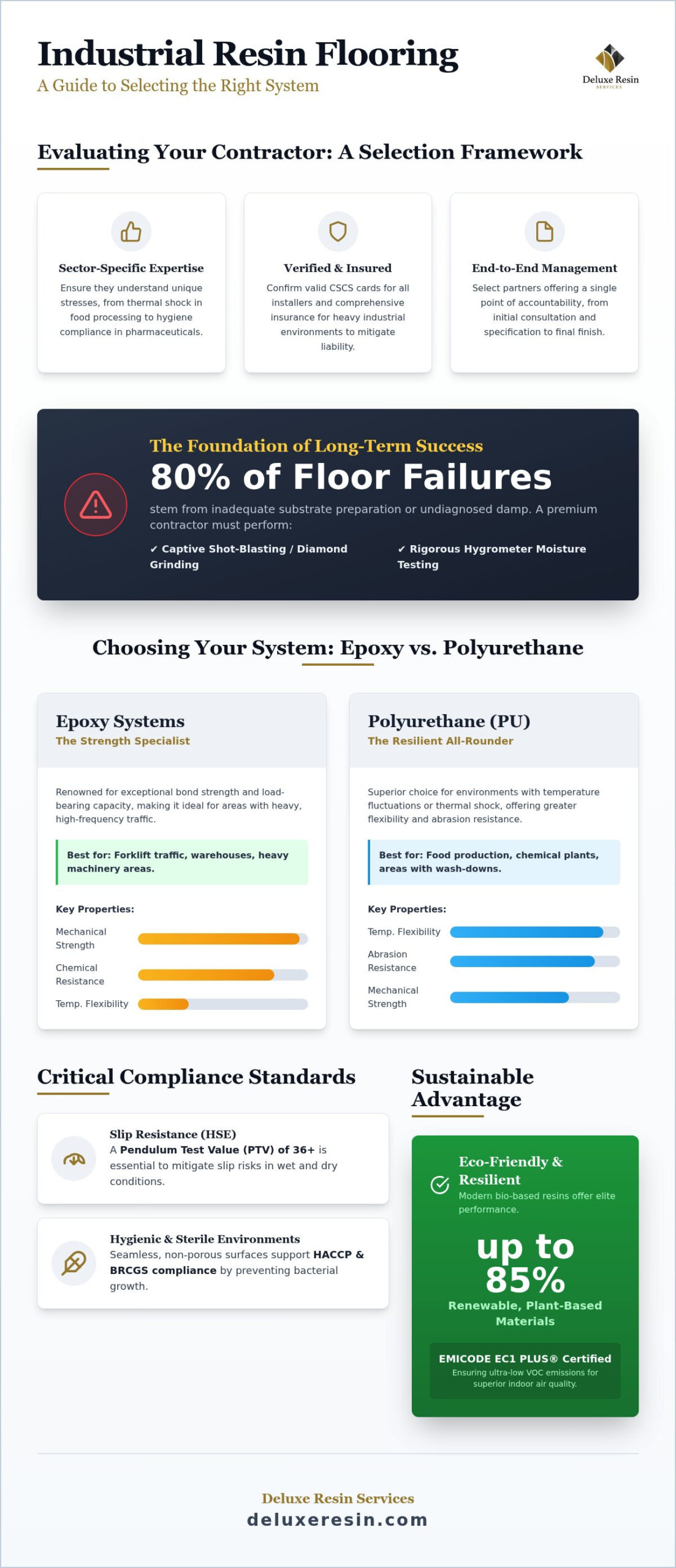
Choosing the right partner for your facility is a decision that impacts operational longevity. High-performance seamless polymer flooring systems require more than just application; they demand a deep understanding of sector-specific stresses. For instance, a contractor working in a food processing plant must account for thermal shock during wash-downs, whilst a pharmaceutical facility requires strict hygiene compliance. Reliable industrial resin flooring contractors provide a comprehensive specification based on your specific mechanical and chemical loads, ensuring the system doesn’t fail under pressure.
Beyond technical knowledge, verify that the installation team holds valid CSCS cards and carries comprehensive insurance for heavy industrial environments. This ensures safety on-site and protects your business from liability. A premium contractor manages the entire project lifecycle, from initial consultation to the final finish, providing a single point of accountability. Look for partners who offer end-to-end project management, as this guarantees that every stage meets the same high standard of craftsmanship. The same principle of selecting technically proficient specialists applies whether you’re surfacing a factory floor or working with professional resin bound driveway installers UK businesses and homeowners rely on for permeable, long-lasting exterior surfaces.
The Importance of Site Preparation and Moisture Testing
Expert industrial resin flooring contractors recognise that 80% of floor failures stem from inadequate substrate preparation or undiagnosed damp. It’s vital that your contractor uses specialised equipment, such as captive shot-blasting or diamond grinding, to create a permanent mechanical bond with the concrete base. They should also perform rigorous hygrometer testing before any materials are laid. Applying resin over a base that’s too wet leads to bubbling and delamination; ensuring the concrete is ready is a non-negotiable step for any high-performance installation.
Technical Specifications: Matching Resin Systems to Industrial Loads
Selecting the right resin chemistry is a balancing act between mechanical load and environmental conditions. Epoxy systems are renowned for their exceptional bond strength and load-bearing capacity, making them ideal for areas with high-frequency forklift traffic. Conversely, polyurethane (PU) flooring is the superior choice for environments prone to temperature fluctuations or thermal shock. Experienced industrial resin flooring contractors will specify the precise screed thickness required to support heavy machinery whilst maintaining surface integrity.
Safety compliance hinges on understanding the HSE “Pendulum Test Value” (PTV). For most industrial settings, a PTV of 36 or higher is essential to mitigate slip risks in both wet and dry conditions. Chemical resilience is equally vital; your system must withstand specific acids, oils, or aggressive industrial cleaners without degrading. Facilities handling corrosive substances should consult our comprehensive guide to chemical resistant industrial floors to understand how to evaluate pH levels and select the correct resin system. Many forward-thinking facilities now incorporate bio-based building materials into their specifications to align with corporate sustainability goals. If you’re unsure which system fits your facility, consulting with specialists in industrial resin flooring can provide the necessary technical clarity.
Hygienic Standards for Food, Beverage, and Pharmaceutical Sectors
In sterile environments, the floor must be entirely non-porous to prevent bacterial growth amongst hidden joints. High-performance resin systems create a seamless finish that supports HACCP and BRCGS compliance. Integrating coving, a curved transition between the floor and wall, removes 90-degree angles where dirt often accumulates, making the entire area easier to sanitise. These details ensure your facility meets the highest global hygiene standards whilst remaining incredibly durable. Leading industrial resin flooring contractors will advise on these specific details to ensure your facility remains audit-ready at all times. For a comprehensive overview of compliance requirements, our hygienic flooring for food industry checklist covers every essential standard from HACCP to UK food safety legislation.
Sustainable Industrial Flooring: The Bio-Based Advantage
The industrial sector is experiencing a profound shift towards ecological responsibility as businesses seek to reduce their environmental impact. Leading industrial resin flooring contractors now offer sophisticated systems formulated with up to 85% renewable, plant-based materials. These solutions effectively debunk the myth that eco-friendly resins are less resilient than traditional petrochemical options. In reality, modern bio-based resins are engineered to withstand the same heavy machinery loads and aggressive chemical exposures whilst providing a significantly lower carbon footprint. Sustainability doesn’t mean sacrifice. This commitment to sustainable resin technology extends beyond the factory floor; the same UV-stable, eco-conscious materials are now championed by resin bound driveway installers UK wide, delivering permeable and environmentally responsible exterior surfacing solutions.
Prioritising indoor air quality is another essential factor for modern facilities. Opting for systems with EMICODE EC1 PLUS® certification ensures exceptionally low VOC emissions, which is vital for the health and safety of your workforce. Cradle to Cradle certification also ensures your flooring contributes to a circular economy and supports your long-term ESG objectives. These high-performance systems provide the reassurance of elite durability without compromising your commitment to environmental stewardship. They offer a future-proof solution for forward-thinking enterprises.
Deluxe Resin Services: National Experts in Sustainable Industry
Deluxe Resin Services stands as a premier provider of high-durability, sustainable industrial solutions throughout the UK. We take immense pride in our craftsmanship, ensuring every project balances technical performance with responsible sourcing. Our Bio-Based Resin Floor Installation processes are designed to meet the rigorous demands of the food, pharma, and manufacturing sectors. For those seeking to extend this seamless, high-end finish into corporate offices or front-of-house areas, we also act as Domestic Resin Flooring Specialists, providing a cohesive aesthetic across your entire facility.
Securing the Future of Your Industrial Facility
Investing in a high-performance floor is a commitment to your facility’s operational longevity and safety compliance. By selecting expert industrial resin flooring contractors who prioritise thorough site preparation and technical precision, you eliminate the risk of premature failure and costly downtime. Whether your environment requires the thermal resilience of polyurethane or the load-bearing strength of epoxy, the right system ensures a seamless, hygienic surface that lasts for years. Embracing modern, bio-based resins further aligns your infrastructure with global sustainability goals without compromising on durability.
Our national UK installation team specialises in delivering EMICODE EC1 PLUS® certified and Cradle to Cradle sustainable solutions tailored to your specific sector. We invite you to request a technical consultation for your industrial project to discover how we can transform your workspace. Taking the time to specify the correct solution today ensures a safer, more efficient environment for your workforce tomorrow.
Frequently Asked Questions
How long does an industrial resin floor take to cure before it can handle traffic?
Most industrial resin systems allow for light foot traffic within 24 to 48 hours of application. However, a full chemical and mechanical cure typically requires seven days to reach maximum durability. Professional industrial resin flooring contractors can often specify fast-cure polyaspartic systems that return the facility to service much quicker; sometimes within just 12 to 24 hours for urgent operational needs.
What is the difference between a resin coating and a heavy-duty resin screed?
A resin coating is a thin, protective layer applied at a thickness of less than 1mm, primarily used for dust-proofing and light wear. In contrast, a heavy-duty resin screed is a much thicker system, usually ranging from 4mm to 9mm. This provides the necessary impact resistance and load-bearing capacity required for heavy machinery, forklift traffic, and aggressive chemical environments.
Can industrial resin flooring be installed over old, damaged concrete?
Yes, industrial resin flooring contractors can install new systems over old concrete, provided the substrate is structurally sound. The process involves rigorous mechanical preparation, such as diamond grinding or shot-blasting, to remove contaminants and open the surface pores. Any significant cracks or potholes are repaired with high-strength resin mortars first to ensure the final seamless finish is perfectly level and durable.
How often should an industrial resin floor be professionally inspected or maintained?
We recommend a professional inspection at least once every twelve months to identify any minor surface damage before it compromises the substrate. Daily maintenance simply requires sweeping and mopping with pH-neutral industrial cleaners. For a complete overview of best practices, our resin floor maintenance guide UK facilities and homeowners rely on covers the right products, cleaning routines, and what to avoid to preserve your seamless surface long-term. A well-maintained floor can last over a decade; regular checks ensure that non-slip properties remain effective and that the seal remains intact against aggressive chemical resistant industrial floors require protection from corrosive spills that can degrade standard surfaces over time.