
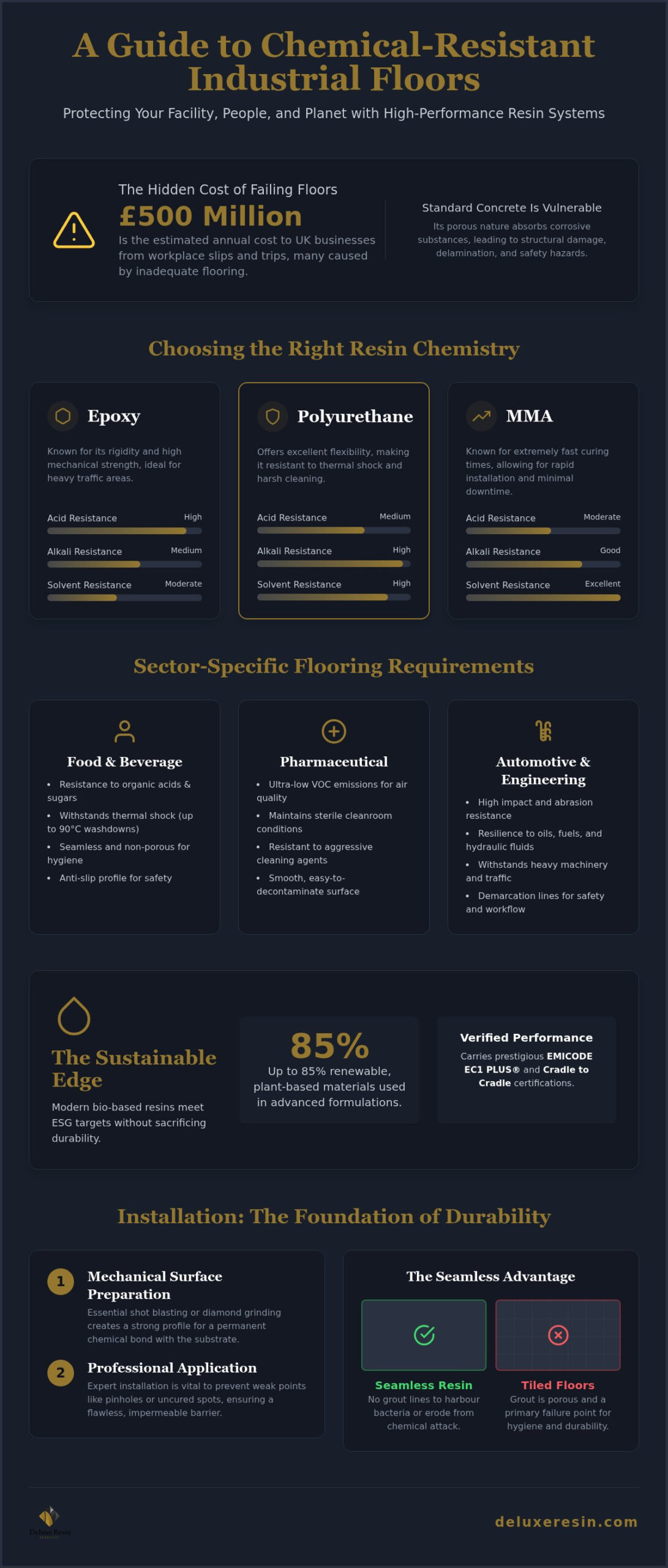
Did you know that workplace slips and trips cost UK businesses an estimated £500 million every year? When your flooring fails under the pressure of corrosive substances, it isn’t just an operational nuisance; it’s a significant risk to your facility’s safety. You’re likely all too familiar with the frustration of traditional concrete eroding under chemical stress, necessitating a transition to high-performance chemical resistant industrial floors to avoid constant maintenance and rising costs.
Discover how to choose the ideal resin system that balances extreme durability with modern sustainability standards for your facility. We’ll guide you through selecting seamless surfaces that ensure HSE compliance whilst meeting rigorous environmental targets. By the end of this guide, you’ll understand how to secure a solution that’s easy to clean, exceptionally tough, and formulated with renewable materials to protect both your plant and the planet.
Key Takeaways
- Learn how to evaluate chemical resistance by analysing pH levels and exposure duration to prevent common substrate failures like delamination and corrosion.
- Identify the specific flooring requirements for your industry, from managing organic acids in food production to maintaining ultra-low VOC emissions in pharmaceutical cleanrooms.
- Discover how to specify high-performance chemical resistant industrial floors that meet modern environmental standards using bio-based resins with Cradle to Cradle certifications.
- Understand why mechanical surface preparation and professional application are essential to ensure a seamless, long-lasting bond that withstands aggressive cleaning regimes.
Understanding Chemical Resistant Industrial Floors: The Selection Framework
In an industrial context, chemical resistance describes a material’s ability to maintain its structural integrity and aesthetic finish whilst exposed to corrosive substances. It isn’t a binary “yes or no” trait. Instead, performance depends on specific pH levels, the temperature of the spill, and the duration of contact before cleaning. Standard concrete is inherently porous. It absorbs liquids that eventually lead to internal corrosion and osmosis. Selecting chemical resistant industrial floors involves more than just picking a colour; it’s about matching the resin to your specific chemical profile to prevent delamination.
Seamless resin systems act as a primary defence by creating an impermeable barrier that stops seepage into the substrate. This protects the building’s foundation from long-term structural damage. For professional project planning, our guide for industrial resin flooring contractors provides a comprehensive roadmap for high-performance installations.
Comparing Resin Chemistries: Epoxy, Polyurethane, and MMA
Each resin chemistry offers distinct advantages based on the chemicals present in your facility:
| Resin Type | Acid Resistance | Alkali Resistance | Solvent Resistance |
|---|---|---|---|
| Epoxy | High | Medium | Moderate |
| Polyurethane | Medium | High | High |
| MMA | Moderate | Good | Excellent |
Polyurethane resin flooring is often the preferred choice for environments facing organic acids and thermal shock. While epoxy offers excellent rigidity, polyurethane resins provide the flexibility required for environments subject to frequent temperature fluctuations and harsh cleaning agents. This resilience ensures the floor doesn’t crack under the stress of hot-washdowns or rapid cooling cycles common in British manufacturing plants.
Sector-Specific Requirements for High-Performance Flooring
Industrial environments aren’t a monolith. Each sector presents unique challenges that dictate the necessary resin formulation. In the food and beverage sector, floors must withstand aggressive organic acids and thermal shock from 90°C washdowns. For a detailed look at regulatory requirements, see our hygienic flooring for food industry checklist. Conversely, pharmaceutical cleanrooms prioritise air quality, requiring systems with ultra-low VOC emissions to maintain sterile conditions. In automotive plants, chemical resistant industrial floors must also provide high-impact resistance to handle heavy machinery and accidental tool drops without fracturing or losing their protective seal.
The Sustainable Edge: Bio-Based Industrial Resins
Modern facility managers face increasing pressure to meet ESG targets without sacrificing floor longevity. Deluxe Resin Services addresses this by utilising advanced formulations containing up to 85% renewable, plant-based materials. These systems carry prestigious EMICODE EC1 PLUS® and Cradle to Cradle certifications, providing transparent, verified data for your corporate sustainability reporting. It’s a common misconception that “green” materials lack the strength of traditional petro-chemical resins. In reality, these bio-based solutions offer complete performance parity. They deliver the same chemical resistance and mechanical strength as conventional products whilst significantly reducing your facility’s carbon footprint. If you’re looking to upgrade your facility’s infrastructure, exploring our range of Sustainable Resin Solutions is an excellent starting point for your next project.
Ensuring Long-Term Durability: Installation and Maintenance
The longevity of chemical resistant industrial floors depends heavily on the initial mechanical preparation. Shot blasting or diamond grinding isn’t optional; it’s the only way to ensure a robust chemical bond with the substrate. Without this meticulous process, even the most advanced resin systems will fail. Professional application is equally vital to prevent issues like pinholing or uncured spots, which act as weak points where corrosive substances can penetrate the surface and compromise the foundation.
Choosing seamless systems offers a clear advantage over tiled alternatives, as there are no grout lines to harbour bacteria or succumb to acid erosion. To ensure your project meets these exacting standards, it’s wise to consult with national premium resin flooring installers UK who understand the nuances of industrial substrates and the importance of a precision finish. If your existing surface has already sustained chemical damage, our guide to industrial floor resurfacing UK outlines the professional restoration process for returning degraded floors to full compliance and performance.
Maintenance Protocols for Chemically Aggressive Environments
Protecting your investment requires a disciplined 3-step routine. First, neutralise spills immediately to prevent prolonged exposure. Second, implement a schedule of mechanical scrubbing using approved equipment. Third, conduct periodic inspections to catch early signs of wear or impact damage.
Always avoid incompatible cleaning agents, as harsh solvents can dull the finish or compromise the surface texture. Maintaining the correct slip resistance is a legal necessity under the Workplace (Health, Safety and Welfare) Regulations 1992. Slip resistance is defined by the floor’s performance during a BS 7976-2 pendulum test, where a Pendulum Test Value (PTV) of 36 or higher is essential for safety in wet industrial zones. Working with specialist anti slip resin floor installers ensures your surface is specified and tested to meet these precise PTV requirements from the outset.
Securing Your Facility’s Future Infrastructure
Selecting the right chemical resistant industrial floors is a strategic investment in your facility’s longevity and safety. By matching resin chemistry to your specific operational stresses and ensuring meticulous mechanical preparation, you eliminate the cycle of frequent repairs and high maintenance costs. Modern industrial standards now allow you to achieve this durability whilst meeting ambitious ESG targets through formulations containing up to 85% renewable materials.
At Deluxe Resin Services, we specialise in high-performance, seamless, and non-slip surfaces designed for the most demanding UK environments. Whether you’re managing a pharmaceutical cleanroom or a high-traffic manufacturing plant, our national UK installation coverage ensures a consistent, premium finish across all your sites.
Ready to upgrade? Discuss your industrial flooring project with our expert team today to find a solution that balances technical excellence with environmental responsibility. We look forward to helping you create a safer, more resilient workspace.
Frequently Asked Questions
What is the best floor for a battery room or chemical storage area?
Polyurethane (PU) resin flooring is often the superior choice for battery rooms because it creates highly effective chemical resistant industrial floors that withstand sulphuric acid. These environments require specialised systems that prevent corrosive seepage into the substrate. Matching the resin formulation to your specific chemical profile ensures the floor remains impermeable and safe for long-term storage.
How long does a chemical-resistant industrial floor last?
A professionally installed chemical resistant industrial floor typically lasts between 10 and 20 years. This lifespan depends on the volume of chemical spills, the severity of mechanical traffic, and your cleaning routine. Adhering to a strict maintenance schedule and neutralising spills quickly will ensure the surface maintains its integrity and non-slip properties throughout its service life.
Can I install chemical-resistant resin over existing concrete?
You can install resin flooring over existing concrete as long as the substrate is structurally sound and free from moisture issues. Meticulous mechanical preparation, including shot blasting or diamond grinding, is essential to create a strong bond. If the existing concrete has been damaged by previous chemical exposure, we must repair those sections before the new installation begins.
Are sustainable or bio-based resins as strong as traditional epoxy?
Bio-based resins deliver the same mechanical strength and chemical resistance as traditional petro-chemical options. Formulations using up to 85% renewable, plant-based materials provide complete performance parity without compromising durability. These sustainable resin solutions are EMICODE EC1 PLUS® and Cradle to Cradle certified, making them a premium choice for facilities aiming to reduce their environmental impact.