
Could a single overlooked spill on your facility floor jeopardise both your staff safety and your annual ESG targets? For many business owners, the anxiety surrounding potential HSE fines and the risk of accidents is a constant pressure, particularly in environments where grease or water are daily realities. You shouldn’t have to choose between a high-performance workspace and a sustainable one. By partnering with specialist anti slip resin floor installers, you can secure a surface that exceeds PTV standards whilst utilising bio-based materials that protect the planet. This article explores how industrial-grade safety and technical excellence come together in modern, seamless flooring solutions. We’ll examine the benefits of plant-based resin systems, the importance of certified slip resistance, and how professional installation ensures minimal disruption to your daily operations.
Key Takeaways
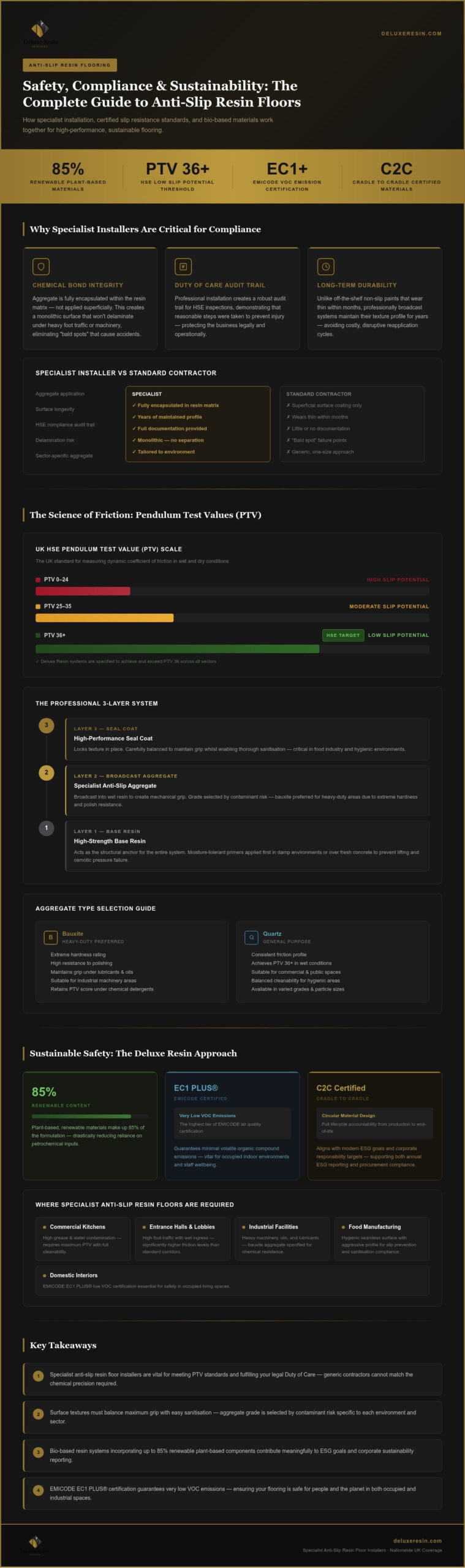
- Learn why partnering with specialist anti slip resin floor installers is vital for meeting PTV standards and fulfilling your legal Duty of Care.
- Discover the science of friction and how to select surface textures that offer maximum grip whilst remaining easy to sanitise.
- See how bio-based resin systems can contribute to your ESG goals by incorporating up to 85% renewable, plant-based components.
- Understand the importance of air quality certifications like EMICODE EC1 PLUS® in ensuring your new floor is safe for both people and the planet.
Why Specialist Anti-Slip Resin Floor Installers are Critical for Compliance
Safety isn’t merely an aesthetic choice; it’s a precision-engineered requirement. Specialist anti slip resin floor installers understand that the efficacy of a non-slip surface relies on the chemical bond between the resin base and the textured aggregate. Whilst a standard contractor might apply a thin, superficial coating, a specialist ensures the aggregate is fully encapsulated within the resin matrix. This creates a monolithic surface that won’t delaminate under heavy foot traffic or machinery. This chemical precision prevents the “bald spots” that frequently lead to workplace accidents and liability claims.
For business owners, the “Duty of Care” is a significant legal responsibility. Choosing professional installation provides a robust audit trail for health and safety inspections, proving that you’ve taken reasonable steps to prevent injury. Unlike “off-the-shelf” non-slip paints that often wear thin within months, a professionally broadcast system maintains its profile for years. This durability ensures you remain compliant with HSE standards without the need for constant, disruptive reapplications. It’s a long-term investment in both safety and operational continuity.
Meeting HSE Slip Resistance Standards in Public and Private Spaces
Compliance requires meeting specific Pendulum Test Value (PTV) scores, which vary depending on whether a floor is likely to be wet or dry. High-risk zones like commercial kitchens or entrance halls require significantly higher friction levels than a standard office corridor. It’s essential to work with industrial resin flooring contractors who can specify the correct grade of aggregate for your specific sector. They ensure that your environment remains safe, hygienic, and fully aligned with current UK safety legislation, providing peace of mind for both your staff and your visitors.
The Technical Specification of Non-Slip Surfaces: The Science of Friction
A high-performance anti-slip floor isn’t a single product; it’s a layered system designed for precision and durability. Professional anti slip resin floor installers begin with a high-strength base resin that acts as a structural anchor for the entire system. Into this wet resin, a specialised aggregate is broadcast to create the necessary mechanical grip. Finally, a high-performance seal coat locks the texture in place. This final layer is vital because surface texture must be carefully balanced with cleanability. For hygienic flooring for the food industry, the profile needs to be aggressive enough to prevent slips whilst remaining smooth enough to allow for thorough sanitisation.
Preparation is just as technical as the application itself. Expert installers often use moisture-tolerant primers when working in damp environments or over fresh concrete. This prevents the resin from lifting or bubbling due to osmotic pressure or residual moisture in the slab. If you’re currently planning a facility upgrade, you can consult our specialists to determine which primer system best suits your specific substrate conditions.
Understanding Pendulum Test Values (PTV) and Aggregate Selection
The Pendulum Test remains the UK standard for measuring slip resistance. It provides a definitive score for the dynamic coefficient of friction in both wet and dry conditions. To achieve a PTV of 36 or higher, which is the HSE threshold for “low slip potential,” installers select different grades of bauxite or quartz aggregate. Bauxite is often preferred for its extreme hardness and resistance to polishing in heavy-duty areas. Meanwhile, chemical resistant industrial floors must maintain this friction even when exposed to lubricants, oils, or aggressive detergents. By tailoring the aggregate size to the specific contaminant risk, specialists ensure consistent safety across the entire site.
The Deluxe Resin Approach: Sustainable Safety and National Delivery
Deluxe Resin Services redefines expectations by proving that high-performance safety doesn’t have to come at an environmental cost. As leading anti slip resin floor installers, we utilise systems formulated with up to 85% renewable, plant-based materials. This commitment ensures that your facility benefits from industrial-grade durability whilst significantly reducing its carbon footprint. Our products carry Cradle to Cradle certifications, reflecting a circular approach to material selection that aligns with modern ESG goals and corporate responsibility targets.
Safety extends beyond physical grip to the air you breathe. Our EMICODE EC1 PLUS® certification guarantees very low VOC emissions, which is particularly vital for domestic resin flooring projects where indoor air quality is a priority. As expert anti slip resin floor installers, we provide national UK coverage with a process that remains rigorous from start to finish. It begins with meticulous mechanical preparation, such as diamond grinding or shot blasting, to ensure a perfect bond. Our service concludes with a performance audit at the six-month mark to verify that the slip resistance remains consistent with the original specification.
A Case Study Framework for Seamless, Non-Slip Restoration
Our methodology for industrial floor resurfacing UK focuses on total restoration rather than temporary fixes. We integrate safety into the design phase, offering an array of bespoke colours and finishes that prove non-slip surfaces can be aesthetically premium. From high-end retail showrooms to heavy-duty manufacturing plants, our tailored approach ensures that every square metre is as beautiful as it is secure. This dual focus on technical excellence and design versatility makes us a reliable partner for those who refuse to compromise on style or safety.
Securing Your Environment with Technical Precision
Selecting specialist anti slip resin floor installers ensures your facility remains compliant with HSE standards whilst advancing your sustainability commitments. We’ve explored how balancing Pendulum Test Values with cleanability creates a safer, more hygienic workspace. By utilising systems made from up to 85% renewable, plant-based materials, you don’t have to sacrifice industrial durability for ecological responsibility. Our Cradle to Cradle certified products and national UK installation team provide the reassurance that comes with high-end craftsmanship. Precision safety is an investment in longevity. Whether you’re managing a commercial kitchen or a luxury domestic interior, the focus remains on long-term performance and environmental stewardship. Request a Technical Consultation for Your Anti-Slip Resin Project to discover how our specialist approach protects your people and your reputation. We’re ready to help you create a safer, greener environment.
Frequently Asked Questions
What is the Pendulum Test Value (PTV) for anti-slip resin floors?
A Pendulum Test Value (PTV) of 36 or higher is the recognised UK standard for achieving a low slip potential in both wet and dry conditions. Professional anti slip resin floor installers specify aggregates that maintain this rating even under heavy use. For high-risk areas like commercial kitchens, we often target significantly higher values to account for constant contaminants like cooking oils or grease.
How do you clean an anti-slip resin floor without reducing its friction?
Effective cleaning requires pH-neutral detergents and mechanical agitation to remove dirt from the textured surface. You should avoid using wax-based polishes or film-forming cleaners, as these fill the “valleys” of the aggregate and create a dangerously smooth surface. Regular scrubbing with a cylindrical brush machine is often the best method to maintain the floor’s original slip resistance and hygienic properties.
Can anti-slip resin be installed over existing tiles or concrete?
Resin systems can be applied over existing substrates provided they are structurally sound and correctly prepared. For concrete, we use mechanical diamond grinding to create a profile for bonding. When installing over tiles, we ensure they are fully adhered before removing the glaze. This versatility allows anti slip resin floor installers to renovate spaces without the need for costly and time-consuming removals.
How long does a professional anti-slip resin floor installation take to cure?
Most professional resin systems allow for light foot traffic after 24 hours at standard room temperature. However, the floor usually requires 48 hours for heavy machinery and a full seven days to achieve its complete chemical resistance. We always provide a specific curing schedule based on the ambient conditions of your site to ensure the finish reaches its maximum durability and safety profile.