

What if the floor that welcomes customers also has to cope with constant footfall, everyday spills and regular cleaning? That’s the challenge behind choosing resin flooring for retail stores: the finish needs to support the look and feel of the space, while practical decisions shape how it performs day to day.
Retailers need more than a polished appearance. Wear, slip resistance, maintenance and the disruption involved in installation all matter when a store needs to keep running smoothly.
This practical guide shows how to bring those priorities together. It explains how the retail setting, floor finish and substrate preparation inform a suitable specification, and how installation planning can account for trading needs. Use the questions and examples below to balance customer experience with safety and upkeep.
Key Takeaways
- Match resin flooring for retail stores to the shop’s footfall, cleaning routine and customer experience goals rather than choosing on appearance alone.
- Use a clear decision framework to weigh the store brief, site constraints, substrate preparation and finish before settling on a solution.
- Consider how a seamless presentation, maintenance needs and suitable non-slip options can work together for the space.
- Plan the work sequence, access and handover around store operations, as preparation and site conditions influence installation planning.
Resin flooring for retail stores: balancing first impressions and daily use
A retail floor has to make an impression while coping with the realities of trading: customers moving through the space, regular cleaning, deliveries and the practical demands of staff. Resin flooring for retail stores can create a continuous, considered finish, but the specification should reflect how each area is used. A seamless surface can support straightforward upkeep, but the finish, preparation and cleaning routine all affect how it works in practice.
Seamless polymer flooring is one flooring category. In a retail setting, assess its suitability against the store’s design brief and daily routines rather than assuming the same solution works everywhere.
Which retail-flooring priorities should shape the specification?
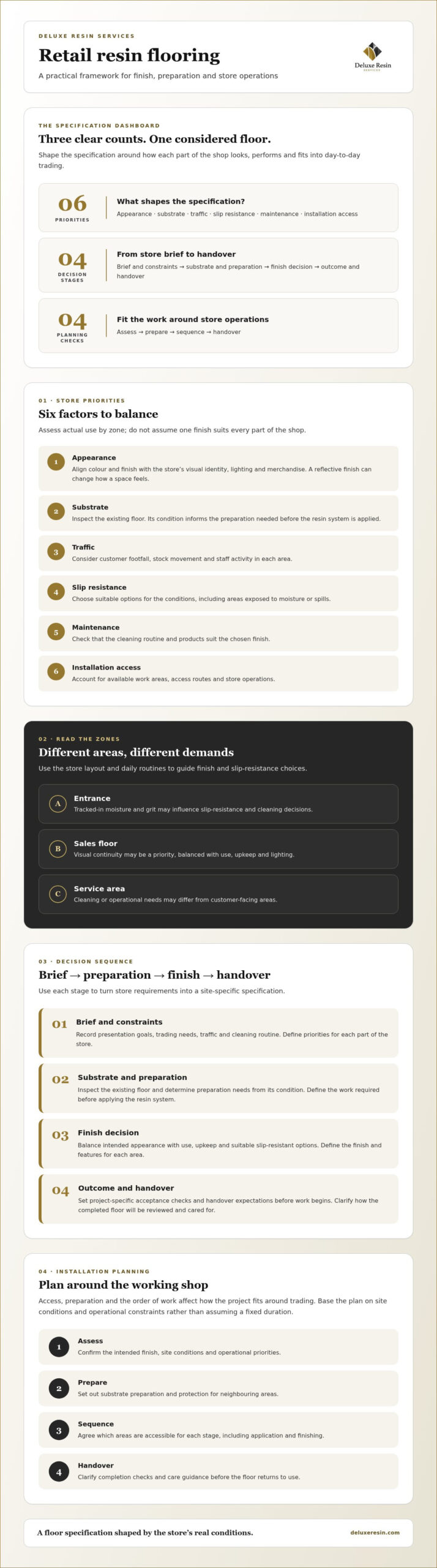
Start by mapping the demands of the space. An entrance may encounter tracked-in moisture and grit, a sales floor may prioritise visual continuity, and a service area may have different cleaning or operational needs. Identify the actual zones in the store before deciding whether they need different finishes or slip-resistant features.
Finish and colour influence how the floor works with lighting and merchandise. A reflective finish can change how a space feels, while colour can create a calm backdrop or define distinct areas. Consider appearance alongside practical performance, including how the chosen finish will look under the store’s lighting and fit its cleaning routine.
- Appearance: Align colour and finish with the store’s visual identity, lighting and merchandise.
- Substrate: Assess the existing surface, since its condition informs the preparation needed.
- Traffic: Consider customer footfall, stock movement and staff activity in each area.
- Slip resistance: Select suitable options for the conditions, including areas exposed to moisture or spills.
- Maintenance: Check that the cleaning routine and products suit the chosen finish.
- Installation access: Account for available work areas, access routes and store operations.
These criteria turn a broad design ambition into a practical specification. For example, a visually consistent sales floor may call for a different balance of finish and slip resistance from an entrance where moisture and grit are more likely. The aim is to match the floor to how the shop actually trades. If your flooring upgrade forms part of a wider commercial renovation, click here to explore comprehensive retail fit-out and interior solutions.
A retail resin flooring case study: from store requirements to a considered finish
Use this example as a decision framework rather than a report of a particular installation. It shows how a retail brief can guide choices about preparation and finish, without assuming every store has the same layout, substrate or trading needs.
How do store conditions guide resin-floor decisions?
Begin with the store’s priorities and constraints: customer-facing appearance, expected traffic, cleaning methods, installation access and the condition of the existing substrate. A site inspection helps establish what preparation is needed. Then compare the intended use and desired finish to shape the resin specification. For background on resin types and performance characteristics, see this overview of resin flooring composition and performance.
| Decision stage | How to assess it | What to define |
|---|---|---|
| Brief and constraints | Record the presentation goals, trading needs, traffic and cleaning routine. | The priorities for each part of the store. |
| Substrate and preparation | Inspect the existing floor and determine preparation needs from its condition. | The work required before applying the resin system. |
| Finish decision | Balance the intended appearance with use, upkeep and suitable slip-resistant options. | The finish and features suited to each area. |
| Outcome and handover | Set project-specific acceptance checks and handover expectations before work begins. | How the completed floor will be reviewed and cared for. |
Brief-to-specification logic: Assess the store’s use and substrate, then align preparation and finish with its operational and visual requirements. For example, if an area is exposed to tracked-in moisture, include that condition in the slip-resistance and cleaning decisions rather than treating the whole shop as one uniform space.
This process makes resin flooring for retail stores a considered choice rather than a purely aesthetic one. Deluxe Resin Services provides commercial resin flooring installation, including site preparation, material supply and finishing.
Planning retail resin flooring installation around store operations
A well-planned installation accounts for the shop as a working environment, not simply a floor area. For resin flooring for retail stores, access, preparation and the order of work all influence how the project fits around trading. Base the plan on the site and the retailer’s operational constraints instead of assuming a fixed duration.
What should a retail flooring installation plan cover?
Start with the brief and a site inspection. The substrate’s condition informs the preparation required, while the store layout helps identify access routes, adjoining surfaces that need protection and areas that may need to remain available. Agreeing these points with the store team helps coordinate the work sequence and avoid preventable clashes with trading activity.
- Assess: Confirm the intended finish, site conditions and operational priorities.
- Prepare: Set out substrate preparation and protection for neighbouring areas.
- Sequence: Agree which areas are accessible for each stage, including application and finishing.
- Handover: Clarify completion checks and care guidance before the floor returns to use.
Preparation and finishing are distinct stages, and the work sequence should reflect the site rather than promise a fixed timetable. Include safety considerations in the brief. The National Floor Safety Institute’s floor safety standards provide background on slip-resistance test methods; the chosen approach should still suit the conditions and use of the retail space.
For further planning context, read the guide to choosing premium resin flooring installers. Once installed, appropriate care helps maintain the finish. The resin flooring maintenance guide covers practical care considerations.
For a retail project, begin by setting out the store’s layout, traffic patterns, cleaning routine and preferred finish. These details help make installation planning specific to the way the space is used.
Shape a retail floor around the way your store works
A considered resin flooring for retail stores solution balances customer-facing appearance with footfall, cleaning routines, slip resistance and the realities of trading. The store’s layout and existing substrate should guide the finish and preparation, while access and sequencing need to be planned around operations. No single specification suits every retail space.
Deluxe Resin Services provides commercial resin flooring installation, with project work covering site preparation, material supply and expert finishing of non-slip surfaces. This brings the key stages together, from assessing site conditions to completing the chosen finish.
To discuss a resin flooring solution for your retail space, contact Deluxe Resin Services with your project requirements.
Frequently Asked Questions
Is resin flooring suitable for a busy retail store?
Resin flooring for retail stores can suit a busy shop when the system is specified for its actual conditions, but suitability isn’t automatic. Consider expected footfall, the substrate’s condition, cleaning methods and the chosen finish together. A high-traffic sales area and a service zone may have different demands. A site assessment helps establish preparation needs and an appropriate specification.
Can resin flooring be made slip-resistant for retail spaces?
Yes, resin flooring can include non-slip options, with the finish selected to suit the space and how it’s used. An entrance exposed to tracked-in moisture may have different considerations from a dry sales area. Site conditions, cleaning routines and the possibility of spills should inform the decision. Avoid assuming a particular level of slip resistance without relevant evidence for the specified floor.
How is resin flooring installed in a retail store?
Installation generally begins with assessing the brief and inspecting the substrate to understand its condition and preparation needs. The surface is then prepared, the resin system is applied and the finish completed, followed by handover guidance. Access, adjoining areas and store operations influence the work sequence. The stages are planned for the specific project, so a fixed duration shouldn’t be assumed.
How do you maintain resin flooring in a shop?
Follow care guidance for the installed finish and use a regular cleaning routine suited to the shop’s traffic and soiling. Remove loose grit to help limit surface abrasion, and clean spills promptly using appropriate methods. Avoid assuming every resin finish takes the same products or treatment. For fuller practical guidance, read the resin flooring maintenance guide.