

What if the right answer to “how long will my floor last?” isn’t a single number? If you’re asking what is the lifespan of a resin floor, conflicting claims can make it hard to judge whether your home’s floor is performing as expected or showing a problem. In practice, service life depends on the resin system, how well the surface was prepared and the floor installed, and the traffic and care it receives.
Everyday wear doesn’t automatically mean a floor needs replacing, but peeling, cracking or persistent damage deserves attention. This guide explains why lifespan estimates vary, how to protect the finish and what to look for when deciding whether a floor needs further attention. It also covers how the right specification and careful installation can support lasting performance, while recognising that every home and floor is different.
Key Takeaways
- There’s no single answer to what is the lifespan of a resin floor: the system, installation, substrate, room use and maintenance all play a part.
- Assessing the substrate and preparing it carefully helps create a sound foundation for long-term performance.
- Foot traffic, furniture movement, impacts and moisture can affect the finish, so consider how each room is used.
- Protect the surface by removing grit, using suitable cleaning products and following the system’s care guidance. Know which signs may need further attention.
What Is the Lifespan of a Resin Floor in a Home?
There is no single lifespan that applies to every resin floor. The answer to “what is the lifespan of a resin floor” depends on the system, the condition of the substrate, installation quality, how the room is used and how the floor is maintained. A carefully prepared and professionally installed floor, used in line with its specification, has different expectations from one exposed to conditions it wasn’t designed for.
It also helps to distinguish functional service life from appearance. A floor may remain usable after scuffs, dulling or other changes affect its finish. By contrast, peeling, cracking or loss of adhesion can point to a more fundamental issue. A change in appearance alone doesn’t necessarily mean the floor has reached the end of its service life.
Why lifespan figures vary between resin floors
“Resin flooring” describes a family of systems, not one uniform material. Epoxy and polyurethane have different properties and shouldn’t be treated as interchangeable. The Epoxy overview provides background on one resin type and its uses. The important decision is whether the chosen system suits the room and the demands it will face.
A living space, hallway and home garage each bring different patterns of footfall, furniture movement and potential impact. These conditions differ from industrial traffic and working environments, so industrial lifespan claims shouldn’t be applied directly to a domestic floor.
A resin floor’s service life is the period it continues to perform for its intended use, shaped by its system and the conditions it experiences. Professional site preparation and expert finishing help establish a sound installation, while appropriate care supports its performance over time.
What Affects How Long a Resin Floor Lasts?
A resin floor’s durability starts before the finish is applied. The substrate needs to be assessed and prepared so it is clean and suitable for the chosen system. Dust, contamination, unevenness or unresolved moisture can undermine the bond or affect the finished surface. Preparation should respond to the actual condition of the room, rather than relying on the resin alone to compensate for problems underneath.
How installation and everyday use influence durability
The system should match the room and its expected use. A quiet bedroom and a busy kitchen place different demands on a floor, just as a domestic garage differs from an industrial working environment. The Resin Flooring Association (FeRFA) provides an industry perspective on resin flooring systems and their applications.
Daily habits matter, too. Grit carried in on footwear can act as an abrasive underfoot. Dragging a heavy chair or table may scuff the finish, while dropped objects can cause impact damage. Moisture can also be relevant if it reaches the substrate or remains on the surface, depending on the system and site conditions. Unsuitable cleaning products or abrasive tools may contribute to surface wear.
Resin floor longevity depends on a suitable system, sound preparation, skilled installation, room conditions, everyday use and appropriate care. That’s why one lifespan figure can’t reliably answer what is the lifespan of a resin floor in every home. Deluxe Resin Services installs domestic resin flooring, including site preparation, material supply and expert finishing of non-slip surfaces. To explore a system suited to your home and its use, view professional resin flooring.
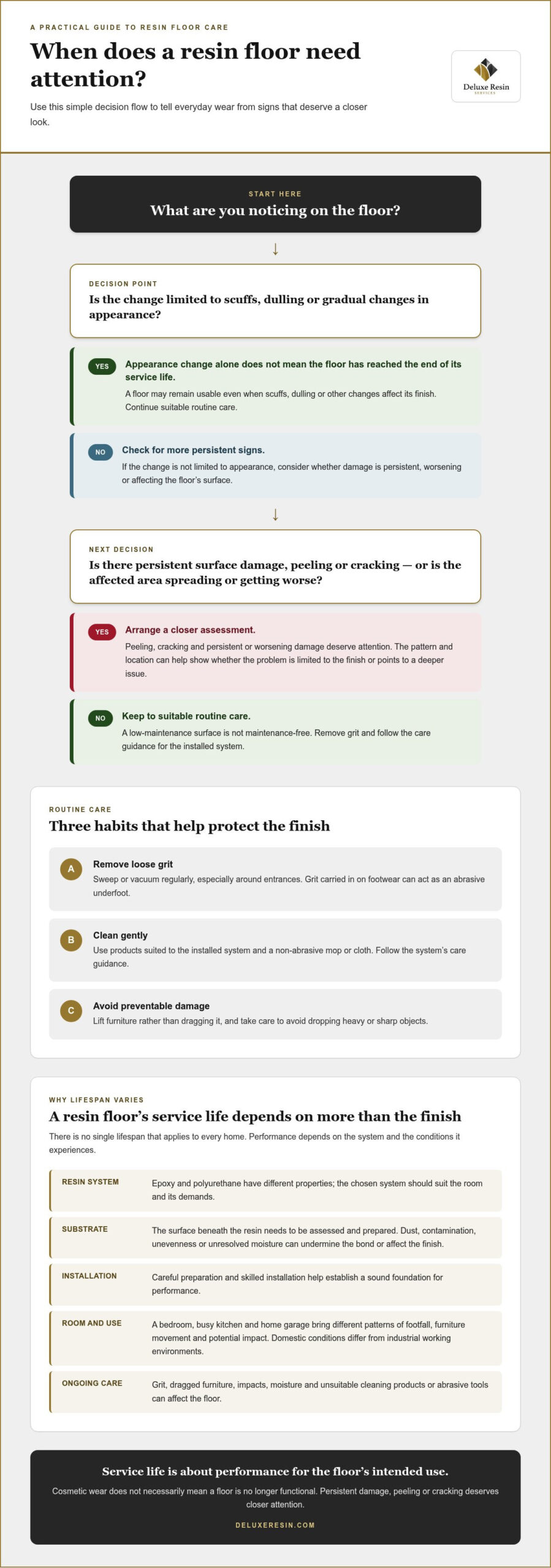
How to Protect a Resin Floor and Know When It Needs Attention
A simple routine helps preserve the finish, although resin flooring is not maintenance-free. Start by removing loose grit, which can cause abrasion as people walk across the surface. Then clean with products and tools suited to the installed system. Follow its care guidance rather than assuming every resin finish responds in the same way.
- Remove grit: Sweep or vacuum regularly, especially around entrances.
- Clean gently: Use a suitable cleaner and a non-abrasive mop or cloth.
- Prevent avoidable damage: Lift furniture rather than dragging it, and take care to avoid dropping heavy or sharp objects.
For more detailed advice, see this resin floor maintenance guide UK. Regular care can help limit everyday wear, but it won’t prevent every mark or address the cause of underlying damage.
Everyday care, visible wear and professional assessment
Scuffs or gradual changes in appearance don’t necessarily mean a floor has stopped serving its purpose. Persistent surface damage, peeling or cracking should be assessed, particularly if the affected area is spreading or getting worse. The pattern and location of the damage can help establish whether it is limited to the finish or points to a deeper issue.
Understanding what is the lifespan of a resin floor also means recognising when its condition has changed. For an overview of finishes designed for home interiors, explore this domestic resin flooring guide.
Make an Informed Choice for Your Home
So, what is the lifespan of a resin floor? There’s no universal figure. Service life depends on the system, preparation, installation, room conditions and ongoing care. A floor may show cosmetic wear while remaining functional, but persistent damage, peeling or cracking deserves closer attention.
Choose a system suited to the room and support it with sensible routine care. Professional preparation and finishing provide important foundations, while a low-maintenance surface still benefits from appropriate cleaning. Material choice can also be part of the decision: Deluxe Resin Services offers resin products formulated with up to 85% renewable, plant-based materials. This is a sustainability consideration, not a measure of how long the floor will last.
Explore domestic resin flooring by Deluxe Resin Services to find a seamless finish designed around your home. Get in touch to discuss a resin flooring project for your space.
Frequently Asked Questions
How long does a resin floor last in a house?
There’s no single lifespan for every household resin floor. The answer to “what is the lifespan of a resin floor” depends on the system, substrate condition and preparation, installation quality, room use and ongoing care. A floor in a lightly used room faces different demands from one in a busy kitchen or home garage. Surface wear doesn’t always mean the floor has stopped functioning.
Does a resin floor last longer than tiles?
Neither resin flooring nor tiles is automatically longer-lasting. Performance depends on product selection, installation and how each surface is used and maintained. A seamless resin finish has no grout joints, while tiled floors have individual tiles and grout that may need attention over time. Both can be affected by impacts or unsuitable cleaning. Compare the specific system with the room’s demands rather than assuming one material always lasts longer.
Can a damaged resin floor be repaired?
Some resin floor damage may be repairable, but the right approach depends on the damage, its cause and the flooring system. A superficial mark is different from peeling, cracking or damage that keeps spreading. The cause and extent of the damage help determine whether the issue is limited to the surface or linked to a deeper problem, and whether repair or another form of attention is appropriate.
How do you make a resin floor last longer?
Remove grit regularly, then clean the floor with suitable products and non-abrasive tools. Follow the care instructions for the installed system, as finishes can differ. Reduce avoidable wear by lifting furniture instead of dragging it and taking care to prevent heavy objects from striking the surface. Clean spills promptly where the system’s guidance recommends it, and keep an eye on persistent marks or damage.