
A resin driveway isn’t a sound investment simply because it looks impressive. The answer to “is a resin driveway a good investment” depends on how well its practical benefits suit your property over time, not on any guaranteed resale return.
It’s sensible to weigh the upfront commitment against other familiar surfaces and consider whether the finish offers more than kerb appeal. This guide explains how to assess long-term value, understand the trade-offs and decide whether resin-bound surfacing suits your home and the way you use your driveway.
We’ll look at durability, maintenance and permeability, including why the right sub-base matters, and explain the difference between resin-bound and resin-bonded surfaces. With those factors in view, you can make a balanced decision based on performance as well as appearance.
Key Takeaways
- To decide whether a resin driveway is a good investment for your home, weigh its everyday usefulness and upkeep alongside its appearance. Don’t assume it will increase resale value.
- Compare driveway options by drainage, maintenance, visual flexibility and how well each suits your property and its intended use.
- Good preparation and careful installation are central to how a resin-bound surface performs over time.
- Resin may suit you if you value a decorative, permeable surface that is relatively low maintenance. Assess the site and upkeep requirements before choosing it.
Is a resin driveway a good investment, or does it simply look the part?
A resin driveway can be a good investment when its performance and appearance suit your property, but its value depends on your priorities and the quality of installation, not on a guaranteed rise in resale price. A refined finish is one benefit; how the driveway works for your household matters just as much. Consider how often you use it, whether the surface suits your home and how much routine care you’re prepared to do.
What does ‘good investment’ mean for a driveway?
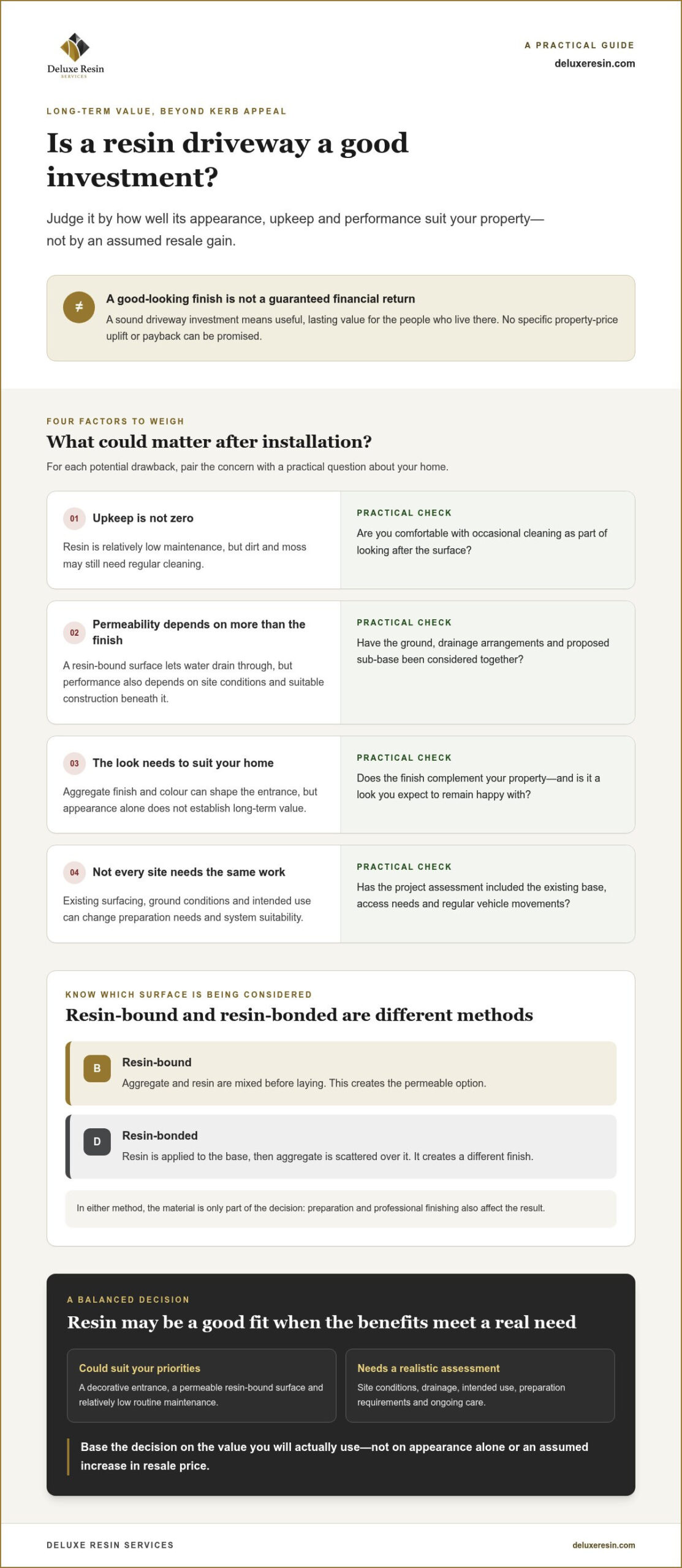
A sound home-improvement investment delivers useful, lasting value for the people who live there. It doesn’t promise a specific increase in the eventual sale price. No particular property-price uplift or payback can be promised for a resin driveway. Treat resale appeal as a possible consideration, not the financial case on its own.
Instead, weigh the practical benefits against your needs. A decorative finish may create a more cohesive entrance, while resin-bound surfacing can provide permeability and relatively low maintenance. That doesn’t mean no upkeep: dirt and moss may still need attention. Consider everyday use, the condition and layout of the site, and whether the finish fits the character of your property.
Resin-bound paving combines aggregate and resin before the mixture is laid, creating a surface that differs from loose gravel. With resin-bonded surfacing, resin is applied to the base and aggregate is scattered over it. The two methods create different finishes, and resin-bound surfacing is the permeable option. In either case, the material is only part of the decision: preparation and professional finishing also affect the result. A homeowner who prioritises a neat entrance and less routine upkeep may value resin differently from someone whose main aim is a guaranteed financial return.
So, is a resin driveway a good investment? It may be right for one home and not another. Assess the benefits you’ll actually use, along with the installation requirements and ongoing care, rather than assuming appearance alone makes it worthwhile.
How to assess the long-term value of a resin driveway
Look beyond the finished surface. Ongoing care, drainage, appearance and the condition of the site all affect whether resin-bound surfacing is a practical fit. Use this comparison to focus on what matters for your property:
| Factor | What to consider |
|---|---|
| Maintenance | Resin is low maintenance, but dirt and moss may still need regular cleaning. Consider whether that routine suits you. |
| Drainage | A permeable finish allows water to drain through the surface, but performance also depends on the site and suitable construction beneath it. |
| Appearance | Consider whether the aggregate finish and colour complement your home, and whether you’ll remain happy with that look. |
| Project suitability | Existing surfacing, ground conditions and intended use can affect preparation needs and the suitability of the proposed system. |
Which factors matter beyond the initial installation?
Site preparation and workmanship help determine how the finished surface performs. The existing base affects the preparation required, so the same surface choice won’t involve identical work at every property. Assess the project as a whole, including the base, drainage approach and finish. For more detail on the process, explore this resin-bound driveway installation guide.
Judge permeable resin-bound surfacing against the site’s ground conditions, drainage arrangements and intended use. It isn’t a one-size-fits-all solution. For broader context on factors that affect service life, read about the durability and lifespan of resin driveways, bearing in mind that performance depends on the specific installation.
To assess whether a resin driveway is a good investment, compare the practical features you’ll value with the preparation your project requires. Deluxe Resin Services’ project-based installations bring together site preparation, material supply and expert finishing. You can also explore resin driveway options as you consider what suits your property.
When a professionally installed resin driveway may be the right investment
A resin-bound driveway may suit a home where a decorative finish, permeability and relatively low maintenance are priorities. These benefits matter most when they meet a real need, such as improving the entrance’s appearance while choosing a surface that allows water to drain through. They don’t make resin right for every property or guarantee a financial return.
Installation matters too. Deluxe Resin Services installs resin driveways through a project-based approach that includes site preparation, material supply and expert finishing. Considering these elements together helps match the chosen surface to the property’s existing conditions and intended use.
How to decide whether resin-bound surfacing fits your project
Before deciding, work through this checklist. Clear priorities make it easier to judge whether the finish offers value for your household:
- Appearance: Would an aggregate finish complement your home and create the entrance you want?
- Everyday use: Does the proposed surface suit how you use the driveway, including access and regular vehicle movements?
- Water management: Are the site conditions and drainage arrangements appropriate for a permeable surface?
- Preparation: Have the existing surface and ground conditions been considered when planning the installation?
- Upkeep: Are you comfortable with occasional cleaning to manage dirt and moss, rather than expecting a surface that needs no care?
If those priorities align, resin-bound surfacing may be a considered choice for your property. If your main reason for installing it is an assumed resale uplift, keep expectations measured: no specific increase in sale price can be promised. Assess the site and the finish you want rather than relying on appearance alone.
Explore resin-bound driveway installation to see how a project-based approach brings preparation, materials and finishing together for your home.
Make your next step a property-led decision
The most useful answer to “is a resin driveway a good investment” comes from matching the surface to the way you want your home to function, rather than relying on an assumed resale return. Identify the qualities that matter most, then weigh them against your site and how you expect to use the driveway.
Deluxe Resin Services installs resin-bound driveways with decorative, permeable and low-maintenance qualities in mind. Each project includes site preparation, material supply and expert finishing, with the work shaped around the property rather than treated as a one-size-fits-all solution.
If resin aligns with your priorities, explore the installation approach and consider how it could work for your home. A considered decision starts with clear expectations and a solution suited to your property. Explore resin-bound driveway installation.
Frequently Asked Questions
Does a resin driveway increase property value?
A resin driveway may improve a home’s frontage, but it can’t guarantee a higher sale price. If you’re asking “is a resin driveway a good investment”, consider whether its appearance and everyday function suit the property for you, rather than relying on a future buyer’s response. Sale value also depends on the wider home, buyer preferences and market conditions, so treat resale appeal as a possibility, not a predictable return.
How long does a resin driveway installation take?
There’s no single timeframe that applies to every installation. The schedule depends on the project, including how much site preparation is needed and the conditions during the work. A site that needs more preparation may require a different plan from one that’s ready for installation. The work includes preparing the site, supplying materials and finishing the surface, so base your expectations on the project plan.
Can resin-bound surfacing help with driveway drainage?
Yes. Resin-bound surfacing is permeable, which allows water to pass through the surface. That doesn’t guarantee a solution to every drainage problem: the outcome depends on site conditions and the complete installation. If water currently pools in a particular area, consider how the ground, base and drainage arrangements affect that spot rather than assuming a permeable finish alone will resolve it.
Is a resin driveway difficult to maintain?
Resin driveways are considered low maintenance, but they still need appropriate routine cleaning to help keep their appearance. Accumulated dirt or moss may need attention as it becomes visible. The amount of care can depend on the driveway’s surroundings and use, so don’t assume it will stay pristine without upkeep. Low maintenance means less demanding care, not a surface that never marks or needs attention.