

Durability alone does not make a warehouse floor the right choice. Heavy duty warehouse flooring options can support ESG goals when they withstand demanding traffic, are practical to clean and help avoid premature replacement. Common systems include epoxy, polyurethane and cementitious flooring. The right fit depends on how each area is used and whether it needs features such as anti-static or anti-slip properties.
Consider how flooring affects vehicle routes, storage layouts, safety and disruption during installation. This guide explains how to weigh those practical demands alongside environmental priorities when selecting a warehouse floor. It covers efficient layouts, where anti-static and anti-slip finishes may be relevant, and how resin flooring can contribute to a more sustainable operation.
Key Takeaways
- Match the floor’s abrasion, compression and flexural resistance to the traffic, equipment and loads in each warehouse zone.
- Weigh concrete’s ability to support demanding operations against its installation and maintenance requirements when considering ESG goals.
- Assess whether anti-static or anti-slip resin surfaces suit the hazards and activities in your facility.
- Compare flooring systems by durability, cleaning needs and operational disruption to find a practical long-term fit.
How does flooring impact warehouse layout and design?
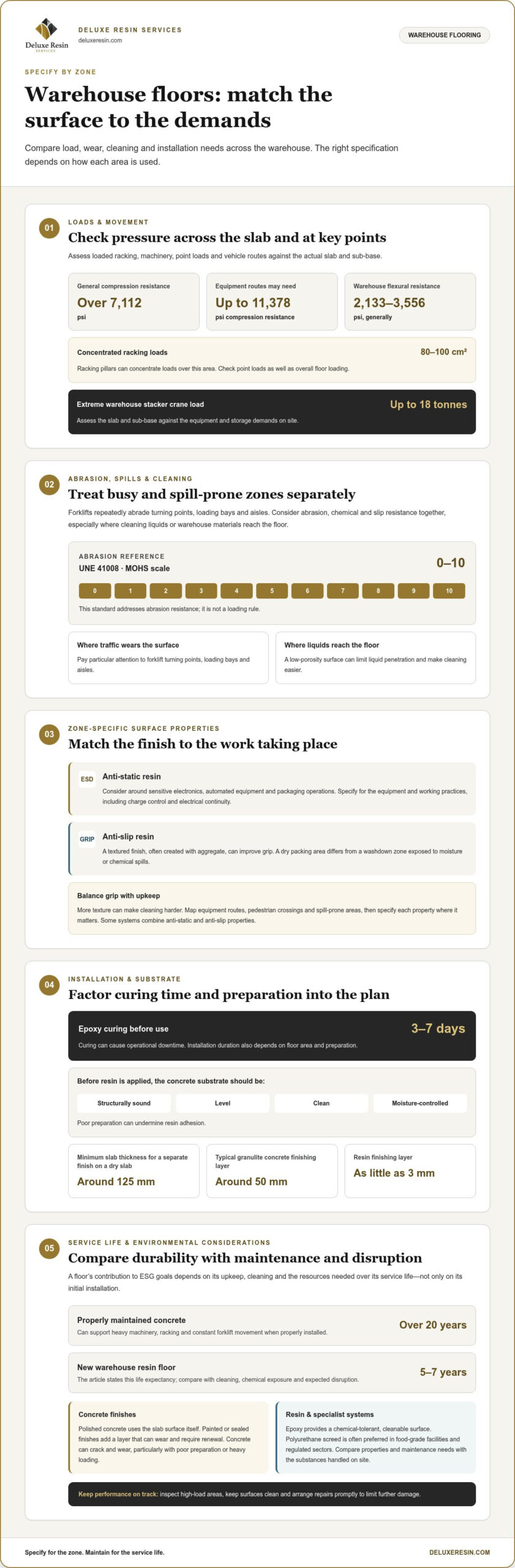
Floor specification influences where heavy machinery, racking and pedestrian routes can operate safely. Installation duration depends on floor area and preparation; epoxy systems can require 3 to 7 days of curing before use.
Resistance to Abrasion and Traffic
Forklift traffic repeatedly abrades turning points, loading bays and aisles, so assess these zones separately. The UNE 41008 standard addresses abrasion resistance using a MOHS scale from 0 to 10. A suitable rating helps inform the choice of industrial flooring for expected traffic and mechanical wear.
Impacts from pallets and equipment can damage weaker surfaces, while chemical spills may affect the finish. Consider abrasion, chemical and slip resistance together, especially where cleaning liquids or warehouse materials reach the floor. A durable, slip-resistant surface can support safer movement and withstand routine cleaning without compromising the layout.
Load and Flexural Resistance
Compression resistance matters beneath loaded racking and heavy machinery. Warehouse floors should generally withstand over 7,112 psi of compression, while equipment routes may need to withstand up to 11,378 psi. Racking pillars can concentrate loads over an area of 80 to 100 cm2, so assess point loads as well as overall floor loading.
Flexural resistance measures how well a floor withstands bending forces without cracking. Warehouse requirements are generally around 2,133 to 3,556 psi. Consider these figures alongside vehicle movements and the slab’s condition when planning routes, storage and work zones. Matching the surface and substrate to these demands can help avoid expensive disruption and premature damage.
A low-porosity surface can help limit liquid penetration and make cleaning easier. Epoxy, polyurethane and cementitious systems are used in warehouse environments; compare their chemical resistance, durability and maintenance needs against the substances handled on site. These properties also shape where spill-prone processes belong and how cleaning routes fit around racking and forklift aisles.
Can warehouse flooring support ESG goals?
Concrete can support heavy machinery, racking and constant forklift movement when properly installed. Properly maintained concrete flooring can last over 20 years, helping reduce replacement demand. Its contribution to ESG goals also depends on maintenance, cleaning and the resources required throughout its service life.
In extreme cases, a warehouse stacker crane load can reach 18 tonnes, so assess the slab and sub-base against actual equipment and storage demands. For UK floor design, UNE 41008 addresses abrasion resistance using a MOHS scale from 0 to 10; it is not a loading rule. Loading design must account for racking, machinery and vehicle movements.
Finishes change how concrete performs in daily use. Polished concrete uses the slab surface itself, whilst painted or sealed finishes add a layer that can wear and require renewal. Epoxy offers a chemical-tolerant, cleanable surface, but curing can take 3 to 7 days and cause operational downtime. Polyurethane screed is often preferred in food-grade facilities and regulated sectors.
Concrete drawbacks include cracking and wear, particularly where the substrate is poorly prepared or heavily loaded. Poor preparation can also cause resin adhesion failure. A separate finishing layer on a dry slab requires a minimum slab thickness of around 125 mm; a typical granulite concrete finishing layer is around 50 mm. Resin finishing layers can be as little as 3 mm, but a new warehouse resin floor is stated to have a life expectancy of 5 to 7 years.
Common problems include cracking, premature wear and loss of adhesion. Inspect high-load areas, keep surfaces clean and arrange repairs promptly to limit further damage. Compare polished, sealed and resin finishes by their cleaning needs, chemical exposure and expected disruption, not just by installation requirements.
Anti-static and anti-slip resin flooring
Anti-static resin flooring helps control static build-up around sensitive electronics, automated equipment and packaging operations. Specify the system to suit the equipment and working practices on site, rather than choosing by appearance alone. When comparing heavy duty warehouse flooring options, consider charge control, electrical continuity and how the floor fits into the wider installation design.
Anti-slip resin flooring uses a textured finish, often created with aggregate, to improve grip underfoot. A dry packing area has different needs from a washdown zone exposed to moisture or chemical spills. More texture can make cleaning harder, so balance slip resistance with hygiene and maintenance requirements.
Some flooring systems combine anti-static and anti-slip properties, but each requirement needs careful specification. Map equipment routes, pedestrian crossings and spill-prone work areas, then identify where each surface property matters. An electronics assembly zone may prioritise static control, while a wet process area may need greater grip. Abrasion resistance also matters where forklifts repeatedly turn or move loads. These demands help identify which heavy duty warehouse flooring options suit each zone.
Installation quality affects performance. The concrete substrate should be structurally sound, level, clean and moisture-controlled before resin is applied; poor preparation can undermine adhesion. Select a finish that supports safe movement, practical cleaning and equipment demands. Explore industrial resin flooring for warehouse environments requiring a resin surface tailored to operational needs.
Deluxe Resin Services: Domestic Resin Flooring
Deluxe Resin Services installs Industrial Resin Flooring for commercial environments where a seamless, durable surface can support demanding daily use. Resin floors offer non-slip finishes, with the surface specified to suit site traffic, equipment and operational requirements. Deluxe Resin Services also installs Domestic Resin Flooring for residential projects.
Sustainability can also inform material selection. Deluxe Resin Services’ products are formulated with up to 85 % renewable, plant-based materials and hold certifications including EMICODE EC1 PLUS® and Cradle to Cradle. These attributes may be relevant when assessing flooring as part of wider environmental goals, alongside durability, cleaning and maintenance needs.
If resin flooring suits your project, contact Deluxe Resin Services to discuss your flooring requirements.
Make your next flooring decision count
Choosing among heavy duty warehouse flooring options is an opportunity to plan for how your operation may evolve, not just for today’s demands. Consider how equipment, working zones and environmental priorities could change, then use those needs to guide the specification. A well-matched floor supports a considered approach to safety, maintenance and long-term use.
Deluxe Resin Services offers Industrial Resin Flooring for commercial projects, alongside Domestic Resin Flooring and Resin Driveways. If resin flooring is a suitable direction for your facility, discuss your project and operational priorities with the team. Contact Deluxe Resin Services to explore the next step. A carefully planned surface can help create a workplace that is ready for what comes next.
Frequently Asked Questions
How do location and weather affect warehouse flooring?
Local conditions affect moisture levels, surface performance and installation planning. In UK warehouses, rainwater brought through goods-in doors can leave entrance areas damp, while moisture beneath the concrete can affect adhesion. Map exposed entrances and damp-prone zones, then factor drainage, moisture control and indoor temperature into the floor specification and installation schedule.
How does warehouse flooring improve operational efficiency?
A well-matched floor supports predictable movement of people, stock and equipment. For example, a smooth, cleanable surface around picking stations can make routine housekeeping more straightforward, while clear floor markings help organise routes and work areas. Plan flooring alongside storage and handling processes to reduce avoidable obstructions and coordinate daily tasks.
What are the key features of logistics-ready flooring?
Logistics-ready flooring needs a level, continuous surface suited to the site’s handling equipment and work processes. Look for durability under repeated movement, practical cleaning and a finish appropriate to dry or spill-prone areas. Plan junctions between work zones carefully so changes in surface or floor marking do not obstruct pallet trucks, forklifts or staff.
What should you consider when choosing warehouse flooring?
Start by mapping each area’s use, from goods-in and storage to packing and dispatch. Record the equipment, load movements, substances handled and cleaning methods in each zone. Then assess the existing concrete, moisture, installation disruption and ongoing maintenance. This practical site overview makes it easier to compare flooring systems against operational priorities.
Why is warehouse flooring important in logistics?
Warehouse flooring is a working part of the logistics environment, not simply a background finish. Its condition affects how smoothly goods move between receiving, storage and dispatch, and how easily teams keep work areas organised. A floor selected for the facility’s actual processes can support consistent operations and a clean, usable workplace.