

A concrete-effect floor is practical only when its finish suits the room’s demands. Concrete effect poured flooring can work in kitchens and workspaces when its protective treatment and texture suit expected footfall, cleaning products and likely spills. PU concrete can also be installed over existing tiles if the floor is stable, has no movement and contains no trapped moisture.
It’s understandable to want a refined-looking floor that keeps everyday cleaning and commercial use manageable. This guide explains where PU concrete flooring works, how to care for it and when tiles can provide a suitable base. You’ll also see how preparation and finish choices affect the result, helping you make an informed decision for your space.
Key Takeaways
- Keep routine cleaning simple: sweep first, then use a cleaner recommended for the floor’s finish.
- Before planning an overlay, assess the existing surface for condition, moisture, cracks and levels.
- Distinguish a mechanically polished concrete slab from a decorative overlay when comparing appearance and installation.
- Explore domestic or industrial resin flooring to match the setting, with sustainable options also available.
Cleaning and maintenance
For PU concrete flooring, start by sweeping or vacuuming loose grit from the surface. Then use a cleaner recommended for the floor, following its directions and using a clean mop. Removing abrasive particles before damp cleaning helps protect the finish. In kitchens, wipe up food and drink spills promptly instead of leaving them on the surface.
Choose care products for the installed material, not just its contemporary concrete appearance. A decorative concrete-effect surface needs appropriate care, and shouldn’t be assumed to resist every stain or type of damage. Resin flooring isn’t maintenance-free. For example, dragging a chair across an unprotected area can mark the finish, so lift furniture where practical.
Protection may also need attention over time. Depending on the surface and its use, occasional wax, sealant or clear glaze may help protect against scratches. Choose the protective treatment and texture to suit expected footfall, furniture movement, cleaning products and likely spills. An industrial workspace and a home kitchen face different demands, so their maintenance needs may differ too.
Vinyl flooring has its own care requirements, so don’t assume PU concrete instructions apply. Sweep or vacuum first, then follow the vinyl manufacturer’s cleaning guidance and use products intended for that floor. Check the care instructions before applying wax or another surface treatment, so routine cleaning suits the installed material.
For any concrete-effect floor, follow a consistent routine: remove loose debris, clean with the recommended product and wipe up spills promptly. Use the floor’s care guidance when choosing cleaners or protective products. If the finish changes or marks remain after routine cleaning, avoid stronger products until you’ve checked that they suit the specific surface.
Floor preparation and suitability over tiles
PU concrete can be laid over existing tiles when the base is stable, without movement or trapped moisture. Careful preparation helps the new surface form a reliable, smooth finish.
Preparing the Existing Floor
Before installation, assess the tiles and underlying floor for movement, moisture, cracks, contamination, coatings and uneven levels. For commercial overlays, complete this assessment before selecting a system. Repairs or tile removal may be needed if the substrate is unsuitable. The overlay’s build height also affects doors, thresholds, joints and adjoining floors, so include them in the preparation plan. Addressing surface defects first helps achieve a polished appearance.
Suitable Rooms and Areas
Stable tiled floors may suit residential kitchens and commercial workspaces if the surface meets the system’s requirements. Bathrooms and wet rooms can use concrete-effect overlays when correctly tanked. A sealed finish with enhanced slip resistance can also be selected for wet areas. Suitability depends on the room’s exposure and preparation, not appearance alone.
For underfloor heating, include the heating system when assessing the substrate and installation build-up. Movement at junctions needs provision, as a correctly installed overlay over a stable base is less likely to crack. True ground polished concrete is different: it requires a concrete slab to grind, so it cannot be laid over tiles. Microcement overlays can cover sound tiles, screed and concrete. For a considered residential upgrade, explore flooring options for your space.
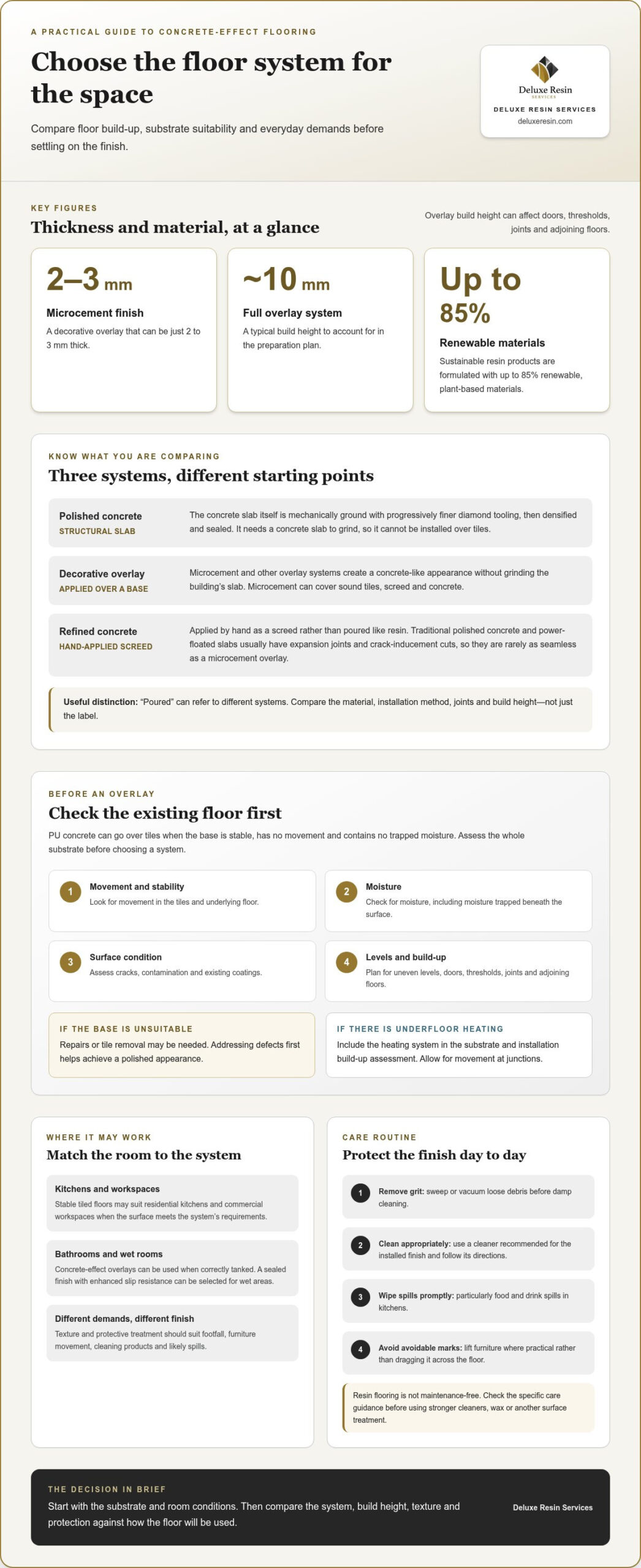
What is poured concrete flooring and what finishes are available in the UK?
In the UK, concrete effect poured flooring can refer to different systems, so identify the material before comparing finishes. True polished concrete is a structural slab, mechanically ground with progressively finer diamond tooling, then densified and sealed. It cannot be installed over another floor because grinding requires the concrete slab itself.
Decorative overlays create a similar appearance without grinding the building’s slab. A microcement finish can be just 2 to 3 mm thick, while a full overlay system is typically around 10 mm. Refined concrete is applied by hand as a screed, rather than poured like resin. These distinctions affect installation and floor build height.
Traditional polished concrete and power-floated slabs usually have expansion joints and crack-inducement cuts, so their surfaces are rarely as seamless as a microcement overlay. PU concrete floors are usually harder than regular concrete floors, making the intended use an important factor when choosing a system.
With concrete effect poured flooring, finish choices involve more than colour. Texture and protective treatment should suit expected footfall, furniture movement, cleaning products and likely spills. A commercial workspace with frequent furniture movement has different demands from a residential kitchen. Samples indicate the intended appearance, but the installed finish can vary in colour and texture.
Before choosing, compare the system’s material, finish and build height with the room’s practical needs. Consider how joints affect the appearance and whether the texture and protection suit daily use. This helps you distinguish a ground slab from a decorative overlay instead of relying on the label “poured” alone.
Deluxe Resin Services: Domestic Resin Flooring
Deluxe Resin Services installs Domestic Resin Flooring for homeowners considering a resin finish for kitchens and other living spaces. The company also provides Industrial Resin Flooring, with options suited to domestic and commercial settings. If you’re considering a resin surface, discuss how the room will be used and the finish you want to achieve.
For readers weighing environmental considerations alongside appearance and performance, the company also offers Sustainable Resin Solutions. Its products are formulated with up to 85% renewable, plant-based materials and hold certifications such as EMICODE EC1 PLUS® and Cradle to Cradle. These credentials can inform your material choice, alongside the practical requirements of the space.
Contact Deluxe Resin Services to discuss your flooring project.
Plan your flooring around the way you use the space
The right next step is to turn your preferred look into a practical brief. Note how each room is used, the finish you want and any substrate concerns, then compare those priorities with the flooring system. That gives a useful starting point for discussing concrete effect poured flooring and whether a resin finish suits your project.
Deluxe Resin Services installs Domestic Resin Flooring and Industrial Resin Flooring for different interior settings, as well as Resin Driveways for external projects. Discussing your space can help narrow the options according to its use and the appearance you want, since every surface has different requirements.
Contact Deluxe Resin Services to discuss your flooring plans and take the next step with confidence.
Frequently Asked Questions
Can it go over an existing floor?
PU concrete can be installed over tiles when the base is stable, with no movement or trapped moisture. For commercial projects, the assessment also considers coatings, contamination, cracks and floor levels. Damaged tiles or an uneven doorway transition, for example, can affect preparation and the proposed overlay. If the existing floor cannot support the finish, a different system may be needed.
Does temperature affect the application?
Yes. For epoxy, temperatures above 29°C may accelerate its polymeric reaction, while temperatures below 13°C may slow it down. This can affect how the application behaves, so temperature conditions matter when planning the work. These figures relate to epoxy and shouldn’t be treated as universal thresholds for every poured floor or resin formulation.
What affects the cost?
Project scope depends on factors such as the area, preparation, repairs, selected finish, detailing and access. A floor needing repairs or extra substrate preparation, for example, requires different work from a sound, ready surface. These details shape the quote, not appearance alone. Request a quote for a tailored price based on the room and finish.
Will it look exactly like a sample?
Not necessarily. A sample shows the intended appearance, but the installed decorative finish can vary in colour and texture. Treat it as a guide to the overall look, not an exact template for every part of the floor. When discussing the finish, explain whether you prefer a more uniform result or welcome natural variation.
How much does poured concrete flooring cost per m² in the UK?
There is no single per-square-metre cost for every UK floor. The system, area, substrate preparation, repairs, finish, detailing and access all affect the project scope. A ground polished concrete slab and a decorative overlay are different installations, so compare like with like. Request a tailored quote from Deluxe Resin Services for your project.