
What if the industrial floor of your dreams is actually a poor fit for your home’s daily comfort? Many UK homeowners are captivated by the minimalist allure of a seamless finish, yet the choice between resin flooring vs polished concrete involves far more than just aesthetics. You’re likely looking for that high-end look but worry about the risk of concrete cracking or the biting chill of raw stone underfoot. We understand that a floor must be as practical as it is beautiful, especially when working within the height constraints of a renovation. This guide explores the critical differences in thermal performance, installation depth, and sustainability to help you select the perfect surface. We’ll examine how modern, plant-based resins provide a warmer, more flexible alternative whilst remaining compatible with underfloor heating for your project.
Key Takeaways
- Understand why resin provides superior thermal comfort and acoustic insulation, making it a warmer and quieter alternative to raw concrete.
- Navigate the “depth dilemma” by comparing resin flooring vs polished concrete installation requirements, specifically how thin-set resin suits renovations where floor levels are limited.
- Learn how the inherent flexibility of resin systems prevents the hairline cracking often seen in rigid, structural concrete slabs as a property settles.
- Evaluate the environmental impact of your choice, focusing on modern bio-based resins that utilise up to 85% renewable, plant-based materials for a lower carbon footprint.
Comparing Aesthetics and Sensory Comfort: Warmth, Acoustics, and Colour
Choosing between resin flooring vs polished concrete often begins with a visual preference. Polished concrete offers a raw, industrial aesthetic that celebrates natural imperfections and aggregate exposure. Whilst striking, it’s limited by the existing slab’s composition and can appear somewhat unpredictable in its final texture. In contrast, luxury resin provides a canvas for bespoke colour matching and perfectly consistent finishes. As domestic resin flooring specialists, we often see homeowners pivot toward resin when they realise it offers the same high-end, seamless look with significantly more design flexibility.
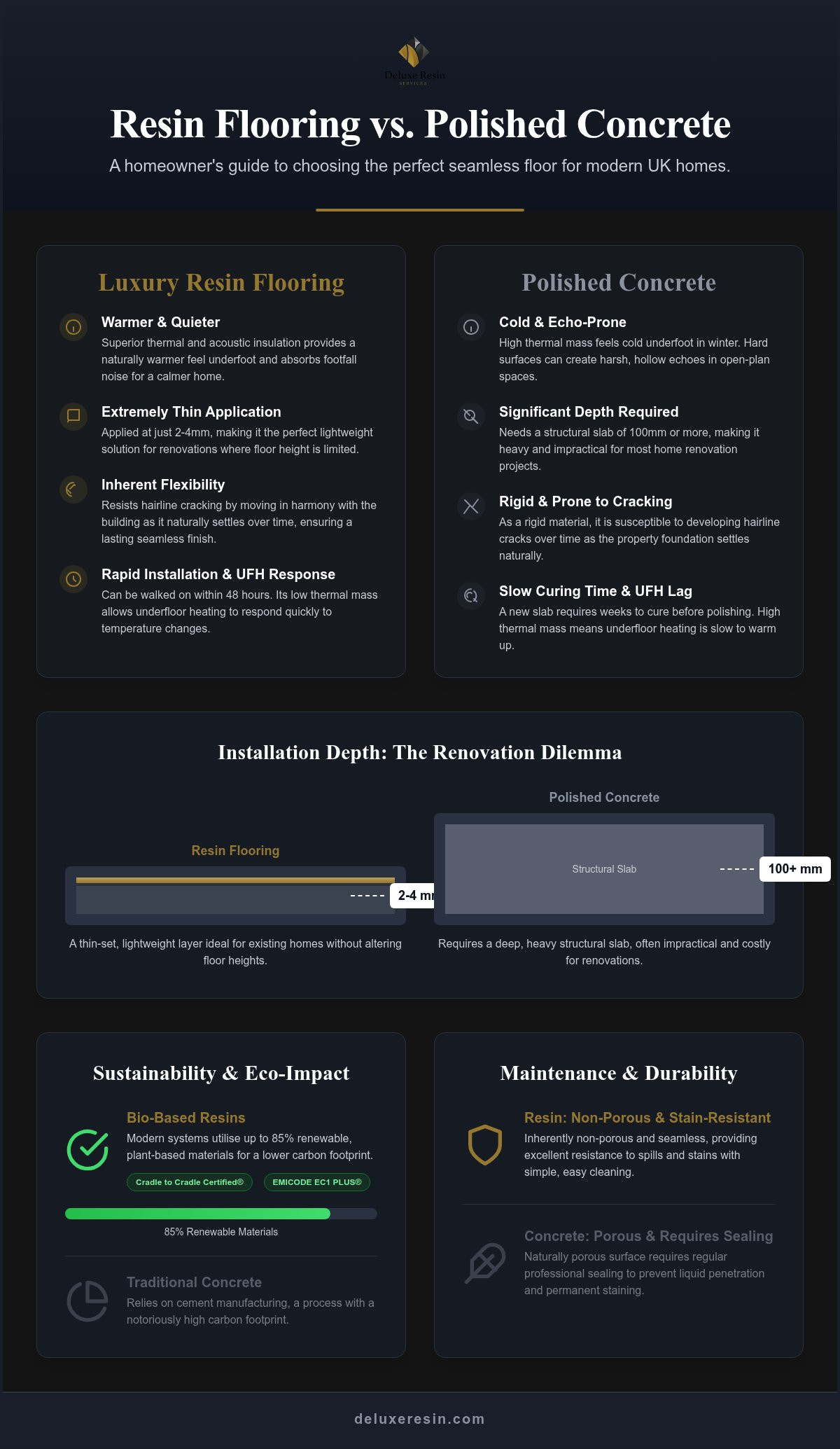
Sensory comfort is where these materials diverge most sharply. Concrete has a high thermal mass; it absorbs heat slowly and can feel biting cold in unheated UK rooms during winter months. Resin feels naturally warmer underfoot because it acts as a more efficient insulator. This material resilience also translates to superior acoustic performance. Whilst large open-plan spaces with concrete surfaces often suffer from harsh, hollow echoes, resin’s slight elasticity absorbs footfall noise. It creates a noticeably calmer, more private atmosphere in busy households.
The Daily Experience: Living With Your Floor
Resin flooring for open plan living offers a softer, more forgiving surface that’s gentler on joints and safer for young children or pets. The way light interacts with these surfaces also creates a distinct mood. Concrete reflects light off a ground, crystalline structure, whereas hand-poured resin provides a smooth, uniform diffusion. This results in a refined, soft glow throughout the room rather than the sharper, more clinical glare sometimes found on highly polished stone. These subtle differences in texture and light play define the long-term liveability of your interior design. The same seamless, safety-conscious approach extends to wet areas too, where a non slip resin bathroom floor combines the identical aesthetic warmth with essential grip underfoot.
Installation Practicalities: Structural Weight, Depth, and Cracking
The technical feasibility of your project often hinges on the “depth dilemma”. When evaluating resin flooring vs polished concrete, the structural requirements are vastly different. Polished concrete typically requires a significant structural slab, often 100mm or deeper, to prevent structural failure. While this depth is a constraint for internal renovations, it is perfectly suited for external areas where you can explore Exposed Aggregate Driveways to see how concrete’s durability is maximised outdoors. Conversely, resin is a thin-set solution, usually applied at just 2-4mm. This makes it an exceptionally lightweight choice that won’t compromise the building’s load-bearing capacity.
Durability also depends on how a material handles movement. Concrete is inherently rigid and prone to hairline cracks as a property naturally settles over time. Resin systems, particularly polyurethane variants, possess a degree of flexibility that allows them to move in harmony with the subfloor. This resilience ensures a truly seamless finish remains intact for years. Additionally, resin offers a much faster installation timeline; whilst a new concrete slab needs weeks to cure before polishing, resin can often be walked upon within 48 hours. This efficiency extends to underfloor heating (UFH) systems, where resin’s lower thermal mass allows for a more rapid response to temperature adjustments.
Renovations vs New Builds
For existing homes, resin is frequently the only logical option. Altering floor heights in a renovation to accommodate a thick concrete slab is often impossible or prohibitively expensive. The preparation also differs significantly. Concrete installation involves heavy grinding machinery and significant dust management, whereas resin relies on a meticulous layering and priming process. If you’re planning a modern update, exploring sustainable resin solutions can help you achieve a high-end look without the structural upheaval of traditional concrete.
Sustainability and Maintenance: Future-Proofing Your Interior
Whilst many view stone-based materials as the natural choice, the debate between resin flooring vs polished concrete requires a closer look at environmental impact. Traditional concrete relies on cement, a material with a notoriously high carbon footprint. Modern flooring technology now provides a more responsible alternative through bio-based resins. These systems, such as those we specialise in, are formulated with up to 85% renewable, plant-based materials. They carry prestigious Cradle to Cradle and EMICODE EC1 PLUS® certifications, ensuring your home maintains the highest standards of indoor air quality without compromising on luxury.
Maintenance also distinguishes these two finishes. Concrete is naturally porous; it requires regular professional sealing to prevent liquid penetration and permanent staining. Resin is inherently non-porous and resistant to spills, making it a more practical choice for busy households. This chemical resistance ensures that the surface remains pristine with minimal intervention, avoiding the long-term cost and hassle of periodic resealing. Before committing to either material, it’s worth reviewing a detailed breakdown of seamless resin flooring cost UK to ensure your investment aligns with your renovation budget.
Long-Term Durability and Hygiene
While seamless flooring is a major step toward better hygiene in the home, industrial and commercial spaces often require a more specialised approach to cleanliness; for those projects, you may want to check out Distribution Hygiene Services Limited to see how they support high-standard environments.
The absence of grout lines or expansion joints creates a significant hygienic advantage. There are simply no crevices where bacteria, dust, or allergens can settle. To ensure your resin flooring for open plan living maintains its lustre for decades, follow this simple care routine:
- Remove loose grit daily using a soft-bristle brush or vacuum.
- Clean spills promptly with a pH-neutral floor cleaner.
- Avoid abrasive scouring pads that might dull the finish.
- Place felt protectors under heavy furniture legs to prevent surface scratches.
Elevating Your Interior With Sustainable Luxury
Choosing between resin flooring vs polished concrete ultimately depends on balancing your aesthetic vision with daily liveability. Whilst concrete provides a classic industrial look, resin offers a more refined, warm, and flexible alternative that adapts to the natural movement of your home. By opting for a non-porous, plant-based system, you ensure a hygienic environment that remains beautiful with minimal maintenance. Our expert UK-wide installation team is ready to help you realise this seamless vision using premium, Cradle to Cradle Certified solutions. You can request a premium resin flooring consultation from Deluxe Resin Services to explore our advanced plant-based formulations. We’re here to help you create a durable, stylish foundation for your modern project.
Frequently Asked Questions
Is resin flooring cheaper than polished concrete in the UK?
Total costs for both finishes depend heavily on the condition of your subfloor and the project’s scale. Resin often provides better value for domestic renovations because it doesn’t require the structural reinforcement or the 100mm depth needed for a new concrete slab. Polishing an existing slab can involve unpredictable labour costs if the concrete quality is poor or uneven. For a comprehensive overview of what influences pricing, our guide to seamless resin flooring cost UK breaks down every variable homeowners need to consider.
Can I install resin flooring over my existing polished concrete?
Yes, you can install resin over existing polished concrete provided the surface is professionally prepared. We use diamond grinding to remove existing sealants and create a mechanical key for the resin to bond. This is a popular choice for homeowners who want to upgrade to a warmer, more flexible finish without the upheaval of removing a structural floor.
Does resin flooring crack as easily as concrete?
Resin flooring is significantly more resilient to cracking than traditional concrete. Whilst concrete is a rigid material that often develops hairline fractures as a building naturally settles, polyurethane resin is inherently flexible. This elasticity allows the floor to move slightly with the subfloor, maintaining a perfectly seamless finish even in environments where minor structural movement occurs over time.
Which is better for underfloor heating: resin or concrete?
Both materials are compatible with underfloor heating, but they offer different performance profiles. Concrete has a high thermal mass, meaning it takes longer to reach temperature but retains heat well. Resin is much thinner and more responsive, allowing your living space to warm up faster. This efficiency makes the choice between resin flooring vs polished concrete a priority for precise climate control. For wet rooms specifically, a non slip resin bathroom floor delivers the same rapid heat response whilst adding a critical layer of underfoot safety.