
A floor with a strong environmental story can still prove costly in use if it cannot meet the demands of the space. That is the central question when choosing sustainable commercial flooring UK businesses can rely on: material claims matter, but so does performance over time.
Environmental credentials can be difficult to compare. A lower-impact option still needs to suit the site’s traffic, cleaning routine, hygiene expectations and safety requirements. This guide sets out how to assess evidence such as renewable or recycled content, product emissions information and third-party certifications, then match a floor to the way your premises operate.
Resin is one option to assess, not a universal answer. Deluxe Resin Services specialises in commercial resin flooring, with formulations containing up to 85% renewable, plant-based materials and products that hold certifications including EMICODE EC1 PLUS® and Cradle to Cradle. We explain how to weigh those credentials alongside durability, maintenance and project priorities.
Key Takeaways
- Assess sustainable commercial flooring uk by weighing material evidence, intended use and expected service life together, rather than relying on a sustainability label alone.
- Map how each area is used, then define its traffic, cleaning, slip resistance and hygiene requirements.
- Compare environmental evidence with maintenance needs to judge whether a flooring option is practical for the space.
- Resin may suit some commercial spaces, but the specification should reflect the building’s operational demands and project priorities.
What makes commercial flooring sustainable in the UK?
Sustainable commercial flooring is assessed by considering its materials, supporting evidence, intended use and expected service life together. A renewable or recycled-content label is a useful starting point, but it cannot show by itself whether a floor suits a particular workplace or establish its overall environmental impact.
That is why sustainable commercial flooring uk projects benefit from a whole-project view. Explore sustainable flooring principles alongside practical questions about installation, maintenance and eventual replacement. A material’s environmental profile is only part of the decision. Its performance in the building matters too.
Which sustainability questions matter before specifying a floor?
Start by defining how the space operates, then examine the evidence for each product under consideration. Certifications and other credentials have a defined scope, so check what they assess rather than treating them as proof of every environmental claim.
- Composition: What materials are used? Is any renewable or recycled content documented?
- Evidence: What does the certification or product documentation actually cover? Deluxe Resin Services’ formulations contain up to 85% renewable, plant-based materials. Its products hold certifications including EMICODE EC1 PLUS® and Cradle to Cradle. Consider each credential in relation to the product and attribute it covers.
- Use and upkeep: Will the floor suit the site’s traffic and cleaning routine? What ongoing maintenance will it require?
- Replacement: How could the expected service life and eventual replacement affect the project’s environmental considerations?
A product-level credential is evidence about a defined product or attribute, not a complete assessment of a floor’s environmental impact across its life. Avoid treating a broad “eco-friendly” label as proof of lower whole-life impact, or making carbon comparisons without comparable, documented evidence. Keep claims precise and test them against the building’s actual needs.
How to assess sustainable commercial flooring for real-world use
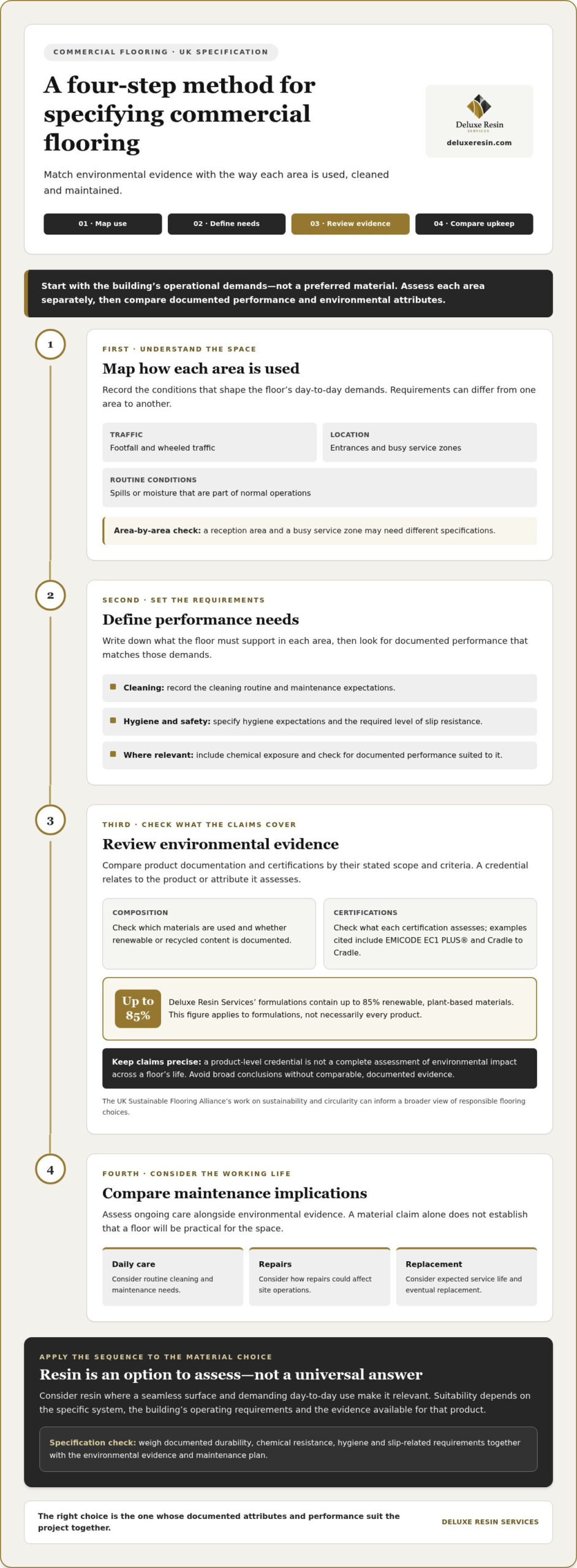
Build the specification around how the space operates, not a preferred material. Use this sequence to compare options for sustainable commercial flooring uk projects, considering operational needs and environmental evidence at each step.
- Map use. Note footfall, wheeled traffic, entrances and areas where spills or moisture are part of normal operations. Requirements may differ between a reception area and a busy service zone, so assess each area separately.
- Define performance needs. Record cleaning routines, hygiene expectations and the required level of slip resistance for each area. Where relevant, include chemical exposure and look for documented performance that matches those demands.
- Review evidence. Compare product documentation and certifications by their stated scope and criteria. The UK Sustainable Flooring Alliance’s work on sustainability and circularity can also inform a broader view of responsible flooring choices.
- Compare maintenance implications. Consider daily care, as well as how repairs or replacement could affect site operations. A lower-impact material claim alone does not establish that a floor will be practical for the space.
How can a floor meet sustainability and performance requirements?
Match the intended use to documented evidence for durability, chemical resistance, hygiene and slip-related requirements. These are project-specific considerations, not qualities to assume across every material or system. Check what each relevant certification assesses and whether its scope covers the product and attribute in question. For demanding environments, this industrial resin flooring guide offers further context on high-performance requirements.
Neither sustainability credentials nor performance claims alone guarantee the right specification. Assess them together against the building’s actual use and maintenance plan. For suitable projects, compare commercial resin flooring options as part of the decision.
Where resin fits in a UK sustainable commercial flooring specification
Resin is worth considering when a commercial space needs a seamless surface that can withstand demanding day-to-day use. Its suitability depends on the specific system, the building’s operating requirements and the evidence available for that product. Environmental credentials matter, but they do not establish that a floor will meet every site’s performance needs.
When should a commercial project consider resin flooring?
Consider resin when a seamless finish and durability suit the way the space is used. An industrial or commercial area with demanding operating conditions, for example, may need a different specification from a lower-traffic workplace. Define the requirements first, including cleaning routines and any slip-related or hygiene considerations. Then assess whether the proposed system has relevant documented performance. Deluxe Resin Services installs industrial resin flooring, and its formulations contain up to 85% renewable, plant-based materials. This figure applies to formulations, not necessarily every product, so weigh it alongside the credentials of the specific system being considered.
To understand how renewable content can feature in resin formulations, explore this bio-based resin floor installation guide. For broader industry context, the Contract Flooring Association sustainability guide can help inform consideration of sustainability in flooring projects.
For a sustainable commercial flooring UK specification, the right choice is the option whose documented attributes and performance suit the project together. If resin fits your commercial space, discuss commercial resin flooring with Deluxe Resin Services. Match the system and its credentials to the installation requirements instead of assuming universal performance or environmental benefits.
Turn your flooring priorities into a considered specification
Turn your sustainability aims into a clear project brief: identify the demands of each area, the performance evidence required and the environmental credentials that matter to your organisation. This gives you a practical reference point for the decision, rather than allowing a single label or design preference to lead the specification. For projects considering resin, Deluxe Resin Services’ formulations contain up to 85% renewable, plant-based materials, and its products hold certifications including EMICODE EC1 PLUS® and Cradle to Cradle. Assess each credential within its relevant product scope and against your project requirements.
Choosing sustainable commercial flooring uk is an opportunity to align the floor with how your workplace functions and your wider environmental priorities. For a commercial resin flooring project, contact Deluxe Resin Services to discuss your requirements. A well-considered brief is a practical first step towards a floor that supports your space and its future plans.
Frequently Asked Questions
Is sustainable commercial flooring durable enough for busy spaces?
Some options can suit busy spaces, but durability depends on the specific system and how it will be used. A reception area with wheeled furniture has different demands from a corridor exposed to frequent deliveries. Compare documented performance with actual traffic, cleaning products and likelihood of impact. Also consider how repairs or replacement would affect ongoing operations.
Is resin flooring considered a sustainable commercial flooring option?
It can be, depending on the formulation, supporting evidence and project requirements. For sustainable commercial flooring uk projects, assess resin alongside other materials rather than assuming its category makes it sustainable. Review documented material credentials and whether the specified system suits the building’s use and maintenance plan. Resin is a stronger fit when environmental evidence and practical requirements align.
Does an environmental flooring certification prove a product is sustainable throughout its life?
No. A certification provides evidence against particular criteria within a defined scope. It does not automatically account for every stage from manufacture through use, maintenance and disposal. Read what the certification assesses and which product it covers. For a broader view, look for lifecycle information addressing the relevant stages rather than treating one credential as proof of total environmental impact.
Can one sustainable flooring material suit every commercial space?
No. A material that works well in a quiet office may not meet the demands of a food preparation area, workshop or public entrance. These spaces can differ in traffic, cleaning methods, moisture exposure and safety needs. Specify by zone: a building may need different flooring systems in separate areas to meet operational requirements while keeping to the overall sustainability brief.