

The apparent shortcut can be the wrong foundation: upgrading from laminate to resin flooring usually isn’t a matter of coating the boards. Laminate is a floating floor and generally doesn’t provide the hard, stable base resin needs. It usually has to be removed so the underlying substrate can be assessed and prepared.
A seamless resin finish can create a clean, contemporary look, but the right choice depends on how the room is used and whether the base is sound. This guide covers suitable finishes for domestic and commercial spaces, how to assess the substrate, and how to decide between repair and replacement.
You’ll also learn how preparation and the demands of the space affect the result, with a comparison of finish options and practical guidance for planning the next step.
Key Takeaways
- Match the resin finish to the room’s use, balancing the look you want with the wear and cleaning demands it will face.
- Before planning an overlay, assess whether the laminate is firm, level and free from moisture damage; a floating floor may not provide a stable resin base.
- Use the extent and cause of lifting, wear or chemical damage to explain whether repair or full replacement is the more practical choice.
- Explore domestic or industrial resin flooring when you’re ready to choose a seamless finish suited to the space and its substrate.
Choosing a finish for domestic or commercial use
For a kitchen or living room, weigh the look you want against cleaning needs and everyday wear. In commercial spaces, consider foot traffic, abrasion and possible chemical spills. A glossy epoxy finish can create a uniform surface, while decorative pigments offer colour options. A UV-stable, abrasion-resistant finish can help an epoxy floor last longer.
A domestic resin finish alone doesn’t determine whether planning or building-control requirements apply. These depend on the work’s scope and the property. Before installation, establish whether the project involves changes beyond the floor surface.
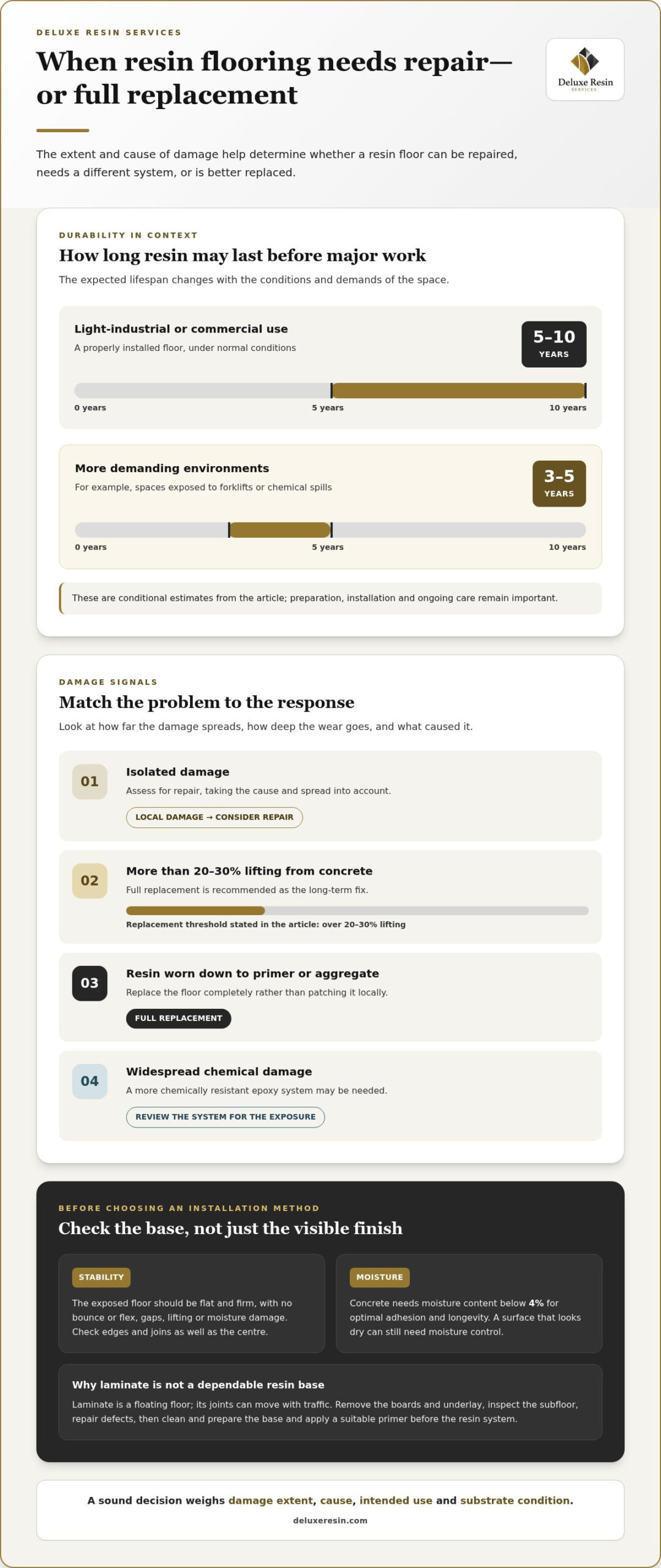
For upgrading, remove the floating laminate and inspect the substrate. Repair and prepare the base, then apply the suitable primer and resin system. Concrete needs moisture content below 4% for optimal adhesion and longevity. Don’t treat a smooth laminate surface as a dependable resin base: poor bonding can lead to peeling or bubbling.
| Finish option | Appearance | Useful consideration |
|---|---|---|
| Gloss epoxy | Shiny, uniform | Highlights light and surface marks |
| Satin epoxy | Soft sheen | More understated appearance |
| Decorative pigment | Coloured finish | Coordinates with room design |
| Flake finish | Patterned surface | Adds visual texture |
| UV-stable finish | Clear or coloured | Helps resist UV-related change |
| Abrasion-resistant finish | Usually smooth | Supports wear resistance |
| Textured finish | Tactile surface | Can improve grip |
| Polyurethane resin | System-dependent | Compare with the space’s demands |
Installation involves preparation, coating and curing, so the time required depends on the substrate and chosen system. The floor can be walked on only after it has cured according to that system’s instructions.
Maintain resin by regularly removing grit and cleaning spills promptly. For slip resistance, choose a textured finish suited to the room. Repair decisions depend on whether the damage is local or widespread.
Choose a finish by balancing appearance, traffic, cleaning needs and the condition of the prepared substrate.
Substrate stability and moisture content
When upgrading from laminate to resin flooring, assess the exposed subfloor before choosing an installation method. Stability and moisture are separate checks, and both affect whether resin can bond properly.
Subfloor stability
Stability means the base stays flat and firm underfoot. Laminate is a floating floor, so its joints can move with traffic, unlike a fixed concrete substrate. Before resin installation, the exposed floor should have no bounce or flex and should be sound, with no gaps, lifting or moisture damage. Check the entire area, including edges and joins, rather than judging only the centre.
Subfloor moisture content
Moisture is a separate check from stability: a firm base can still hold excess water. Epoxy resin flooring requires a substrate moisture content below 4% for optimal adhesion and longevity. Concrete can provide a suitable base when its moisture is controlled. Dampness or swelling in the exposed floor signals a substrate problem, not a cosmetic issue to cover with resin. Moisture control matters even where the surface looks dry.
Laminate removal and preparation
Successful upgrading from laminate to resin flooring starts with lifting the boards and underlay, then inspecting the subfloor. Remove loose residue and debris, identify damage, and repair defects before coating. Stability and moisture checks establish whether the base is suitable; preparation then creates a surface ready for bonding. Grind concrete where needed, clean it thoroughly and apply a suitable primer before the resin system. Dust, gloss and contamination can weaken adhesion, so careful preparation is essential for lasting performance.
Explaining replacement decisions to customers
Base the choice on the floor’s condition, intended use and likely durability. The decision isn’t simply resin versus laminate: consider whether repair or replacement will address the damage.
Resin flooring
Resin can form a seamless protective layer resistant to wear, chemicals and stains, making it suitable for demanding spaces. Its longevity depends on the system and conditions: a properly installed floor in light-industrial or commercial use should last 5-10 years before major work under normal conditions. In demanding environments, such as those exposed to forklifts or chemical spills, it may last closer to 3-5 years. Preparation and ongoing care remain important.
Laminate flooring
Laminate offers a different benefit: it provides a decorative surface without requiring a resin coating. However, its floating construction means it isn’t designed to serve as a resin subfloor. Damaged laminate may therefore make an overlay unsuitable, even if the visible wear seems local. Assess the underlying floor, not just the finish: resin needs a suitable, stable base to perform properly.
For an existing resin floor, use the damage pattern to explain the next step. If more than 20-30% is lifting from concrete, full replacement is recommended as the long-term fix. Resin worn down to primer or aggregate should also be replaced completely, rather than patched locally. Widespread chemical damage may call for a more chemically resistant epoxy system. By contrast, isolated damage can be assessed for repair, taking its cause and spread into account.
Regularly remove abrasive grit and deal with chemical spills promptly to help protect resin. To discuss a replacement suited to the floor’s condition, plan a resin flooring project.
Deluxe Resin Services: Domestic Resin Flooring
Deluxe Resin Services installs Domestic Resin Flooring for homeowners considering a seamless, contemporary alternative to laminate. It’s a natural next step when you’re planning a new finish and want to consider the room’s use, appearance and prepared substrate together.
For a home project, the key question is whether the existing floor can provide a suitable base. Laminate is usually removed before the underlying surface is assessed and prepared for resin. This helps match the flooring choice to the conditions needed for a lasting result.
Deluxe Resin Services also offers Sustainable Resin Solutions. Its products are formulated with up to 85% renewable, plant-based materials and hold certifications such as EMICODE EC1 PLUS® and Cradle to Cradle. These options may suit homeowners who want to consider material impacts alongside finish and function.
Contact Deluxe Resin Services to discuss Domestic Resin Flooring for your project.
Plan your next flooring step
Treat upgrading from laminate to resin flooring as a design decision shaped by how you want the space to work over time. Before choosing a finish, note the room’s priorities, the look you want and what you’d like to improve. Consider how the space is used each day and which finish suits its purpose. This gives your project discussion a clear starting point and connects the surface choice to the room’s needs.
Deluxe Resin Services offers Domestic Resin Flooring, Industrial Resin Flooring and Resin Driveways, giving homeowners and businesses options for different settings.
Move from considering finishes to discussing a practical direction for your project. Contact Deluxe Resin Services today to explore which flooring option fits your plans, and take the next step with confidence.
Frequently Asked Questions
What Flooring Can You Safely Put Over Laminate?
For resin, the safer approach is generally to remove laminate and prepare the stable subfloor underneath. Adding another floor can also affect clearances: typical laminate is around 8 mm thick, and a 5 mm LVT floor with 2 mm underlay above it creates a 15 mm floor-height increase. That may interfere with doors or thresholds, so account for the full build-up.
What lifespan can you expect from an epoxy resin floor?
A properly installed epoxy floor in a light-industrial or commercial space should last 5-10 years before major work under normal conditions. In demanding environments with forklift traffic, dropped tools or chemical spills, it may last closer to 3-5 years. Regularly removing grit, dealing with spills promptly and protecting impact-prone areas can help extend its service life.
Can resin flooring be installed over existing laminate flooring?
Generally, resin shouldn’t be applied directly over laminate. Its smooth, often glossy surface can make bonding difficult, while movement in floating boards can cause peeling, bubbling or uneven curing. For example, a board that flexes underfoot may compromise the coating above it. Removing the laminate lets the underlying substrate be assessed and prepared for the resin system.
What subfloor conditions are required before installing resin flooring?
The base should be flat, firm and free from bounce, gaps, lifting and moisture damage. Concrete needs moisture content below 4% for optimal adhesion and longevity. Cracks may need repair before installation, and the surface requires thorough cleaning and suitable preparation. These checks help distinguish a sound base from one that could undermine the new coating.
What types of resin flooring are suitable for UK homes, such as epoxy or polyurethane?
Epoxy- and polyurethane-based resin flooring systems are both options for homes. Suitability depends on the room, intended use, substrate and desired finish. For example, consider how a kitchen’s cleaning needs differ from a bedroom’s. Domestic resin systems can provide seamless surfaces, with decorative finishes and anti-slip properties tailored to the space. Choose a system for practical needs as well as appearance.