

Why do we invest in bespoke cabinetry and premium worktops only to settle for floor grout that inevitably discolours and harbours bacteria? It’s a frustrating reality for many homeowners who find that traditional tiling eventually undermines the sleek, minimalist aesthetic they’ve worked hard to create. If you’ve ever spent a weekend scrubbing stubborn stains from floor seams, you’ll understand why modern seamless kitchen flooring has become the premier choice for contemporary British homes.
Choosing a resin surface means opting for a perfectly flat, unbroken finish that’s as practical as it is beautiful. You’ll discover how these advanced systems eliminate dirt traps whilst providing a warm, comfortable feel underfoot that works in harmony with modern design. We’ll also examine the impressive eco-credentials of our domestic solutions, which use up to 85% renewable, plant-based materials and hold prestigious EMICODE EC1 PLUS® and Cradle to Cradle certifications. This guide provides everything you need to know about achieving a hygienic, sustainable, and high-end kitchen environment that truly lasts.
Key Takeaways
- Learn why modern seamless kitchen flooring has surpassed traditional tiling as the definitive benchmark for luxury and hygiene in contemporary British homes.
- Understand how the inherent flexibility of resin surfaces provides superior resistance to impact and cracking compared to rigid stone or ceramic alternatives.
- Discover the environmental benefits of bio-based resins; these systems utilise up to 85% renewable plant materials to ensure exceptional indoor air quality.
- Explore how to create a unified, open-plan aesthetic using threshold-free transitions that connect your kitchen and living zones flawlessly.
- Compare the long-term lifecycle value of professional resin installations against the recurring maintenance and cleaning burdens associated with traditional grout lines.
The Evolution of Modern Seamless Kitchen Flooring
The journey of the British kitchen floor has moved from the rustic textures of flagstones and the rigid grids of ceramic tiles toward a more fluid, integrated approach. Historically, flooring was chosen for raw utility; today, it’s a foundational design element. The rise of seamless polymer flooring represents a significant shift in how we perceive domestic space. What began as a high-performance solution for aircraft hangars and surgical suites has been refined into an elegant, domestic surface that defines the modern home.
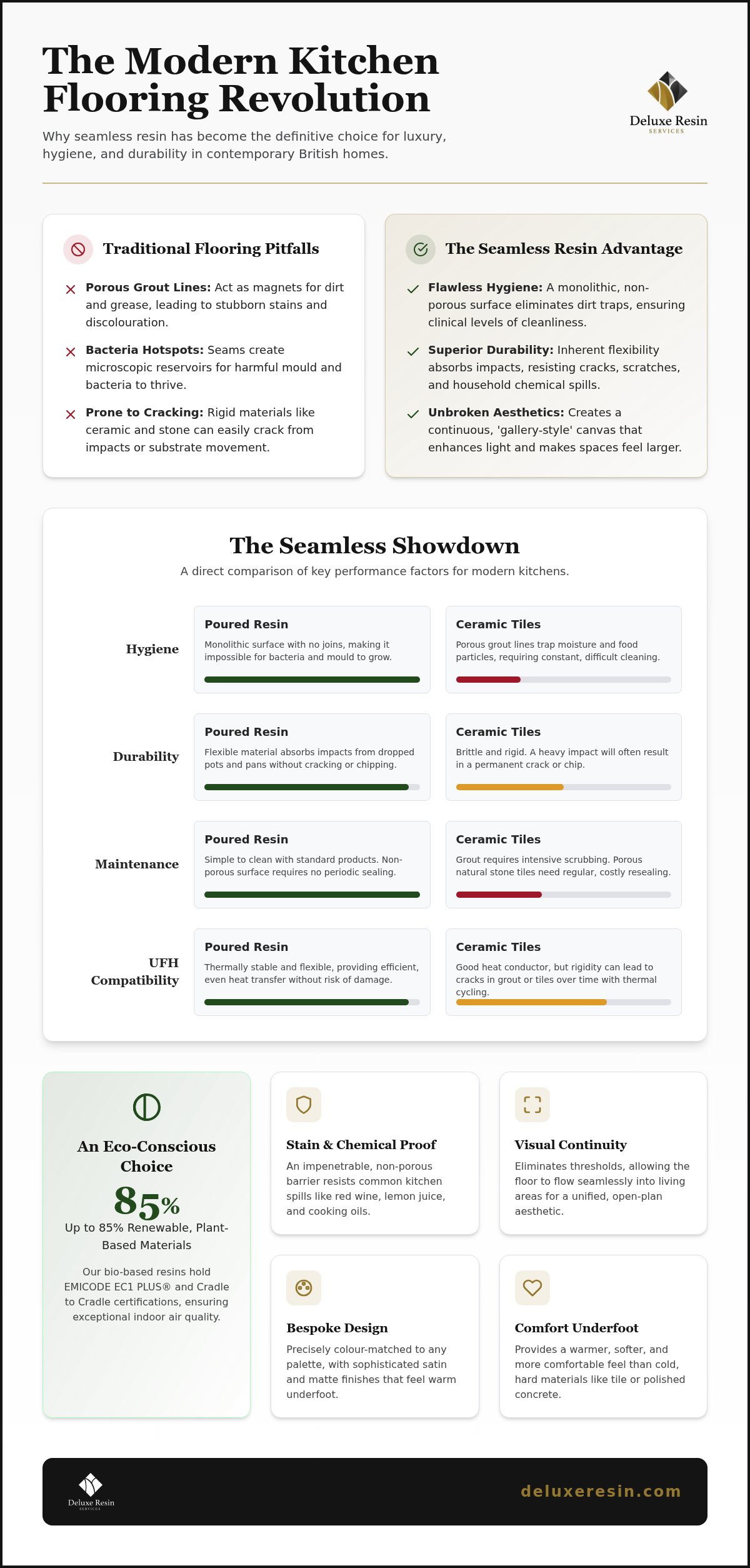
Modern seamless kitchen flooring has transitioned from a niche architectural choice to the definitive benchmark for luxury UK design. This shift isn’t merely about appearance; it’s a response to the inherent failures of traditional materials. Grout lines, no matter how narrow, act as magnets for moisture, grease, and bacteria. By removing these joins, homeowners achieve a level of clinical hygiene that was previously impossible in a residential setting. Modern resin technology has successfully bridged the gap between industrial durability and domestic elegance, offering a surface that’s as resilient as it is refined.
Defining “Truly Seamless” in Interior Design
Many retailers market large-format tiles or luxury vinyl tiles (LVT) as “seamless-look” solutions. However, these systems still rely on mechanical joins or grout. Even the most precise installation leaves microscopic gaps where dirt accumulates over time. A truly seamless floor is poured in situ, creating a monolithic structure that bonds directly to the substrate. Joins are the weak points of any kitchen; they’re where tiles crack and LVT planks eventually lift. An unbroken surface eliminates these vulnerabilities whilst creating a visual “infinity” effect that makes compact British kitchens feel significantly more expansive.
The Aesthetic Appeal of an Unbroken Surface
The visual impact of a poured resin floor is often described as “gallery-style” because of its clean, minimalist profile. Unlike tiles that break the room into a grid, a seamless surface allows the eye to travel across the space without interruption. This provides a neutral, high-end canvas that lets bespoke cabinetry and statement islands take centre stage. For those looking to refresh their existing units to match this premium look, Cabinet refinishing Denver provides an excellent example of how professional refinishing can revitalise a kitchen’s aesthetic. The way light behaves on these surfaces is also distinct. Because there are no recessed grout lines to create shadows, light reflects more uniformly, brightening the entire room and enhancing the sense of volume.
- Bespoke Colour Matching: Surfaces can be precisely pigmented to complement specific kitchen palettes or cabinetry.
- Sophisticated Textures: Modern resins offer satin and matte finishes that avoid a “plastic” look, feeling warm and organic underfoot.
- Visual Continuity: The absence of thresholds allows the floor to flow into adjacent rooms, unifying the home’s architecture.
Performance and Durability: Why Resin Excels in Culinary Spaces
Kitchens are the most demanding environments in any home. Modern seamless kitchen flooring excels here because it’s engineered to withstand the unique pressures of daily culinary activity. Unlike rigid stone or ceramic tiles, which often succumb to hairline fractures when heavy cast-iron cookware is dropped, resin possesses inherent tensile strength. This flexibility allows the material to absorb impact energy rather than dissipating it through a crack; it’s a resilient surface that moves with the house rather than resisting it.
Spills are inevitable in a busy household. Red wine, lemon juice, and cooking oils can permanently etch natural stone or discolour traditional grout. Resin is non-porous by design. It creates an impenetrable barrier that resists common household chemicals and aggressive staining agents. This chemical resilience ensures the floor maintains its pristine appearance for years without the need for the periodic resealing required by timber or stone.
Temperature fluctuations are a constant in British kitchens, from the heat of an oven to the cool air from an open garden door. Resin surfaces are thermally stable. They expand and contract at a rate that prevents delamination or warping. This makes them an ideal partner for underfloor heating systems, as they provide a comfortable, consistent warmth without the risk of the “tenting” often seen with luxury vinyl planks.
Hygiene and Ease of Maintenance
The absence of grout lines is perhaps the most significant functional advantage for a homeowner. In traditional flooring, seams act as microscopic reservoirs for moisture, mould, and food particles. A poured resin surface is entirely non-porous and “wipe-clean.” This eliminates the environment where bacteria and allergens thrive. Maintaining this high-end finish is straightforward; it requires nothing more than a pH-neutral cleanser and a damp mop to ensure the kitchen remains a sterile, safe environment for food preparation.
Safety and Slip Resistance
Safety is paramount in a space where liquids are frequently handled. Many homeowners worry that a smooth, unbroken floor will be slippery when wet. However, professional installations include specific additives to create a subtle “orange peel” texture. These enhance grip without compromising the sleek, modern aesthetic. Our systems are designed to meet rigorous UK safety standards for slip resistance, providing peace of mind even in the busiest households. The same principles that make resin a safe kitchen surface also apply throughout the home; if you’re considering wet areas, our guide to non slip resin bathroom floors covers the essential safety and style checklist for those spaces. If you’re planning a renovation, exploring domestic resin flooring options can help you balance these safety requirements with high-end design.
Resin vs Tiles and Luxury Vinyl: The Seamless Showdown
Whilst porcelain and natural stone have long been the standard for British kitchens, they carry a hidden burden of maintenance that many homeowners only discover after the first year of use. The primary distinction between these traditional materials and modern seamless kitchen flooring lies in the structural integrity of the surface. Tiles are only as durable as the grout that surrounds them. Over time, this grout becomes the point of failure; it absorbs spills, develops hairline cracks, and eventually requires professional re-grouting. Resin, by contrast, is a monolithic system that is poured in situ, creating a single, unbroken layer that bonds directly to your subfloor.
Luxury Vinyl Tile (LVT) is often marketed as a practical alternative, yet it remains a segmented product. Each plank or tile is a potential entry point for moisture. If a dishwasher leaks or a heavy spill occurs, water can seep into the joins, causing the adhesive to fail and the edges to lift. Resin eliminates these vulnerabilities entirely. Whilst the initial investment in a professional resin installation is higher than basic tiling, the lifecycle cost is significantly lower. You aren’t just paying for a material; you’re investing in a permanent architectural feature that won’t require the periodic repairs or deep-cleans associated with modular flooring.
The installation process for resin is a precise craft that involves several layers, including primers and a final decorative coat. Homeowners should plan for a curing period, typically allowing foot traffic after 24 to 48 hours. This time allows the chemical bond to reach full strength, ensuring the floor remains resilient for decades.
The Grout Problem: A Deep Dive
Grout is essentially a porous mortar, making it the least hygienic part of any kitchen. Even the most expensive porcelain tiles are undermined by the “grid” look, which can make a small kitchen feel cluttered and busy. A seamless floor removes this visual noise, creating a clean, expansive canvas. From a financial perspective, the cost of professional steam cleaning and eventual re-grouting often exceeds the one-time premium paid for a high-quality resin surface.
Comfort and Underfoot Feel
One of the most surprising benefits of resin is its thermal property. Unlike stone or polished concrete, which can feel cold and unforgiving, resin is naturally warmer to the touch. It provides a slight “give” that is much kinder to your joints during long periods of standing or cooking. Acoustically, resin is also superior. It dampens the clatter of dropped items and the echo of footsteps, contributing to a calmer, more sophisticated atmosphere in open-plan living spaces. If you’re weighing up your options, our detailed guide on resin flooring vs polished concrete explores these thermal and acoustic differences in depth to help you make the most informed choice for your home.
Design Versatility and Open-Plan Integration
Open-plan living has redefined the British home, turning the kitchen into a multi-functional hub for cooking, dining, and socialising. This architectural shift demands a floor that can traverse different zones without visual interruption. Modern seamless kitchen flooring provides the ideal solution for these expansive layouts. By extending the same unbroken material from the culinary area into the dining and seating zones, you create a cohesive architectural statement that makes the entire floor plan feel more generous and considered.
One of the most significant design advantages of resin is the ability to achieve a threshold-free home. Traditional materials like timber or stone often require unsightly metal expansion strips or height adjustments at doorways. Resin removes these barriers. It creates a perfectly level transition between rooms, which is as much a safety feature as it is an aesthetic one. This level-access approach is particularly beneficial for families with young children or those designing for long-term accessibility. It ensures a fluid movement throughout the ground floor that modular systems simply cannot replicate.
The poured nature of resin also allows for flawless integration with bespoke cabinetry and kitchen islands. Instead of cutting tiles around a complex island base, the resin is installed to meet the plinth with precision. This creates a tailored, “built-in” look that enhances the high-end feel of a designer kitchen. If you are ready to transform your open-plan space, you can request a consultation for domestic resin flooring to explore how these systems can be integrated into your specific layout.
Seamless Flooring and Underfloor Heating
Resin is an exceptional conductor of heat, making it one of the most efficient companions for underfloor heating (UFH) systems. It’s typically installed at a thickness of 2mm to 4mm, which is significantly thinner than stone but far denser than timber. This allows for rapid heat transfer and more responsive temperature control. High-quality resins are also engineered with “breathable” properties that accommodate the subtle movements of the subfloor during heating cycles, preventing the bubbling or delamination often associated with inferior synthetic coatings.
Bespoke Colours and Finishes
The ability to customise the hue and finish of your floor offers unparalleled creative freedom. Whilst industrial greys remain a staple for minimalist designs, the palette is virtually limitless. You can choose a soft matt finish to create a calm, gallery-like atmosphere or a satin sheen to help bounce natural light into darker corners. A lighter tone can significantly increase the perceived volume of a room, whilst deeper, earthy pigments provide a grounding, sophisticated base for modern cabinetry. Each floor is hand-finished, ensuring the final texture perfectly complements your interior vision.
The Bio-Based Advantage: Choosing an Eco-Conscious Floor
Sustainability is no longer a secondary consideration for the discerning UK homeowner; it’s a fundamental requirement. In high-end construction across the country, the focus has shifted toward materials that offer extreme longevity without compromising the planet’s health. Modern seamless kitchen flooring is at the forefront of this movement, specifically through the development of sophisticated bio-resins. These advanced systems replace traditional petroleum-based components with renewable resources such as castor and rapeseed oil. Our domestic formulations utilise up to 85% renewable, plant-based materials, significantly reducing the carbon footprint of your home renovation whilst maintaining the premium performance expected in a luxury setting.
A critical aspect of eco-conscious design is the management of Volatile Organic Compounds (VOCs). In many traditional flooring options, chemical off-gassing can persist for months, affecting the air your family breathes every day. By choosing a low-VOC or VOC-free resin, which contains less than 5 grams per litre of volatile compounds, you ensure a safer indoor environment. This is particularly important in a kitchen setting. Heat from ovens and hobs can often accelerate the release of airborne chemicals from inferior materials, making the choice of a certified, stable surface a vital health consideration.
Indoor Air Quality and EMICODE EC1 PLUS®
The development of these high-performance materials is supported by an international network of technical plastic specialists, such as the fournisseur PTFE france, who distribute the advanced components required for both industrial and high-end domestic applications.
The EMICODE EC1 PLUS® certification is the gold standard for indoor air quality and material safety. It guarantees that the flooring system meets the most stringent international limits for emissions, effectively eliminating the harsh chemical smell that often plagues synthetic installations. For modern, airtight, and energy-efficient homes in the UK, this level of purity is essential. It prevents the accumulation of pollutants in highly insulated spaces, ensuring that your high-end kitchen remains a healthy sanctuary for food preparation and family life. This certification provides a transparent, verifiable proof of quality that goes beyond simple marketing claims.
Cradle to Cradle: A Circular Approach
Investing in Cradle to Cradle certified materials represents a commitment to the circular economy. This framework evaluates products based on five rigorous categories, including material health and product circularity. We organise our sustainable resin projects to minimise environmental impact, ensuring that the materials used are safe for humans and the environment from production through to the end of their lifecycle. Choosing a Cradle to Cradle solution isn’t just a stylish design choice; it’s a responsible investment in a material that has been meticulously audited for its ecological resilience and long-term value. This circular approach ensures that your floor is as kind to the environment as it is beautiful in your home.
Investing in the Future of Your Kitchen Design
Choosing modern seamless kitchen flooring is a definitive step toward a more hygienic, durable, and visually expansive home. You’ve discovered how the transition from modular tiles to monolithic resin surfaces removes the burden of grout maintenance whilst offering a warmer, more ergonomic feel underfoot. Whether you’re unifying a large open-plan diner or seeking a minimalist backdrop for bespoke cabinetry, a poured floor provides a level of architectural continuity that traditional materials simply cannot achieve.
At Deluxe Resin Services, we combine this aesthetic excellence with a deep commitment to environmental stewardship. Our expert UK-wide installation teams utilise systems that are Cradle to Cradle certified and formulated with up to 85% plant-based renewable materials. This ensures your new kitchen is as sustainable as it is stylish. Ready to elevate your interior with a surface that truly lasts? Request a bespoke quote for your modern kitchen project from Deluxe Resin Services and take the first step toward a flawlessly finished home.
Frequently Asked Questions
Is seamless resin flooring suitable for a family kitchen with pets?
Yes, resin is exceptionally resilient to pet claws and heavy footfall. Its non-porous surface ensures that accidents don’t soak into the material, preventing permanent odours or stains. Unlike timber, it won’t scratch easily or warp when exposed to water bowls. The seamless nature also means pet hair and dander have nowhere to hide, making it a far more hygienic choice for households than carpet or traditional tiles with deep, porous grout lines.
How long does it take to install modern seamless kitchen flooring?
A professional installation of modern seamless kitchen flooring typically takes between three and five days. This meticulous process involves surface preparation, priming, pouring the resin layers, and applying a protective seal. Whilst the floor is usually dry enough for light foot traffic after 48 hours, it requires a full week to achieve maximum chemical resistance. Planning for this curing period ensures the longevity and performance of the finish in a demanding culinary environment.
Can resin flooring be applied over existing kitchen tiles?
Resin can often be applied over existing tiles provided they are structurally sound and firmly bonded to the substrate. Our specialists will first grind the tile surface to create a mechanical key and apply a high-strength primer to ensure perfect adhesion. If tiles are loose or damaged, they must be removed to prevent movement from telegraphing through the new surface. This approach can save significant time and disruption during a major kitchen renovation.
Is a seamless resin floor slippery when wet?
Modern resin floors are designed with safety in mind and are not inherently more slippery than other hard surfaces like polished stone. To enhance grip, we incorporate specific non-slip additives or create a subtle texture during the final coating phase. This ensures the floor complies with stringent UK safety regulations for slip resistance, providing a secure surface for your family even when dealing with the inevitable spills and splashes that occur in a busy kitchen. The same approach to safety applies across all wet areas of the home; our comprehensive guide on non slip resin bathroom floor options explores how these principles extend to one of the most hazard-prone rooms in any household.
Does resin flooring work with underfloor heating systems?
Yes, resin is one of the most efficient materials to use alongside underfloor heating. Its excellent thermal conductivity allows heat to radiate quickly into the room, reducing energy consumption. Because the material is flexible, it accommodates the thermal expansion and contraction of heating cycles without cracking. This combination provides a consistent warmth that enhances the premium feel of a modern seamless kitchen flooring installation, making it a practical choice for contemporary British homes.
How do I clean and maintain my seamless kitchen floor?
Maintenance is remarkably simple due to the absence of grout lines and joins. Daily cleaning requires only a soft brush or vacuum followed by a damp mop using a pH-neutral cleanser. You should avoid aggressive scouring pads or bleach-based products, as these can dull the protective topcoat over time. For high-traffic areas, a periodic professional polish can refresh the surface, ensuring your kitchen remains a pristine and hygienic environment for food preparation and socialising.
Will a resin floor crack if the house settles?
High-quality resin systems possess inherent flexibility, allowing them to bridge minor movement and vibrations that would cause rigid tiles to crack. Whilst no material is entirely immune to extreme structural shifts, resin’s tensile strength provides a significant advantage in newer builds or period properties prone to subtle settling. If significant movement is anticipated, we can incorporate specific flexible membranes to ensure the surface remains unbroken and visually flawless, providing long-term peace of mind for homeowners.
Is resin flooring more expensive than high-quality kitchen tiles?
The initial investment for a professionally installed resin floor is often comparable to premium porcelain or natural stone. However, when you factor in the costs of specialist adhesive, grout, and the intensive labour required for tiling, the price gap narrows. Resin offers superior long-term value by eliminating the need for re-grouting and professional deep cleaning. It represents a permanent architectural feature that maintains its high-end aesthetic and functional integrity far longer than traditional modular alternatives.