

What if the most sophisticated design choice you make this year isn’t about colour or texture, but about the molecular composition of the air you breathe? You’ve likely felt the frustration of choosing between a high-end, seamless aesthetic and the nagging worry about volatile organic compounds (VOCs) affecting your indoor air quality. It’s a common dilemma, yet a professional bio based resin floor installation now offers a compromise-free path to luxury in 2026.
In this guide, you’ll discover how plant-based biopolymers, formulated with up to 85% renewable materials, are redefining premium interiors through superior durability and industry-leading certifications like EMICODE EC1 PLUS®. We’ll explore the technical reality of these sustainable systems, their long-term ROI, and the precise installation process that ensures your home remains both a designer masterpiece and a healthy sanctuary for your family.
Key Takeaways
- Discover how biopolymers derived from renewable feedstocks like castor oil are replacing traditional petrochemicals to create a more sustainable luxury finish.
- Learn why a professional bio based resin floor installation involves a sophisticated multi-layer system to achieve maximum durability and moisture resistance.
- Understand the significance of the EMICODE EC1 PLUS® certification and how it ensures your chosen flooring meets the highest standards for indoor air quality.
- Identify the practical benefits of choosing sustainable resin solutions that offer both a seamless designer aesthetic and a significantly reduced environmental impact.
The Biopolymer Revolution: Why Bio-Based Resin Flooring is Trending in 2026
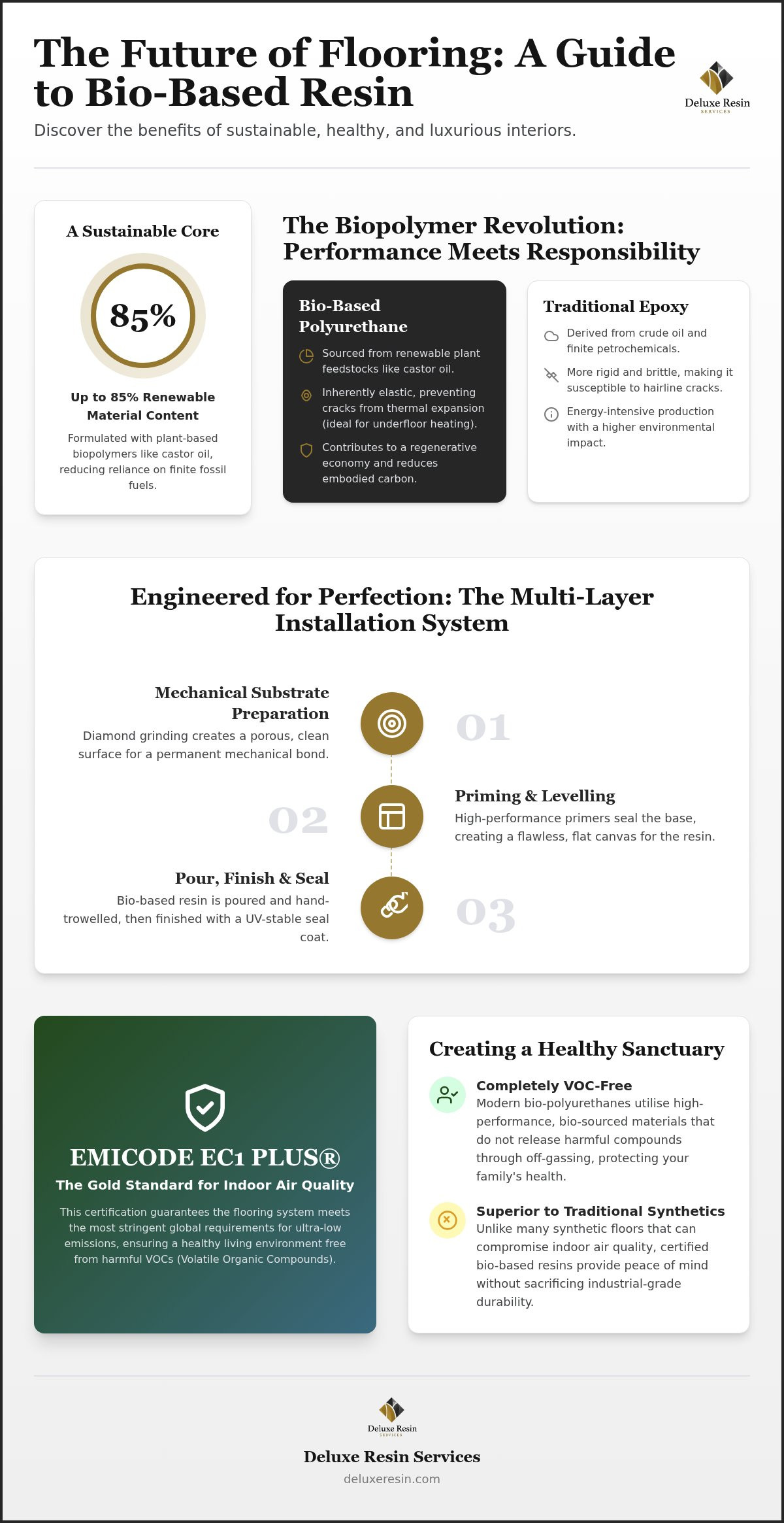
The UK luxury interior market is undergoing a fundamental shift towards ethical specification. In 2026, a professional bio based resin floor installation is no longer a niche choice but a technical benchmark for designers who refuse to compromise on aesthetics or ecological responsibility. This transition reflects a wider market move away from traditional, crude-oil derived epoxies towards sophisticated, sustainable polyurethane systems. Bio-based resin is a high-performance floor system where up to 85% of the polymer content is sourced from renewable plant materials. By utilising Biopolymers, these surfaces provide the seamless, minimalist aesthetic favoured in high-end residential projects whilst actively reducing the embodied carbon of the building.
The Environmental Impact of Renewable Feedstocks
The primary feedstock for these innovative systems is castor oil, harvested from beans that thrive on marginal land. This is a critical distinction; these crops don’t compete with food production or necessitate the clearing of ancient forests. Whilst the production of traditional synthetic resins is energy-intensive and relies on finite fossil fuels, plant-based alternatives benefit from natural carbon sequestration during the growth cycle of the crop. This makes a bio based resin floor installation a cornerstone of circular design within modern UK architecture. It allows homeowners to invest in a durable, industrial-grade surface that supports a regenerative economy. By choosing materials that are as technically resilient as they are environmentally sound, the industry is proving that luxury and sustainability are finally synonymous. Homeowners looking to understand the full scope of plant based resin flooring benefits will find that these systems can reduce a home’s flooring carbon footprint by up to 96% compared to traditional petroleum-based alternatives.
Professional Bio-Based Resin Floor Installation: A Multi-Layer System
A successful bio based resin floor installation isn’t a simple single-coat application; it’s a meticulously engineered multi-layer system designed for decades of high-performance use. These advanced biopolymer materials are currently Transforming Architecture by providing a seamless floor canvas that’s both resilient and visually striking. Whilst traditional epoxy can be brittle, the inherent elasticity of bio-polyurethane makes it the superior choice for modern UK homes featuring underfloor heating. It naturally accommodates thermal expansion and contraction, preventing the hairline cracks often seen in more rigid materials. To achieve this level of technical excellence, a professional bio based resin floor installation requires the expertise of domestic resin flooring specialists who can accurately manage substrate preparation and moisture testing.
The Critical Stages of a Seamless Installation
The journey to a perfect floor follows a highly structured sequence to ensure the material performs as intended:
- Mechanical Substrate Preparation: We utilise diamond grinding to remove surface contaminants and open the substrate’s pores, ensuring a permanent mechanical bond with the biopolymer.
- Priming and Levelling: High-performance primers seal the base, whilst dedicated levelling layers create a flawless, flat canvas for the resin pour.
- The Decorative Pour and Finishing: The bio-based resin is poured and hand-trowelled to your specific requirements. We finish with a technical, UV-stable seal coat that ensures the colour remains vibrant and resists yellowing, even in sun-drenched rooms.
This methodical approach guarantees a surface that’s as safe as it is beautiful. The same high-performance principles that govern domestic installations also underpin the work of industrial resin flooring contractors, where durability, safety compliance, and minimal disruption are equally paramount. For homeowners extending their commitment to premium resin surfaces beyond the interior, working with trusted resin bound driveway installers UK specialists ensures the same rigorous standards of material science and craftsmanship are applied to your exterior spaces. If you’re ready to upgrade your interior, you can explore our sustainable resin solutions to find the perfect fit for your project.
Health Standards and Certifications: EMICODE EC1 PLUS® and Beyond
When planning a bio based resin floor installation, the primary concern for many homeowners is the long-term safety of their living environment. It’s a critical consideration; traditional synthetic floors often release volatile organic compounds (VOCs) through a process known as off-gassing. Modern bio-polyurethanes solve this by utilising high-performance bio-sourced materials that are completely VOC-free. This shift ensures that your interior remains a healthy sanctuary without compromising on the industrial-grade durability required for busy domestic spaces.
In 2026, the EMICODE EC1 PLUS® label has become the non-negotiable benchmark for premium UK interiors. This certification indicates that a flooring system meets the most stringent global requirements for ultra-low emissions. When combined with Cradle to Cradle certification, which assesses a product’s safety for human health and the environment across its entire lifecycle, you gain a floor designed for a waste-free future. These independent verifications provide the transparency needed to distinguish genuine sustainable innovation from surface-level marketing.
Improving Indoor Air Quality with VOC-Free Solutions
VOCs are carbon-based chemicals that evaporate easily at room temperature, often leading to poor indoor air quality. Whilst older resin technologies might have carried a chemical scent, bio-based systems contribute to a significantly cleaner atmosphere. This is particularly beneficial for families with allergies or respiratory sensitivities. Rather than relying on vague eco claims, you should always insist on seeing official third-party certification. The same rigorous standards that apply to residential spaces are equally critical in commercial environments, where specialist industrial resin flooring contractors must meet stringent HSE and hygiene requirements. For a deeper understanding of how to separate genuine performance from marketing claims, our guide on VOC free resin flooring for homes: myth vs reality clarifies exactly what certifications to look for and why they matter. A professional bio based resin floor installation ensures that your designer aesthetic is supported by a healthy, breathable foundation that protects your family for years to come.
Investing in a Healthier, More Sustainable Home
Choosing a bio based resin floor installation is a commitment to both high-end design and long-term environmental stewardship. By moving away from traditional petrochemicals, you’re investing in a sophisticated biopolymer system formulated with up to 85% renewable materials. These surfaces don’t just look exceptional; they actively protect your indoor air quality through certified EMICODE EC1 PLUS® and Cradle to Cradle standards. Whether you’re renovating a minimalist kitchen or an expansive living area, our technical expertise ensures a seamless finish that’s as durable as it is responsible.
It’s time to redefine your interior with a floor that prioritises your family’s health without compromising on style. Explore our sustainable resin flooring solutions and request a professional consultation today. We’re ready to help you create a beautiful, future-proof home that reflects your values and your vision for a cleaner, safer planet.
Frequently Asked Questions
Is bio-based resin flooring as durable as traditional epoxy?
Bio-based resin systems are exceptionally durable and often outperform traditional epoxy in domestic settings. Whilst epoxy is famously hard, it can be brittle and prone to cracking under impact. A professional bio based resin floor installation offers greater flexibility, allowing the surface to absorb impacts and accommodate structural shifts without losing its seamless integrity or premium visual appeal.
How long does a bio-based resin floor installation take to complete?
A professional bio based resin floor installation typically requires between four and six days to complete. This timeframe allows for the meticulous application of multiple layers, including mechanical substrate preparation, priming, the main decorative pour, and protective seal coats. Each stage must cure correctly to ensure the long-term performance and durability expected of a sustainable flooring solution.
Can plant-based resin floors be installed over underfloor heating?
These systems are perfectly suited for use with underfloor heating. Unlike rigid materials that might crack when subjected to thermal expansion, the inherent elasticity of bio-polyurethane allows it to expand and contract naturally as temperatures fluctuate. This flexibility ensures a consistent, seamless surface that remains stable and comfortable underfoot whilst maintaining excellent thermal conductivity throughout your home.
What is the maintenance routine for a sustainable seamless floor?
Maintaining your sustainable resin floor is remarkably straightforward. The seamless nature of the surface means there are no grout lines or joins where dirt can accumulate. A regular routine of sweeping or vacuuming, followed by mopping with a pH-neutral cleaner, is usually all that’s required. It’s best to avoid abrasive tools or harsh chemicals to preserve the protective UV-stable seal coat.