
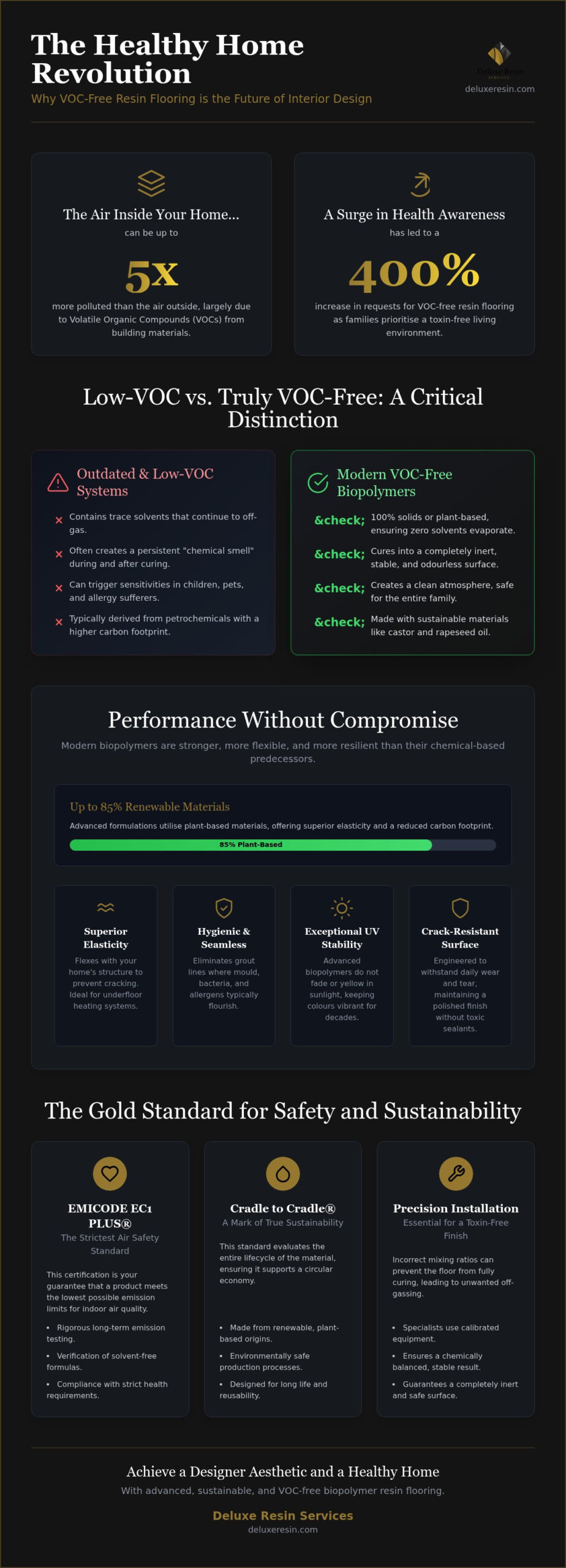
Did you know the air inside your home can be up to five times more polluted than the air outside? Much of this invisible burden stems from off-gassing materials, which explains the 400% increase in requests for VOC free resin flooring homes as families prioritise their health. It’s natural to feel concerned that a “new floor smell” is actually a cocktail of hidden toxins, or to worry that sustainable alternatives won’t withstand the rigours of a busy household.
You shouldn’t have to choose between a designer aesthetic and your family’s wellbeing. This article explores how advanced plant-based biopolymers deliver both a luxury finish and a healthy living environment. We’ll clarify the distinction between low-VOC and truly VOC-free systems, whilst highlighting safety certifications like EMICODE EC1 PLUS and the performance of floors made with up to 85% renewable materials.
Key Takeaways
- Understand the impact of Volatile Organic Compounds on indoor air quality and how modern resin systems eliminate the traditional “chemical smell” whilst curing.
- Discover why VOC free resin flooring homes utilise plant-based biopolymers to achieve a high-end finish that is both flexible and exceptionally durable.
- Learn how professional installation and precise mixing ratios are essential to ensuring your new surface remains completely toxin-free.
- Identify key safety benchmarks like Cradle to Cradle and EMICODE EC1 PLUS to verify the long-term environmental credentials of your flooring choice.
The Truth About VOC-Free Resin Flooring for Homes
Modern UK homes are increasingly designed for energy efficiency, resulting in highly airtight environments. Whilst this preserves heat, it also traps Volatile Organic Compounds (VOCs), which are gases emitted from synthetic building materials. Many homeowners fear that resin floors will release a persistent chemical odour, yet this is a misconception based on outdated industrial products. High-specification VOC free resin flooring homes use modern biopolymers that cure without the aggressive off-gassing associated with solvent-based epoxies. These surfaces are designed to be inert once installed, creating a clean and odourless atmosphere.
Distinguishing between ‘low VOC’ and ‘zero VOC’ is vital for long-term respiratory health. Low-VOC products still contain trace solvents that can trigger sensitivities in children or pets. In contrast, zero-VOC systems rely on 100% solids or plant-based formulations, ensuring no solvents evaporate into your living space. These biopolymers, often derived from castor or rapeseed oil, represent a significant transition from petrochemical reliance to sustainable innovation. Investing in VOC free resin flooring homes ensures that your interior design doesn’t compromise your family’s lung health.
Why EMICODE EC1 PLUS® is the Gold Standard for Air Quality
EMICODE EC1 PLUS® is the strictest European standard for indoor air safety. This certification guarantees that a product meets the lowest possible emission limits, providing a transparent benchmark for safety. It focuses on several key areas:
- Rigorous testing for long-term emission behaviour.
- Verification of solvent-free formulations.
- Compliance with environmental health requirements.
Beyond air quality, plant-based resin flooring benefits include a significantly reduced carbon footprint and a Cradle to Cradle lifecycle. Choosing a certified system ensures your luxury floor supports a healthy, sustainable home environment.
Debunking the Durability Myth: Are VOC-Free Floors Weaker?
A common misconception persists that for a floor to be durable, it must rely on harsh chemical solvents. Many believe that removing these components makes the resin brittle or soft; yet the reality in 2026 is quite the opposite. Advanced VOC free resin flooring homes utilise formulations containing up to 85% renewable, plant-based materials. These biopolymers offer a significant structural advantage: elasticity. Unlike traditional industrial epoxies, which are designed for static loads and can be prone to cracking, plant-based systems flex naturally with your home’s structural movements. This inherent durability is why VOC free resin flooring homes are increasingly favoured for high-traffic domestic areas, and why they are a particularly smart choice when selecting sustainable flooring for new builds where airtight construction demands the lowest possible emissions.
This flexibility makes them the ideal choice for resin flooring for underfloor heating. As temperatures fluctuate, the floor expands and contracts without the risk of hairline fractures. Beyond structural integrity, the seamless nature of these surfaces eliminates the grout lines where allergens and mould typically flourish amongst traditional tiles. By reducing the impact on indoor air quality, these floors create a sterile, luxury environment that is as tough as it is healthy. If you’re planning a renovation, you can consult with our domestic resin flooring specialists to ensure your project meets these high performance standards.
The Performance Advantages of Biopolymer Technology
Modern biopolymers have solved the yellowing issue that plagued older resin systems. Whilst traditional resins often fade or discolour when exposed to sunlight, plant-based systems boast exceptional UV stability. This ensures your chosen colour palette remains vibrant for decades. These floors don’t just survive daily wear; they thrive in it, providing a crack-resistant surface that maintains its polished finish without the need for toxic sealants.
Choosing and Installing VOC-Free Resin Flooring Safely
Achieving a truly healthy environment with VOC free resin flooring homes depends heavily on the precision of the installation process. Whilst the materials themselves may be certified, incorrect mixing ratios can prevent the chemical reaction from reaching full completion. This leaves unreacted components within the floor’s structure, which may lead to the very off-gassing you are trying to avoid. Professional specialists use calibrated equipment to ensure every batch is chemically balanced, resulting in a stable, inert surface that won’t compromise your indoor air.
When selecting a contractor, look for Cradle to Cradle certified floors. This standard evaluates the entire lifecycle of the material, from its renewable origins to its eventual recyclability. Don’t hesitate to ask for physical copies of EMICODE or Health Product Declarations (HPDs). A reputable partner will welcome your scrutiny and provide clear evidence of their sustainability claims rather than relying on vague marketing terms. They should be able to demonstrate exactly how their products meet the rigorous standards expected in 2026, including the latest benchmarks outlined in our sustainable flooring for new builds eco-luxury guide.
Why a Professional Finish Outperforms DIY Kits
DIY resin kits frequently lack the sophisticated biopolymer chemistry found in premium systems. These retail products often contain higher levels of unreacted monomers, which can leach into your home for months. Choosing bio-based resin floor installation by trained experts ensures the floor is fully cured and safe from the moment it’s finished. To maintain this VOC free resin flooring homes environment, always use pH-neutral, eco-friendly cleaning agents. Harsh chemical cleaners can strip the surface and introduce the very toxins you’ve worked so hard to eliminate.
Transform Your Home with Sustainable Luxury
Choosing the right surface for your living space is a significant decision that impacts both your interior aesthetic and your family’s health. We’ve established that modern VOC free resin flooring homes don’t just mimic industrial strength; they surpass it through superior elasticity and UV stability. By opting for formulations with up to 85% renewable plant-based content, you’re investing in a floor that is as kind to the environment as it is to your indoor air quality.
Ensuring long-term safety requires looking for rigorous certifications like EMICODE EC1 PLUS® and Cradle to Cradle certified floors. These benchmarks provide the peace of mind that your luxury finish is truly inert and sustainable. If you’re ready to elevate your interior with a seamless, toxin-free solution, enquire about a VOC-free luxury resin floor for your home today. Creating a healthy, beautiful sanctuary for your family has never been more achievable.
Frequently Asked Questions
Is VOC-free resin flooring safe for babies and pets?
Yes, VOC free resin flooring homes are exceptionally safe for babies and pets. Because these systems are EMICODE EC1 PLUS® certified, they don’t release harmful emissions into your living space. The seamless, non-porous finish also prevents the accumulation of dust mites and pet dander. This makes it a superior choice for households prioritising respiratory health and a hypoallergenic environment.
How long does VOC-free resin take to cure before I can move back in?
You can usually walk on the surface in socks after 24 to 48 hours. However, the floor requires a full seven days to achieve a complete chemical cure. During this initial week, it’s best to avoid placing heavy furniture or using water for cleaning. This steady curing process ensures the biopolymers reach their maximum durability and remain entirely inert for the duration of their lifespan.
Does VOC-free resin flooring smell during the installation process?
Unlike traditional solvent-based epoxies, VOC free resin flooring homes do not produce a strong chemical odour whilst being installed. You might notice a very faint, neutral scent during the application, but it isn’t the aggressive “new floor smell” that causes headaches. This allows for a much more comfortable renovation experience, as the air remains clear and safe for occupants throughout the professional installation.
Can I use VOC-free resin over my existing underfloor heating?
Yes, sustainable resin solutions are perfectly compatible with underfloor heating systems. The material’s inherent elasticity allows it to expand and contract with temperature changes without cracking. Additionally, resin is an excellent thermal conductor, which helps to distribute heat evenly across the room. This combination provides a luxury finish that remains comfortable underfoot whilst maintaining the high energy efficiency of your modern UK home.