

Why settle for “standard” developer-grade vinyl when your new home is engineered for the future? Moving into a bespoke property is a significant milestone, yet the reality of low-quality synthetic finishes often feels like a compromise. You’ve likely felt the frustration of choosing between aesthetics and air quality, especially whilst worrying about how airtight construction might trap harmful emissions. Selecting the right sustainable flooring for new builds is no longer just a design choice; it is a vital step in ensuring your environment is as healthy as it is beautiful.
We understand that you want a home that breathes. This guide demonstrates how to elevate your project with high-performance, bio-based flooring that pairs premium seamless aesthetics with 2026 sustainability standards. You will discover how to maximise your underfloor heating efficiency, navigate subfloor moisture challenges, and achieve a VOC-free finish that adds genuine property value.
Key Takeaways
- Understand how the Future Homes Standard and modern airtightness requirements necessitate breathable, low-emission materials to maintain a healthy indoor environment.
- Learn why bio-based resin outperforms developer-standard LVT, providing a premium option for sustainable flooring for new builds that eliminates PVC and reduces carbon footprints.
- Discover how to maximise the efficiency of heat pumps and underfloor heating systems through the superior thermal conductivity of seamless, plant-based flooring.
- Identify the critical installation windows and professional subfloor preparation techniques required to achieve a flawless, high-value finish on new concrete or screed.
Navigating 2026 UK New Build Standards for Sustainable Flooring
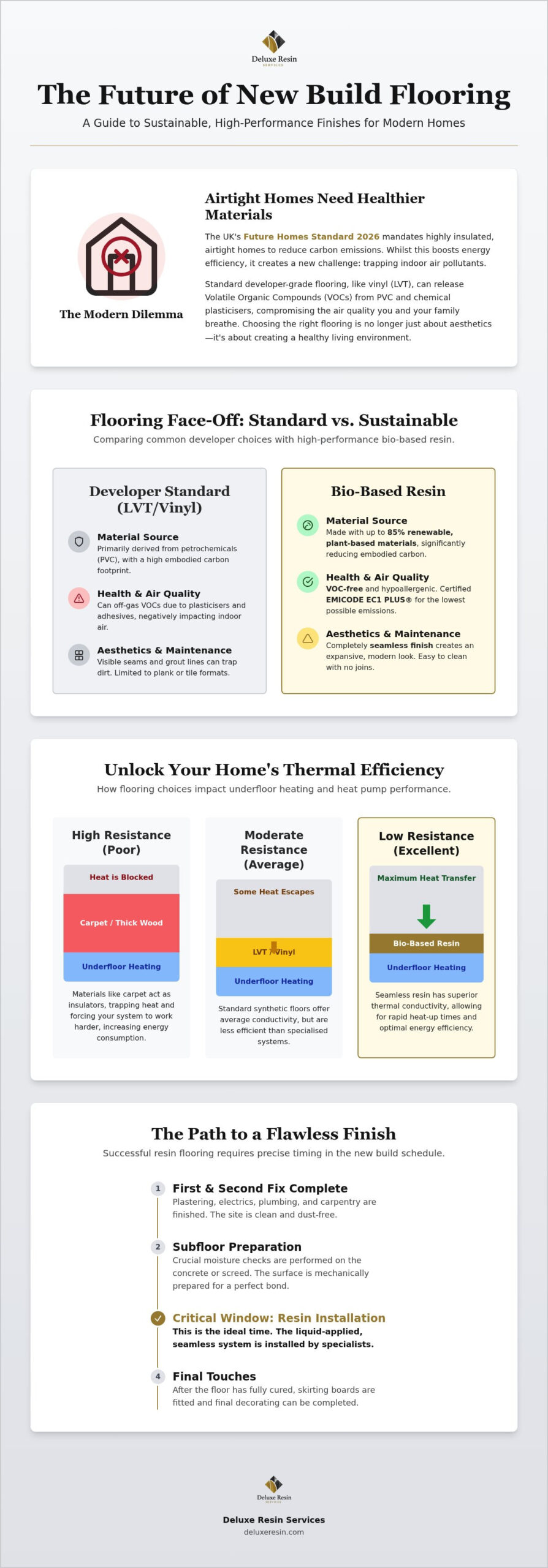
The 2026 UK building landscape is shaped by the Future Homes Standard and updated Part L regulations. These frameworks mandate a significant reduction in carbon emissions, which influences every material choice from the foundations to the final finishes. For those specifying sustainable flooring for new builds, the focus has shifted towards the building envelope’s overall performance. In modern, airtight homes, selecting materials that support healthy indoor air quality is vital to avoid the buildup of volatile organic compounds. It’s a balance between high-performance insulation and the need for a breathable, non-toxic living environment.
Seamless resin systems are now a preferred choice for open-plan new build designs, providing an uninterrupted aesthetic that traditional planks or tiles cannot match. This lack of joins creates a sense of expansive space whilst simplifying long-term maintenance. In this high-performance environment, thermal conductivity is the most critical metric for 2026 flooring choices because it dictates the energy efficiency and response time of the entire heating circuit.
Thermal Efficiency and Underfloor Heating Compatibility
The thermal resistance, or R-value, of your floor determines how hard your heat pump must work to reach the desired temperature. When evaluating sustainable flooring materials, bio-based resin stands out for its superior conductivity compared to engineered wood or carpet. These plant-based systems allow for rapid heat-up times and consistent temperature control, which is essential for the low-flow temperatures of air-source heat pumps. By choosing a material that acts as a thermal mass rather than an insulator, you ensure that heat is transferred directly into the room. This reduces energy consumption and ensures the home remains at a stable, comfortable temperature throughout the year.
Comparing Sustainable Flooring Materials: Beyond Developer Standards
Standard developer upgrades often include Luxury Vinyl Tile (LVT) or vinyl. While these materials are durable, they frequently fail to meet the highest sustainability criteria due to high PVC content and chemical plasticisers. For homeowners seeking genuine sustainable flooring for new builds, it’s essential to look beyond these synthetic defaults. The plant-based resin flooring benefits extend far beyond aesthetics, directly reducing a project’s embodied carbon through the use of up to 85% renewable materials. Unlike traditional synthetic resins derived entirely from petrochemicals, bio-based systems utilise plant-derived components to create a more circular product lifecycle.
Identifying authentic eco-credentials requires scrutiny of third-party certifications. The UK Sustainable Flooring Alliance highlights that rigorous standards like Cradle to Cradle and EMICODE EC1 PLUS® are the benchmark for material health. These labels ensure that a product is responsibly sourced and safe for long-term domestic use. If you are aiming for a truly eco-luxury finish, you might explore our sustainable resin solutions as a superior, low-impact alternative to mass-produced plastics.
The Bio-Based Advantage: VOC-Free Living and Air Quality
Modern new builds are designed to be exceptionally airtight to conserve energy. This efficiency makes VOC-free resin flooring for homes a necessity rather than a luxury. Without natural ventilation, off-gassing from low-quality materials can quickly degrade indoor air quality. EMICODE EC1 PLUS® certification guarantees the lowest possible emissions, fostering a healthier environment. Additionally, the seamless nature of resin eliminates the grout lines and fibres where dust mites and allergens typically accumulate, providing a hypoallergenic surface that supports long-term wellbeing.
Implementing Sustainable Resin Flooring in Your New Build Project
Successful integration of sustainable flooring for new builds requires precise timing within the construction programme. Whilst timber requires weeks of onsite acclimatisation, resin is a liquid-applied system that demands a specific “critical installation window”. It’s typically the final internal trade to enter the site, ensuring the seamless finish isn’t compromised by other contractors. We can organise bio-based resin floor installation to align with your developer’s handover schedule, typically following the second-fix carpentry but before final decorating. To ensure a successful bond, you must check subfloor moisture levels using a calibrated hygrometer to confirm readings are below 75% relative humidity (RH) before application.
Managing the Subfloor and the Critical Drying-Out Period
New-build properties inevitably settle during their first year. Unlike rigid tiles that may crack under stress, flexible polyurethane resin accommodates minor structural movements without surface failure. Co-ordinating with your developer is essential to ensure the concrete or screed is prepared to a power-floated or smoothed standard. When comparing various sustainable flooring materials, the inclusion of a high-performance damp-proof membrane (DPM) is a non-negotiable step for ground floors. This barrier protects the premium finish from residual construction moisture as the slab continues its drying-out period. Professional subfloor preparation ensures that the final result is a perfectly level, high-value asset for your new home. It’s a meticulous process that transforms a standard construction site into a refined living space. This methodical approach to sustainable flooring for new builds guarantees durability and aesthetic excellence from the moment you move in.
Elevating Your New Home with Future-Proof Flooring
Transitioning into a bespoke property offers a unique opportunity to define your living environment from the ground up. By selecting sustainable flooring for new builds that exceeds current 2026 regulations, you invest in long-term thermal efficiency and superior indoor air quality. We provide Cradle to Cradle Certified® solutions formulated with up to 85% plant-based materials, ensuring your home remains a healthy, VOC-free sanctuary. Our expert team provides national installation across the UK, co-ordinating directly with your developer to manage the critical drying-out period and subfloor preparation. This meticulous approach guarantees a seamless, high-end aesthetic that perfectly complements the modern architecture of your new home.
Contact our sustainable flooring specialists to discuss your new build project today. Your vision for a responsible, luxury interior is within reach.
Frequently Asked Questions
Is resin flooring more sustainable than engineered wood for a new build?
Resin systems formulated with up to 85% renewable, plant-based materials often provide a lower carbon footprint than engineered woods that rely on synthetic glues and high-energy manufacturing. While wood is a traditional choice, bio-based resin offers superior thermal mass for energy-efficient homes. This makes it a highly effective sustainable flooring for new builds, as it balances renewable origins with exceptional long-term durability and heating performance.
Can I install sustainable resin flooring over underfloor heating in a new home?
Yes, bio-based resin is one of the most effective materials to pair with modern underfloor heating systems. Its high thermal conductivity ensures that heat is transferred rapidly and evenly into the living space, which is vital for the low-flow temperatures used by air-source heat pumps. Unlike timber or carpet, which can act as insulators, resin allows your heating system to operate at maximum efficiency.
How long does a new build subfloor need to dry before resin flooring can be installed?
The drying time depends on the thickness and type of screed used, but a subfloor must reach a relative humidity of 75% or lower. Traditional sand and cement screeds typically dry at roughly 1mm per day for the first 50mm. We always conduct professional moisture testing using a hygrometer before application. If the build schedule is tight, we can utilise damp-proof membranes to safely accelerate the process.
Are bio-based resin floors durable enough for high-traffic areas like kitchens and hallways?
Bio-based resin floors are exceptionally durable and specifically engineered to withstand the rigours of high-traffic domestic environments. Their seamless, non-porous surface is resistant to impacts, spills, and scratches, making them ideal for busy kitchens and hallways. Because there are no grout lines or joins, the floor is incredibly easy to clean. This ensures your investment in sustainable flooring for new builds retains its premium aesthetic for decades.