
Could the traditional driveway you’ve always admired actually be the source of your most persistent home maintenance headaches? For many homeowners, the classic charm of bricks is quickly overshadowed by the relentless chore of digging out weeds from sand joints or the frustration of watching puddles form after a heavy British downpour. You likely want a front entrance that reflects the quality of your home without requiring constant labour just to maintain its appearance. We understand that a driveway should be a high-performance engineering solution whilst serving as a stylish design choice for your property.
Deciding between resin bound vs block paving is a significant investment that impacts both your property’s kerb appeal and its long-term market value. This guide compares these two surfaces to help you choose a solution that balances durability with a premium, seamless aesthetic. We’ll examine how modern, eco-conscious resin systems provide a sustainable, SuDS-compliant alternative to traditional paving, ensuring your driveway remains perfectly level and puddle-free for years to come.
Key Takeaways
- Understand the technical composition of each surface to predict how they will perform under daily vehicle use over the next decade.
- Compare the maintenance profiles of resin bound vs block paving to understand which solution effectively eliminates weed growth and joint instability.
- Learn about the environmental benefits of using certified, plant-based materials that offer a sustainable alternative to concrete-heavy paving.
- Discover how a seamless, non-slip finish enhances your property’s kerb appeal whilst ensuring compliance with modern drainage regulations.
Resin Bound vs Block Paving: Understanding the Core Differences
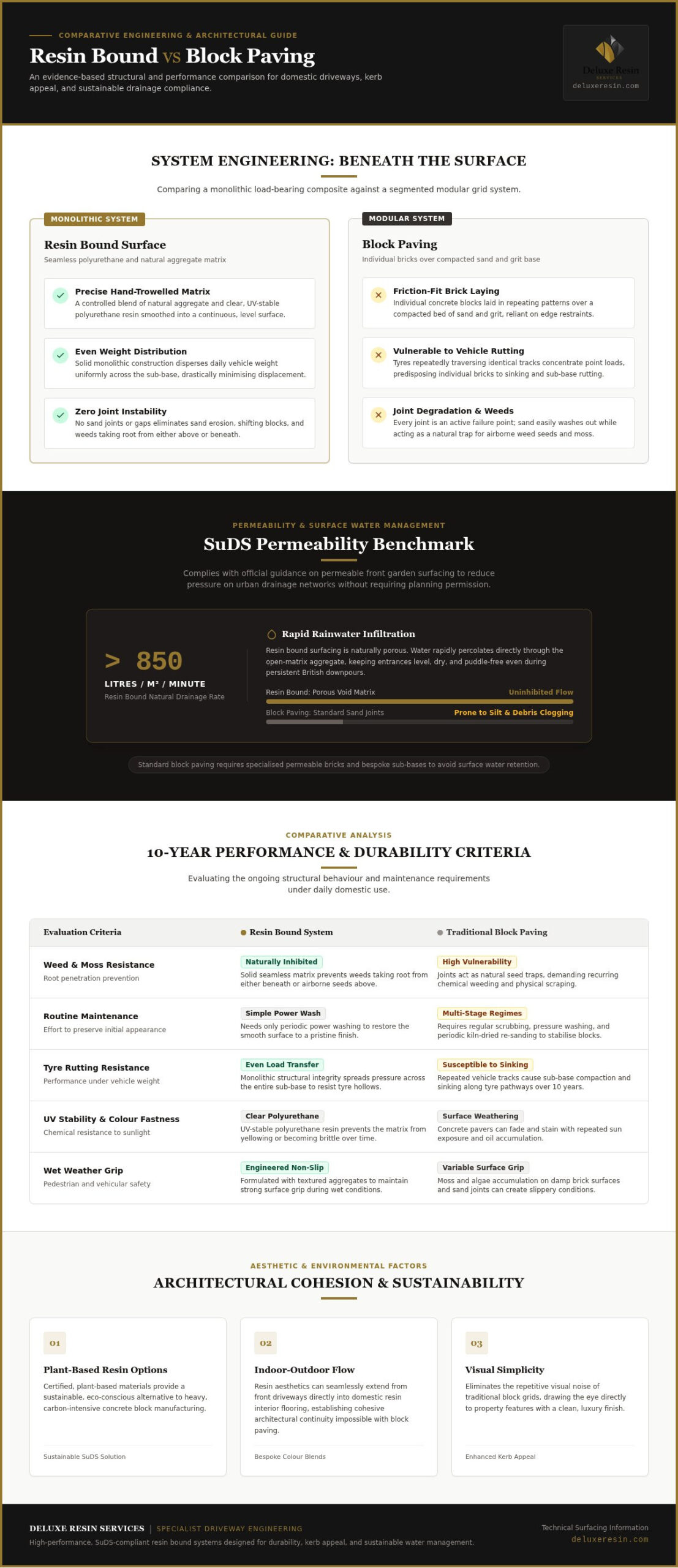
Choosing between resin bound vs block paving requires looking beneath the surface. It’s not just about the top layer; it’s about the entire engineering system. A resin bound surface involves a precise mixture of natural aggregate and clear, UV-stable polyurethane resin. Once blended, it’s hand-trowelled to a smooth finish that feels solid and uniform. In contrast, block paving relies on individual bricks or stones laid in specific patterns over a compacted sand and grit base. While both serve the same purpose, the structural feel is entirely different. For technical clarity, many homeowners refer to resin-bound paving specifications to understand the aggregate-to-resin ratios required for a durable, permeable matrix.
It’s helpful to view these as systems rather than just materials. Block paving is a modular system where every joint is a potential point of movement. Resin is a monolithic, seamless system that distributes weight evenly across the entire area, significantly reducing the risk of shifting. This distinction is vital when considering the visual centre of your property, as the lack of joints creates a calm, modern aesthetic compared to the grid-like appearance of traditional blocks.
The Aesthetic Appeal: Seamless Luxury vs Traditional Patterns
Resin allows for bespoke colour blends that can complement any architectural style, from rustic cottages to minimalist modern homes. Because there are no joints, you avoid the busy visual noise often associated with traditional block patterns. This creates a clean, sophisticated look that draws the eye to the property itself rather than the driveway grid. The result is a premium finish that looks intentional and polished.
For a truly integrated design, homeowners are increasingly extending this aesthetic from the entrance into the home. By matching a driveway to domestic resin flooring, you create a seamless indoor-outdoor flow that makes the entire property feel more expansive and cohesive. This continuity is difficult to achieve with block paving, which remains strictly a traditional outdoor material.
Performance and Maintenance: Which Driveway Surface Lasts Longer?
When comparing resin bound vs block paving for longevity, the maintenance requirements differ significantly. Block paving joints act as natural traps for airborne seeds and moss, requiring annual pressure washing and re-sanding to prevent overgrowth. Conversely, resin bound systems provide a solid, seamless surface that prevents weeds from taking root from beneath or above. Over a ten-year period, block paving is more susceptible to “rutting” or sinking where vehicle tyres consistently travel, whereas the monolithic structure of resin distributes weight more effectively across the sub-base. Safety remains a primary concern for domestic properties; premium resin systems are specifically formulated with non-slip finishes to maintain grip in wet conditions. UV stability refers to the resin’s chemical resistance to ultraviolet radiation, which prevents the material from yellowing or becoming brittle over time.
SUDS Compliance and the Importance of Natural Drainage
Understanding how resin driveway drainage works is essential for modern homeowners. These systems are naturally porous, allowing water to filter through the surface at rates exceeding 850 litres per square metre per minute. Traditional block paving often requires specific permeable bricks and specialised sub-bases to achieve similar results, as standard sand joints can quickly clog with silt and debris. Following official guidance on permeable front garden surfacing helps ensure your project meets SuDS requirements without needing planning permission. This responsible approach reduces pressure on local drainage networks amongst dense urban developments. If you’re looking for a high-performance, eco-conscious finish, exploring our sustainable resin solutions can provide both peace of mind and long-term durability.
Sustainability and Long-Term Value: Making the Right Investment
Whilst the initial installation cost of resin bound vs block paving may vary depending on the sub-base requirements, the total cost of ownership often favours the resin system. Block paving requires a cycle of intensive scrubbing, chemical weeding, and periodic re-sanding to maintain its structural integrity. In contrast, a high-quality resin bound driveway needs only a simple power wash to look brand new. This low-maintenance profile, combined with a seamless finish, can increase a property’s market value by an estimated 5% to 10% by significantly enhancing kerb appeal. To protect this investment, it’s vital to select UV stable resin driveway finishes, which ensure your chosen colour doesn’t fade or amber under solar radiation.
Adhering to UK government guidance on permeable surfacing also adds long-term value by ensuring full compliance with drainage regulations. This avoids the potential legal complications or enforcement notices that can arise from laying non-permeable surfaces larger than five square metres without planning permission. By choosing a system that manages rainwater naturally, you’re investing in a solution that protects both your property and the wider environment.
Bio-Based Materials: The Future of Responsible Surfacing
For the eco-conscious homeowner, premium resin systems now offer a sustainable alternative to traditional, carbon-heavy concrete blocks. Some of our advanced formulations are composed of up to 85% plant-based, renewable materials. These systems often carry prestigious certifications like EMICODE EC1 PLUS® and Cradle to Cradle, which verify their low environmental impact and safety standards. This approach allows you to achieve a high-end, luxury aesthetic whilst actively reducing your property’s carbon footprint. It’s a forward-thinking choice that prioritises both craftsmanship and environmental stewardship.
Choosing a Surface Built for the Future
Selecting the right entrance for your home balances aesthetic desire with functional performance. When evaluating resin bound vs block paving, the modern, seamless approach offers clear advantages in maintenance and drainage. It effectively eliminates weed growth. It manages rainwater naturally. This ensures your property remains beautiful and compliant with environmental standards. Our solutions prioritise craftsmanship through Cradle to Cradle Certified products and formulations containing up to 85% plant-based resin. These materials also hold EMICODE EC1 PLUS® certification, ensuring superior air quality for your household. A premium driveway is more than just a place to park. It’s a long-term investment in your home’s value. We invite you to enquire about our sustainable resin bound driveway installations to discover how we can transform your property entrance with precision and care.
Frequently Asked Questions
Is resin bound more expensive than block paving?
When evaluating resin bound vs block paving, the initial installation cost for resin is typically higher due to the premium materials and specialist labour required. However, the total cost of ownership is often lower over time. You won’t need to pay for regular chemical weeding, joint repairs, or kiln-dried sand, making it a more cost-effective choice for the long term.
Does resin bound crack more easily than block paving?
Resin bound surfaces are engineered to be flexible, meaning they are less likely to crack than rigid paving if installed on a suitable sub-base. Block paving often suffers from individual units shifting or sinking, which creates uneven ruts. Our high-performance systems use UV-stable binders that maintain their structural integrity and flexibility even as temperatures fluctuate throughout the year.
How do you clean a resin bound driveway compared to block paving?
Maintaining a resin surface is significantly easier than looking after traditional bricks. A simple power wash with cold water is usually enough to restore its original appearance. Block paving requires frequent intervention to clear moss and weeds from the joints, followed by re-sanding to keep the blocks in place. Resin remains seamless and clean with very little manual labour.
Can resin bound be laid over existing block paving?
It isn’t recommended to lay resin bound systems directly over existing block paving because the blocks don’t provide a sufficiently stable foundation. Any movement in the individual pavers can lead to reflective cracking in the resin above. For a durable finish, we recommend installing over a solid, monolithic base like tarmac or concrete to ensure the system remains perfectly level.