
The highest durability rating doesn’t automatically make a floor right for your site. Commercial flooring durability standards help you compare specific types of performance, but a test result only tells part of the story. A busy warehouse, food-preparation area and public entrance place different demands on a surface, from abrasion and chemical exposure to slip resistance and cleaning.
Choosing a floor from a headline rating alone can leave important questions unanswered. Standards may use unfamiliar terms, and product documents don’t always explain how results relate to actual site conditions. This guide explains what common flooring tests measure, how to compare evidence and which documents to request from a contractor. It also shows how to turn traffic, contaminants and maintenance needs into a practical specification, including when resin flooring may be worth assessing.
Key Takeaways
- Use commercial flooring durability standards as evidence for specific performance conditions, not as a single grade or promise of service life.
- Match requested tests to your site’s traffic, wheeled loads, impact risks, chemicals and cleaning routine.
- Check each test report’s method and conditions before comparing results. Figures aren’t meaningful without that context.
- Ask for the proposed resin system’s specification, relevant test reports, installation requirements and maintenance guidance, then check they suit your site.
What commercial flooring durability standards actually measure
A durable floor isn’t simply one with the highest rating. Its performance depends on whether the specified system can withstand the conditions it will face, including traffic, loads, impact, spills and cleaning. Commercial flooring durability standards assess particular properties, but no single grade covers every demand or guarantees a set service life.
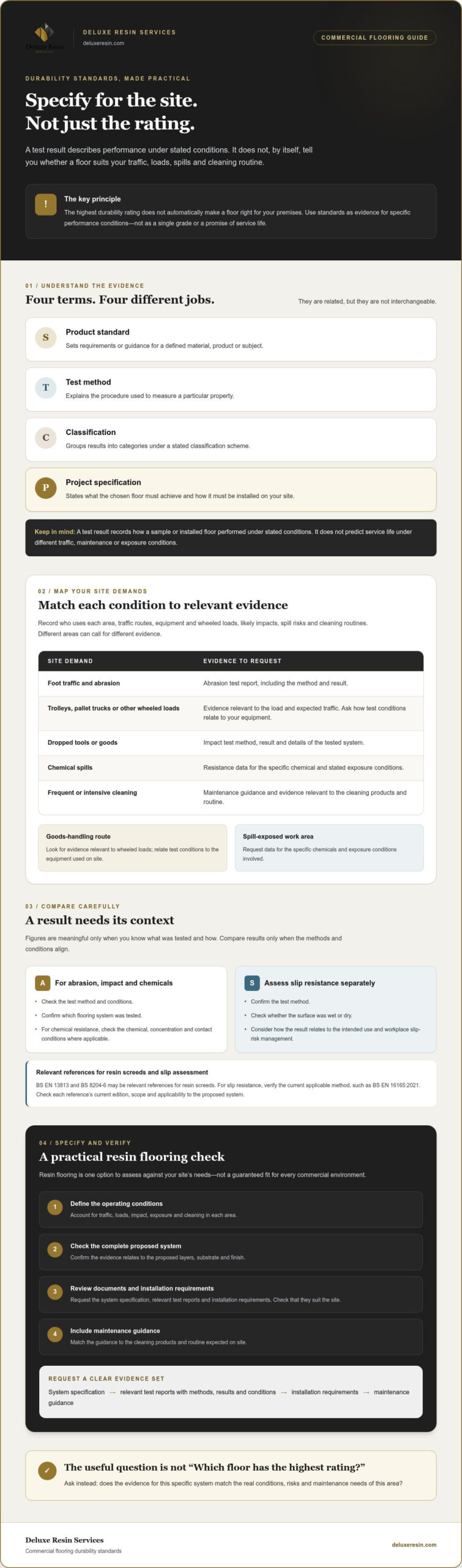
Start by distinguishing four types of information: a product standard sets requirements for a material or product; a test method explains how a property is measured; a classification system groups results into categories; and a project specification states what the chosen floor must achieve on site. These terms are related, but they aren’t interchangeable.
What does a flooring standard tell you?
A flooring standard is a published document defining requirements, test procedures or guidance for a particular material or performance property. A test result records how a sample or installed floor performed under stated conditions. It doesn’t, by itself, predict service life under different traffic, maintenance or exposure conditions. For background on common flooring materials and subfloors, see this overview.
For resin screeds, BS EN 13813 and BS 8204-6 may be relevant references. Check their current editions, scope and applicability to the proposed system rather than assuming either standard covers every aspect of a finished floor.
- Standard: requirements or guidance for a defined subject.
- Test method: the procedure used to measure a property.
- Classification: a category assigned to results under a stated scheme.
- Specification: the performance and installation requirements for your site.
Match commercial flooring test results to site demands
Before comparing products, map the different areas of your site and record who uses each one, traffic routes, equipment and wheeled loads, likely impacts, spill risks and cleaning routines. For example, a goods-handling route may need evidence relevant to wheeled loads, while a work area exposed to spills calls for data on the specific chemicals involved. This helps you identify which commercial flooring durability standards and test evidence matter for each area. In mixed-use commercial premises where front-of-house or hospitality spaces require hard-wearing decorative floorcoverings alongside industrial surfaces, you can visit Surefit Carpets Ltd to source heavy-duty carpets designed to withstand regular foot traffic.
Which performance evidence matters most for your premises?
Use the site conditions to guide what you request. Abrasion, impact and chemical-resistance results describe performance only under the stated test method and conditions. Check which flooring system was tested and, for chemical resistance, the chemical, concentration and contact conditions where applicable.
| Site demand | Evidence to request |
|---|---|
| Foot traffic and abrasion | Abrasion test report, including method and result. |
| Trolleys, pallet trucks or other wheeled loads | Evidence relevant to the load and expected traffic. Ask how the test conditions relate to your equipment. |
| Dropped tools or goods | Impact test method, result and tested system details. |
| Chemical spills | Resistance data for the specific chemical and stated exposure conditions. |
| Frequent or intensive cleaning | Maintenance guidance and evidence relevant to the cleaning products and routine. |
Test results are comparable only when the methods and conditions align. Slip resistance needs a separate assessment: confirm the test method, whether the surface was wet or dry, and how the result relates to the intended use. HSE guidance informs workplace slip-risk management. Consult its UK slip resistance guidance and verify the current applicable method, such as BS EN 16165:2021. For areas where contamination or wet conditions are a concern, reviewing the options for a slip resistant commercial floor coating can help you understand what performance evidence to request and how testing methods relate to your site conditions.
If you’re considering resin for a commercial site, use these criteria to assess whether an industrial resin flooring system suits its operating conditions.
How to specify and verify durable commercial resin flooring
Resin flooring is one option to assess against your site’s needs, not a guaranteed fit for every commercial environment. A rating alone won’t establish suitability. Check that the evidence relates to the complete proposed system, including its layers, substrate and finish, and reflects the actual traffic, loads, exposure and cleaning conditions.
For information on relevant standards and their scope, consult the British Standards information and verify the current editions that apply to your project. Ask the flooring contractor for the system specification and relevant test reports, with the test method, results and conditions clearly identified. If a report covers only a sample or a particular layer, ask how it relates to the complete system proposed for your site.
What should a flooring specification and handover include?
Record the performance requirements for each area and how the proposed system is intended to meet them. The specification and handover should also set out:
- Substrate preparation: the required condition and preparation before installation.
- Installation requirements: system components, application conditions and relevant site constraints.
- Acceptance criteria: the checks or results used to confirm the completed work meets the agreed specification.
- Ongoing care: suitable cleaning methods, products and maintenance guidance.
Review maintenance advice before work begins, so the planned cleaning routine is compatible with the floor system. For broader background, see the industrial resin flooring and resin floor maintenance guides, and check any recommendations against the proposed system’s documentation.
Clear documentation keeps expectations aligned from specification through handover. If you’re considering a commercial resin flooring project, you can discuss your flooring requirements with Deluxe Resin Services.
Make your flooring specification work for your site
The most useful commercial flooring durability standards answer your site’s specific questions, rather than simply offering an impressive-sounding rating. Use relevant test evidence to set clear performance requirements, then check that the proposed resin system, installation details and maintenance guidance align with how each area operates.
Resin flooring may be worth assessing for demanding commercial environments, but suitability depends on the project and supporting evidence. Deluxe Resin Services installs industrial resin flooring and offers durable, low-maintenance flooring solutions.
To assess a system against your site’s requirements, discuss your commercial resin flooring requirements with Deluxe Resin Services.
Frequently Asked Questions
What standards apply to commercial flooring in the UK?
The applicable standards depend on the flooring material and the performance being specified. For resin screeds, BS EN 13813 and BS 8204-6 may be relevant, but neither should be assumed to cover every project requirement. Ask the project specifier to confirm each standard’s current edition, scope and applicability to the proposed system before using it as a specification reference.
Does a flooring durability rating guarantee how long a commercial floor will last?
No. A rating or test result describes performance under defined conditions. It can’t account for every site’s traffic, installation quality, maintenance or exposure. Use commercial flooring durability standards as evidence for comparison, not as a promise of lifespan. Check that the test conditions reflect your intended use and that the evidence relates to the complete flooring system being proposed.
Which tests should I compare when choosing commercial flooring?
Choose tests based on your premises’ expected use, including foot traffic, wheeled loads, impact, chemical exposure, cleaning and slip risks. Request the relevant reports and check the method, conditions and tested flooring system. Not every test applies to every material. Compare results only where methods and conditions align, and agree suitable performance criteria with the project’s flooring specifier.
Is resin flooring suitable for high-traffic commercial premises?
Resin flooring may suit some high-traffic premises, but suitability depends on the system, substrate, installation and operating conditions. First document traffic, equipment, spills and cleaning needs, then review relevant technical evidence with a competent flooring professional. Avoid choosing on material name or a general durability claim alone. Deluxe Resin Services installs industrial resin flooring for commercial and industrial environments.